











Category: Content type

  • A330-300 Retrofit Trends: Bridging the Delivery Gap

    Cirium is proud to be the Official Data Analytics Partner of Aircraft Interiors Expo 2026

    James Mellon, Senior Aviation Data Research Analyst, Cirium

    Airbus A330-300s make up 13% of the widebodies operating passenger flights, with 602 examples in service. That equates to 77% of the 777 A330-300s built over 28 years between 1992 and 2020.

    Given that new widebodies are being delivered at a relatively glacial pace amid OEM ramp-up issues, the reliance on keeping older aircraft in service for even longer will increase as the decade continues. In February 2026, Cirium Ascend Consultancy noted that market values for the A330-300 had increased 20% since January 2025, while market lease rates were up 15%.

    The outlook appears to brighter for the -300 than for its smaller sibling the -200. Just 6% of the passenger -300 fleet is stored, compared with 21% of the -200’s. The average age of the in-service passenger -300s is 14 years old. The 271 in-service passenger -200s have an average age of 16.

    The increasing value of the A330-300 makes it a more worthwhile investment prospect, as it appears that many will remain operational well into the next decade.

    In my analysis, I look at some of the airlines that have retrofitted their fleets of A330-300s over the past few years, and other airlines planning to update theirs soon.

    Past Airbus A330-300 Retrofits

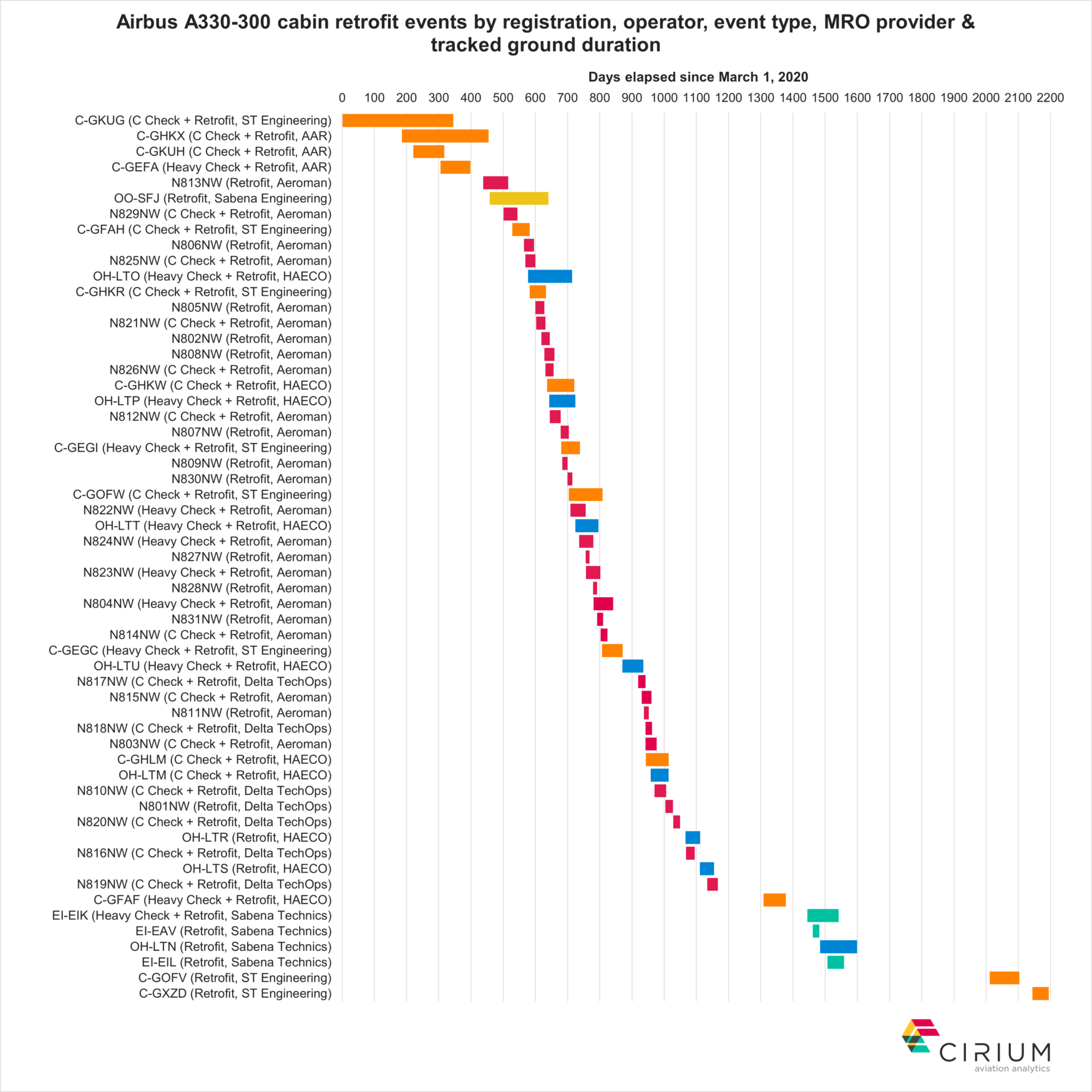
    Cirium Ascend Ground Events data indicates that 57 Airbus A330-300s have been retrofitted with new cabins since March 2020.

    Source: Cirium Ascend Ground Events, retrofit events commencing between March 1, 2020 – March 9, 2026.

    Airlines’ ability to retrofit aircraft hinges on multiple factors, so installing the right interior products at the time of acquiring second-hand aircraft isn’t always possible.

    Since 2019, Air Canada’s fleet of eight A330-300s has been supplemented with 12 second-hand examples, all originating from Singapore Airlines. Air Canada has operated the ex-SIA units for a long period with their inherited 285 seat dual-class configuration, prior to their being retrofitted with new business-class seats while premium-economy cabins were added. Ground Events data shows that 18 aircraft in the fleet have been retrofitted at four different locations across the USA, Hong Kong and Singapore.

    Ground Events data shows that Delta Air Lines’ entire fleet of 31 A330-300s was retrofitted over a two-year period between May 2021 and May 2023, when premium-economy cabins were installed. Collins Aerospace MiQ seats were added when 24 aircraft visited Aeroman in El Salvador. The other seven were retrofitted in-house by Delta TechOps at Minneapolis-Saint Paul.

    Between 2021 and 2024, Finnair had its entire widebody fleet of A350-900s and A330-300s, totalling 26 aircraft, refreshed with the installation of new cabin products. The brand-new Airlounge seat from Collins Aerospace was central to the airline’s new business-class product, while premium economy was introduced and HAECO Vector seats debuted. Ground Events data shows that seven A330-300s were retrofitted by HAECO in Hong Kong between 2021 and 2023, while the eighth aircraft was updated a year later, during the second quarter of 2024, by Sabena Technics in Bordeaux, France.

    Future Airbus A330-300 Retrofits

    Several airlines have publicly announced plans to retrofit their fleets of A330-300s over the next few years, in some cases as a bridge to the delivery of brand-new replacements. In most cases, the upgrades will be focused on the premium cabins.

    Following the recent installation of premium-economy cabins, Delta Air Lines’ latest business-class offering, the ‘Delta One’ suites, will also be retrofitted onto its oldest A330s. Cirium Ascend Fleets Analyzer shows that the average age of Delta’s A330-300s is 17 years, but this is skewed by the 21 Pratt & Whitney-powered aircraft that have an average age of 20 years old. Originally delivered between 2003 and 2007, to Northwest Airlines, the aircraft were acquired through that carrier’s merger with Delta in 2008.

    Delta’s other widebody fleets featuring Delta One suites have Thompson Aero Seating Vantage and Vantage XL seats, from a mix of line-fit and retrofit installations.

    It is not yet clear which MRO facility the A330-300s will visit, but Ground Events data shows that ST Engineering Aerospace recently retrofitted nine Delta A350-900s at its Paya Lebar location in Singapore, while all 21 Boeing 767-400ERs were retrofitted at Guangzhou, China.

    Cathay Pacific also plans to refresh its A330-300s, with 20 set to undergo retrofit work starting in late 2026. Fleets Analyzer shows that of Cathay Pacific’s 43 A330-300s, 23 were manufactured between 2010 and 2015, and the other 20 between 2001 and 2007. The new ‘Aria Studio’ business-class product will be introduced alongside improvements to the economy and premium-economy cabins. Cathay’s A330-300s currently feature six different cabin configurations, per Fleets Analyzer. This retrofit project will allow the rejuvenated aircraft to be streamlined into one seat configuration.

    This work is starting prior to the arrival of Cathay Pacific’s first A330neo. Fleets Analyzer shows that the airline has ordered 30 A330-900s and taken options on 30 more, with deliveries due from 2028.

    The popularity of premium economy continues, with various airlines rolling the cabin out across their whole widebody fleets. Premium-economy cabins are being added to Swiss’s A330-300s, following the introduction in 2022 of the new cabin class on board its Boeing 777-300ERs. The retrofit of its 14 A330-300s will also add new cabin products, to match the brand-new A350-900s currently joining the fleet. Premium-economy seats manufactured by ZIM will sit alongside overhauled first, business and economy cabins with new seats and suites supplied by Collins, Stelia and Recaro, respectively.

    In addition to Swiss, other Lufthansa Group airlines will also update their A330-300s in the coming years. Leisure-focused Discover Airlines is planning nose-to-tail upgrades, including new wi-fi from Starlink, as part of a group-wide deal to equip around 850 aircraft. Discover will also expand its fleet to 16 A330-300s, benefiting from the fleet rationalisation that Lufthansa Group is undertaking. Fleets Analyzer shows that the seven remaining Lufthansa A330-300s are all scheduled to be transferred in 2026-27, with five aircraft moving to Discover and the other two to Brussels Airlines. The Belgian carrier will also overhaul its fleet of A330-300s, upgrading all three cabins.
    The Chinese Market’s Potential

    Looking at the current in-service fleet, 20% of A330-300s are operated by airlines based in China. It appears that these aircraft have not undergone any significant alterations to their original interiors since delivery.

    Fleets Analyzer shows that nine Chinese airlines operate 120 of the aircraft with an average age of 10.5 years old. Cirium Ascend Consultancy and other industry observers note that China has a dearth of widebody aircraft orders, relative to the size of the current in-service fleet that will need replacing in the coming years.

    Fleets Analyzer shows that 41 widebody passenger aircraft are currently on order or under LOI for Chinese airlines. It is likely that some of the nation’s carriers will receive widebodies ordered by lessors.

     The increasing value of the A330-300

    Despite airlines’ rebuilding of their long-haul networks to pre-pandemic scale, the rate at which new widebodies are being delivered that can operate these routes remains be significantly lower than the 2010s. As evidenced by the examples above, airlines are investing in their legacy widebody fleets by retrofitting them with new interiors to extend their service lives before any brand-new replacement aircraft will be delivered.


    Cirium provides aircraft OEMs, MRO and the aftermarket with independent aircraft intelligence, enabling them to reduce downtime, manage risk and act before the market moves. Discover more

    Attending Aircraft Interiors Expo in Hamburg? Don’t miss Andrew Doyle present an in-depth analysis of fleet and market trends at CabinSpace Live alongside Gary Weissel, Managing Officer at Tronos Aviation Consulting, Wednesday 14 April from 09:30. Find out more and connect with the Cirium team

  • The helicopter market: from volatility to maturing resilience

    Cirium Ascend Consultancy is trusted by clients across the aviation industry to provide accurate, timely, and insightful aircraft appraisals. The team provides the valuations and analysis the industry relies on to understand the market outlook, evaluate risks and identify opportunities.

    Discover the team’s industry reports & market commentaries. Read their latest expert analysis, viewpoints and updates on Thought Cloud.

    Team Perspective

    Sara Dhariwal, Lead Appraiser – Helicopter & AAM Markets , Cirium Ascend Consultancy

    Last week’s Cirium Ascend Consultancy helicopter market webinar examined the key forces shaping today’s rotorcraft market, from fleet growth and replacement cycles to civil‑military production dynamics, oil pricing and delivery trends.

    After more than a decade of disruption, the market is showing clear signs of maturity. Long asset lives, disciplined deliveries and an ageing global fleet are supporting stability today, while also underpinning future replacement demand.

    Reflecting this shift, Sarah Johnston, In‑House Counsel at SMFL Helicopters, noted that increased stability and a growing number of market participants represent “a very positive development” for the sector. Gabriella Oliveira del Mastro, Fleet Director at PHI, similarly observed that greater stability reflects a more deliberate and mature market approach.

    Steady fleet growth, shaped by longevity

    Over the past decade, the global civil helicopter fleet has grown at an average rate of around 1.5% per year. Growth slowed briefly in 2020 as the pandemic disrupted deliveries, but has since recovered, with expansion closer to 2% annually in recent years. By the end of 2025, the global fleet reached approximately 24,500 helicopters, representing a net increase of just over 3,200 aircraft.

    Fleet growth has been supported less by elevated deliveries and more by persistently low exit rates, with retirements and total losses averaging just over 1% per year. Longevity remains a defining feature of the market, with around 90% of helicopters delivered over the past 30 years still in operation and the average retirement age approaching 40 years. While this durability underpins asset values, it has also resulted in a steadily ageing global fleet.

    Replacement demand is building — but slowly

    Looking ahead, replacement rather than fleet expansion is expected to be the primary driver of helicopter demand. Cirium estimates that just over 4,000 helicopters could require replacement over the next decade — equivalent to around 70% of the current global fleet. While elevated asset longevity and OEM production constraints have delayed replacement activity, they have also helped restrict supply and support asset values.

    As the market evolves, a more mature secondary ecosystem is beginning to form. del Mastro noted that the helicopter sector is starting to adopt attributes long established in fixed‑wing aviation, including structured part‑out activity and lifecycle management. Echoing this, Johnston highlighted the need for stronger and more formalised secondary‑market support, underscoring the role this will play in enhancing capital efficiency and long‑term value preservation.

    Civil and military demand: competition for capacity?

    A recurring question is whether rising military demand is constraining deliveries into the civil helicopter market. Civil and military variants often share production lines and supply chains, making this a valid concern given the current geopolitical environment.

    Historical data suggests OEMs have generally balanced production across both segments over the long term. However, the ongoing deferral of civil replacement into the latter part of this decade risks overlapping with the next anticipated military renewal cycle in the early‑to‑mid 2030s. Should this occur, pressure on production capacity and delivery lead times could intensify.

    In parallel, sustained increases in military utilisation could place additional strain on shared supply chains, particularly in parts availability and MRO capacity, with potential knock‑on effects for both civil and military operators.

    Oil prices: short‑term volatility versus structural impact

    Geopolitical conflict and associated oil‑price volatility have renewed concerns about a potential downturn similar to that experienced in 2014. However, there is currently little evidence to suggest that short‑term price movements alone will materially alter helicopter fleet dynamics.

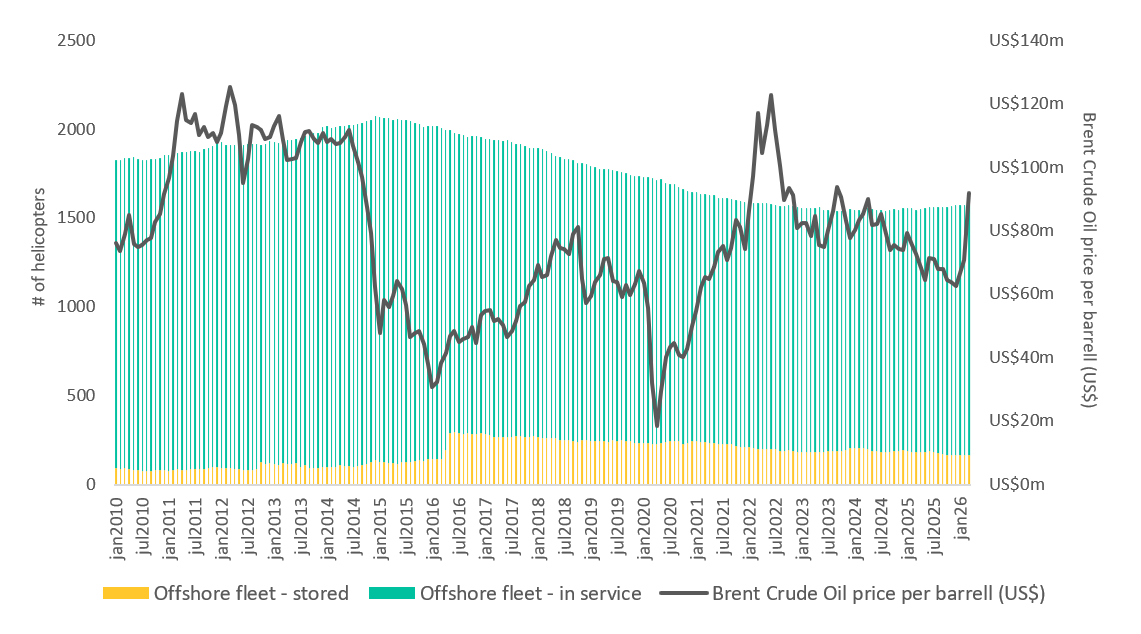
    Chart 1: Offshore fleet evolution and crude oil pricing

    Source: Cirium Fleets Analyzer / U.S Energy Information Administration EIA

    The previous downturn was driven not by volatility, but by a prolonged period of sustained high oil prices, which encouraged aggressive fleet expansion based on assumptions of long‑term demand growth. When prices subsequently fell and remained depressed, the market was left with significant oversupply and prolonged pressure on utilisation and values. By contrast, recent pricing appears to have settled at a more sustainable level, around US$80 per barrel, historically supportive of offshore helicopter operations and a more balanced supply‑demand environment.

    While broader macroeconomic risks persist — including inflationary pressures and recessionary concerns that could weigh on values and investment appetite — the key takeaway for the helicopter industry is clear: sustained structural trends matter far more than short‑term volatility.

    A maturing helicopter leasing market

    The helicopter leasing sector has evolved significantly since its emergence around 15 years ago. Recent consolidation has concentrated a sizeable portion of the global leased fleet among a small number of major international lessors, contributing to greater stability and a more disciplined growth profile.

    Growth among established lessors has increasingly been driven by sale‑and‑leaseback transactions, rather than speculative order books, improving alignment with operator demand and reducing risk exposure. While leasing penetration remains lower than in commercial fixed‑wing aviation, there is clear scope for further expansion across multiple mission profiles, including EMS, utility, offshore energy and search‑and‑rescue operations.

    Johnston described the sector as “highly dynamic and competitive”, noting that “there remains considerable headroom for additional leasing activity, both globally and across different market segments”.

    del Mastro echoed this view, adding that increased competition is a positive development: “Coming from the fixed‑wing sector, where leasing choice is well established, I expect similar trends to continue developing in the rotorcraft market.”

    Deliveries and the outlook for the next decade

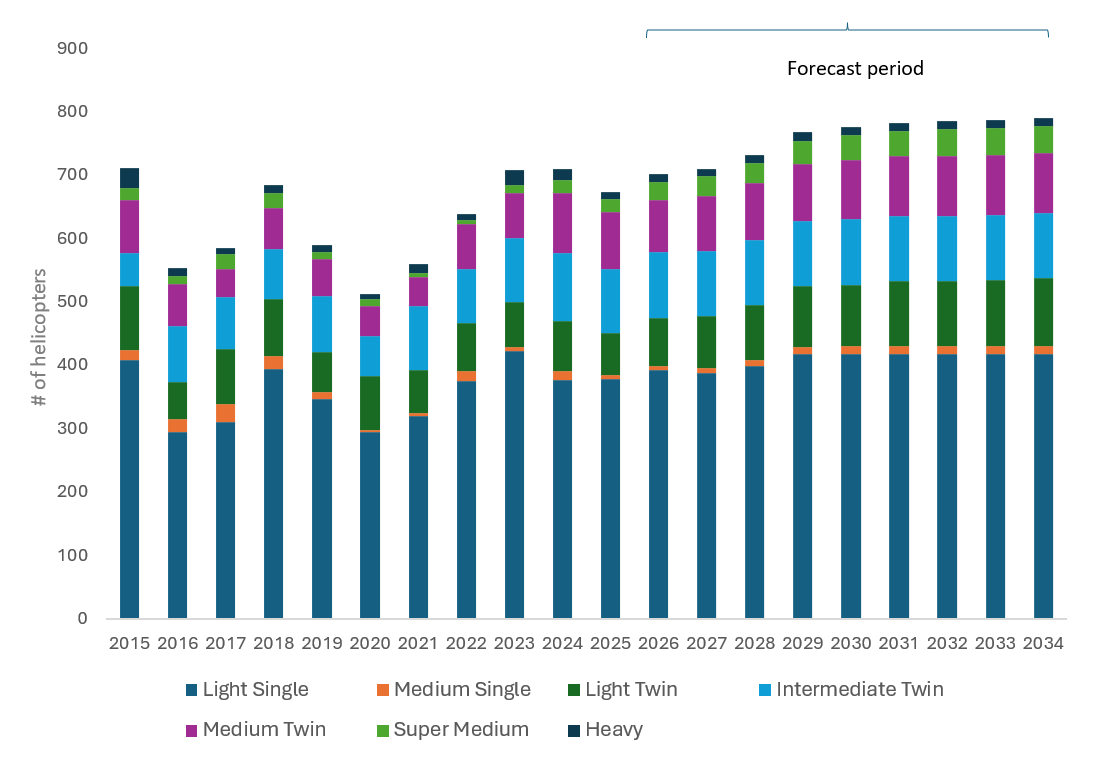
    Following delivery volumes of around 700 aircraft per year in 2023 and 2024, 2025 saw a modest decline, in line with expectations. Over the next decade, Cirium anticipates a gradual recovery, with average fleet growth of approximately 1.4% per year, equating to around 7,500 deliveries. Importantly for investors, more than half of these aircraft are expected to serve replacement demand, representing an addressable market of roughly US$50 billion on a full‑life value basis.

    Chart 2: Cirium Helicopter 10-year Fleet Delivery forecast 2025

    Source: Cirium 2025 Helicopter Fleet Forecast

    While extended lead times and ongoing supply‑chain constraints continue to limit near‑term deliveries, they have also reinforced supply discipline and supported asset values. From an operator and investor perspective, predictability and capital efficiency remain key priorities. del Mastro noted, “greater predictability on when aircraft can enter service is critical, alongside improved capital efficiency over the life of the aircraft and better access to competitive lease and debt financing”. She added that more predictable certification, STC processes and OEM production schedules would further enhance lifecycle optionality and returns.

    New technology: complementary rather than disruptive

    Emerging technologies — including autonomous helicopters, drones and eVTOL platforms — continue to attract attention. While progress is being made, their near‑term impact on the traditional helicopter market is expected to be complementary rather than disruptive.

    Initial applications are likely in cargo, logistics and unmanned operations, where certification and operational barriers are lower. More complex missions will take longer to materialise, particularly where energy density, safety and regulation remain limiting factors.

    A resilient market, well set up for gradual change

    The helicopter sector today is defined by stability and resilience rather than rapid expansion. Long asset lives, disciplined production, diversified missions and a more mature leasing ecosystem have reduced volatility and helped stabilise values.

    While supply‑chain constraints and geopolitical uncertainty remain, the overarching outlook is one of measured growth, delayed but unavoidable replacement demand, and gradual evolution rather than disruption. For operators, investors and OEMs alike, predictability, transparency and disciplined planning will be critical as we move into the next decade.

    Watch the webinar on-demand

    To access the presentation and watch Sara, Gabriela and Sarah’s full discussion, register to watch.

  • How do you build a foundation for trustworthy aviation data?

    Aviation runs on complex, fast-moving data. Every decision requires high levels of precision, and the interconnected nature of the industry means that data quality impacts operational, financial, and safety outcomes.

    To address how organizations can manage this critical asset, Sarah Davis, VP for Data at Cirium, and Candice Parfitt, Head of Data Governance at Cirium, recently presented the Data Governance 101: Aviation Foundations webinar. They shared how Cirium structures its internal data governance and why establishing a solid data framework is essential for modern aviation operations.

    Key highlights

    • Trust is paramount: Data governance involves aligning the right people, processes, and technology to build reliable, accurate datasets.
    • AI requires a solid foundation: Artificial intelligence magnifies data issues. Effective AI governance starts with trustworthy underlying data.
    • Start small: Organizations should evaluate their maturity and tackle governance initiatives in small increments to provide immediate value.
    • Human oversight remains necessary: While AI can augment governance by detecting inconsistencies, human review is crucial for accountability and accuracy.

    Defining governance for aviation

    Aviation data must meet the same rigorous standards as the industry itself regarding reliability and safety. Poorly governed data creates significant exposure. Data governance is not about adding layers of bureaucracy; rather, it is a strategic necessity that defines how good data needs to be for specific use cases.

    Effective governance ensures that data management becomes an embedded practice rather than an afterthought. Organizations need to consider governance at the point of data inception. By implementing data literacy programs, companies can help their teams understand the connections between data quality, ethics, and responsible data use.

    The cost of inaction

    When data governance is absent, the first symptoms are usually confusion and a lack of trust in the numbers. Teams start working in silos, relying on tribal knowledge instead of a single source of truth.

    Without clear data ownership, issues bounce between departments. This creates operational friction and delays time-sensitive decisions. Over time, this lack of clarity prevents organizations from fully leveraging their data assets and makes it nearly impossible to scale advanced analytics or AI capabilities confidently.

    Real-world cases at Cirium

    Cirium applies these governance principles internally to maintain its data credibility. One key initiative is the introduction of Data Product Managers and Data Governance Councils. These roles provide strategic oversight and embed data governance throughout the organization. Data Product Managers build relationships across teams, foster trust, and explain the concrete value of data sharing.
    Even simple issues require governance. For instance, industry acronyms can carry different meanings depending on the department. Establishing agreed-upon definitions eliminates misunderstandings and aligns cross-functional teams. By partnering closely with product teams, Cirium identifies new use cases and ensures its data processes remain robust and relevant.

    The role of technology

    Technology operationalizes governance strategies. Cirium utilizes Collibra as a central platform to manage data governance at the appropriate level. A major focus is data observability—monitoring data quality continuously from the moment of ingestion all the way to product surfacing.

    For operational aviation data, such as flight times, there is rarely a single ground truth. Governance technologies help define authoritative sources for specific purposes while documenting differences in timing, scope, and context. Furthermore, while AI can suggest classifications and detect anomalies, it serves to augment rather than replace human oversight. AI systems will produce confident answers even if the input data is wrong, making a governed data foundation the prerequisite for any AI initiative.


    Building a mature data governance framework takes time, but the value of accurate, trustworthy data is clear. Tackling governance in thin slices allows organizations to build momentum and establish a culture of data literacy. By focusing on clear purposes and guidelines, the aviation industry can continue to improve through secure, reliable data sharing.

    To explore these strategies deeper and evaluate your own organization’s governance maturity, watch the full webinar recording on demand: Data Governance 101: Aviation Foundations.

  • Measuring the impact of the Middle East conflict on global airline capacity

    Cirium Ascend Consultancy is trusted by clients across the aviation industry to provide accurate, timely, and insightful aircraft appraisals. The team provides the valuations and analysis the industry relies on to understand the market outlook, evaluate risks and identify opportunities.

    Discover the team’s industry reports & market commentaries. Read their latest expert analysis, viewpoints and updates on Thought Cloud.

    Richard Evans airline consultant
    Richard Evans airline consultant

    Team Perspective

    Richard Evans, Senior Consultant, Cirium Ascend Consultancy

    While it is too early to predict the length or macro-level effect on the global economy of the conflict in the Middle East, we can measure the impact to-date on airline capacity, via Cirium’s Tracked Utilisation data.

    At the start of 2026, Cirium Ascend Consultancy’s view was that global traffic (RPKs) and capacity (ASKs) would grow in the range of 4-6% versus 2025. This was broadly in line with the visible forward schedule, and also similar to IATA’s December 2025 Outlook, which predicted 4.9% global RPK growth.

    IATA reported January 2026 traffic was up 3.8% versus 2025, on capacity up 3.5%. It has not yet reported February figures, but Cirium data shows that actual ASKs flown grew by 5.3% last month.

    For March 2026, Cirium’s forward schedule, at the start of the month, indicated the airlines would expand capacity by 5.6%. This figure had already declined slightly compared to the advance March schedule at the start of the year, which showed growth of 6.8%.

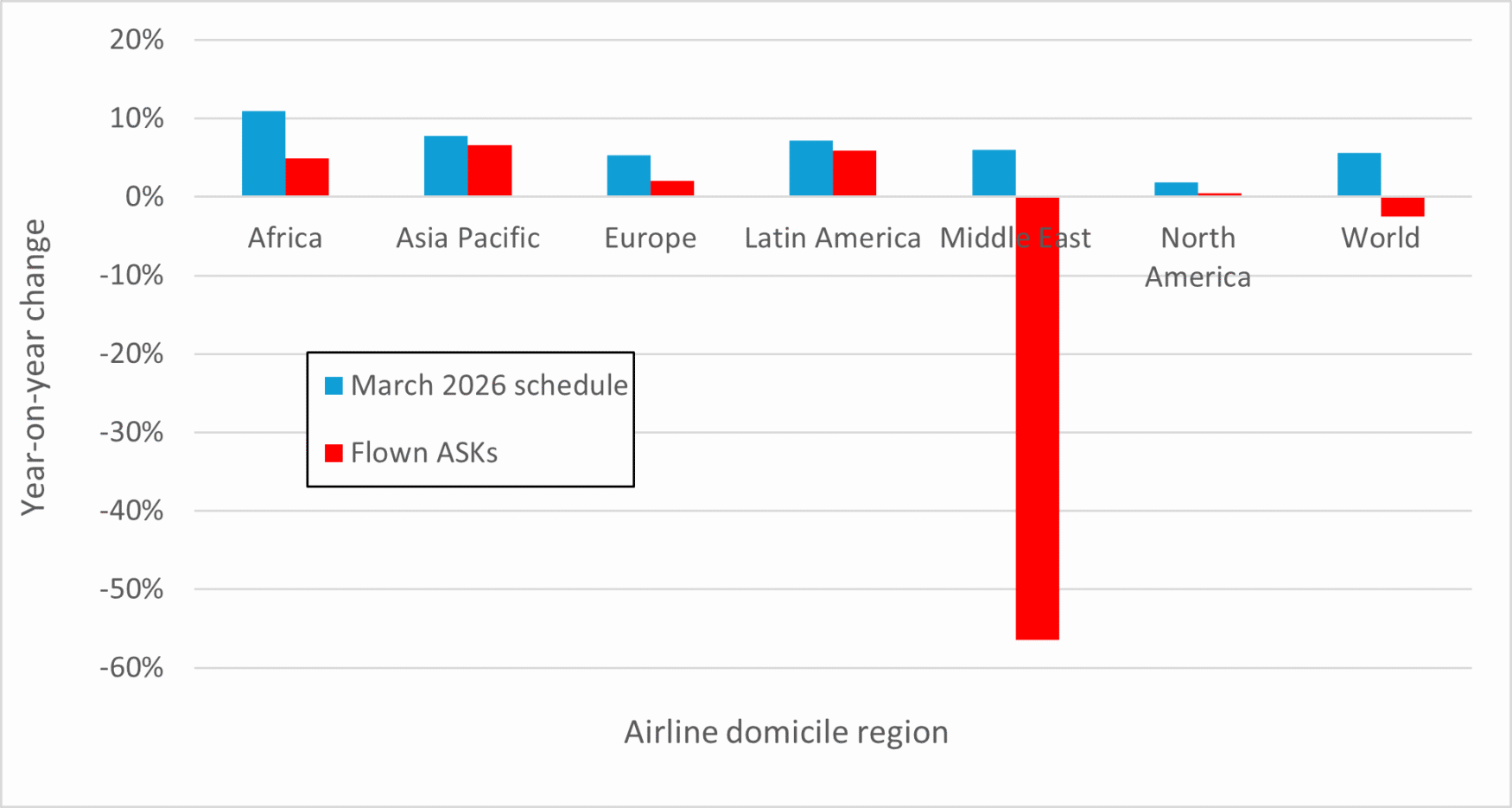
    Our tracked data, up to and including 22 March 2026, shows that the number of passenger flights grew by just 1.2% over the same period in 2025. Unsurprisingly, the major impact was on Middle East domiciled airlines, which have experienced a 52% decline in flights year-on-year. The region made up just 4% of tracked flights in March 2025, but it has a far larger impact in terms of ASKs, as the airlines tend to fly larger aircraft and serve longer stage lengths than in other regions. It amounts to 10% of global ASKs, based on March 2025 data.

    The chart below shows March 2026 flown ASKs, by airline domicile region, compared to March 2025. The 56.5% decline in Middle East airline capacity contributes to a global contraction of 2.5% in the first 22 days of the conflict.

    Actual capacity flown 1-22 March 2026, versus planned schedule

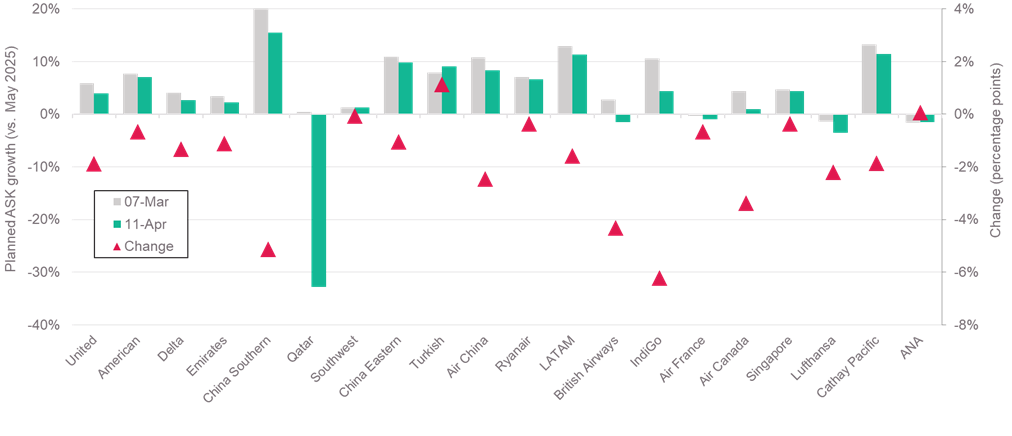
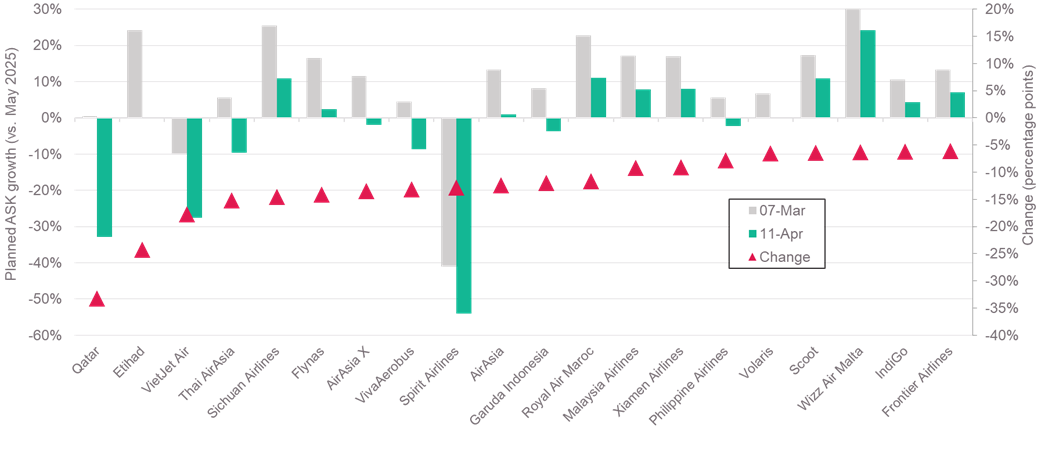
    Other regions are also impacted, but to a lesser degree, with many airlines cancelling flights to the Gulf states, Saudi Arabia and Israel. Comparing the forward schedule for March with the actual ASK flown provides an indication of the impact. African carriers have seen a roughly 5-6 percentage point hit, with European airlines the second most affected, with flown ASKs up 2%, versus a planned schedule increase of 5.3%. Asian carriers have experienced just a one percent impact, but this obviously varies considerably, with Indian sub-continent airlines most affected. North American airlines have seen a similar effect, with United Airlines noting that suspending its services to Riyadh and Dubai knock about 1% from its ASKs.

    Looking further ahead, several airlines have announced that service suspensions to the Middle East will continue into April and May. However, the forward schedule at the time of writing has not changed dramatically. April 2026 currently shows 3.4% year-on-year growth in ASKs, compared to 5.4% immediately before the conflict started. May 2026 has fallen marginally, from 6.6% to 6.3%.

    Even if passenger load-factors remain high, with strong demand in other markets stated by several airlines, the conflict has led to an eight percentage-point hit to airline capacity in March. This is before we see any measurable impact from higher jet fuel prices on demand. This level of demand/capacity disruption, if it continues for any length of time, does imply a significant effect on aircraft utilisation rates and fleet plans.    

  • February 2026 – Southeast Asia On-Time Performance Monthly Report

    February 2026

    A 40% reduction in flight cancellations across Asia-Pacific helped Garuda Indonesia rise as the region’s On-Time Performance leader, reinforcing its position as one of the top-performing airlines in the market. Meanwhile, Singapore Airlines and Philippine Airlines remained among the most reliable carriers in Southeast Asia, despite month-on-month declines in on-time performance that point to increasing operational challenges, shifting airline performance trends, and evolving aviation reliability dynamics across the region.

    Download the February 2026 Southeast Asia On-Time Performance Report

    When you submit the form, you will be redirected to the latest Southeast Asia Monthly On-Time Performance Report. You will also receive an email with a link to the report for future reference.

    SUBSCRIBE to be the first to hear about new Cirium reports and analyses.

    January 2026

    A 19% decline in flight cancellations in the Asia-Pacific market has directly contributed to improved schedule integrity across Southeast Asian carriers. Analysis of operational data shows that decreased disruption rates allowed airlines to achieve up to a six‑point increase in On‑Time Performance. This performance shift has also resulted in a reordering of OTP rankings, with a new leader emerging due to more efficient turnaround processes, reduced ground delays, and optimized fleet utilization.

    November 2025

    While widespread flight cancellations plague the aviation industry, Southeast Asian carriers are not just surviving—they’re thriving. Philippine Airlines (PAL) successfully defended its crown as the regional leader for the fourth consecutive month, delivering an impressive 84.67% OTP. Making the biggest move this period, Garuda Indonesia pulled off a massive upset. The carrier leaped from sixth to second place in the rankings after a sharp, decisive boost in its On-Time Performance.

    October 2025

    Philippine Airlines maintained its streak as the regional OTP frontrunner for the third month running. The AirAsia Group showcased massive dominance, placing three subsidiaries (Philippines, Indonesia, and Thai) in the rankings, while Scoot demonstrated resilience, making the top ranks despite a 2-point dip in its on-time performance.


    Southeast Asia On-time performance airline reports

    2025

    Southeast Asia On-time performance airlines reports

    2024

    Southeast Asia On-time performance airlines reports

    2023

    Southeast Asia On-time performance airlines reports

    Learn more about Cirium On-Time Performance and download 2024 Reports, here.

  • MRO Market Shakeup: Unpacking the 2025 Global Trends

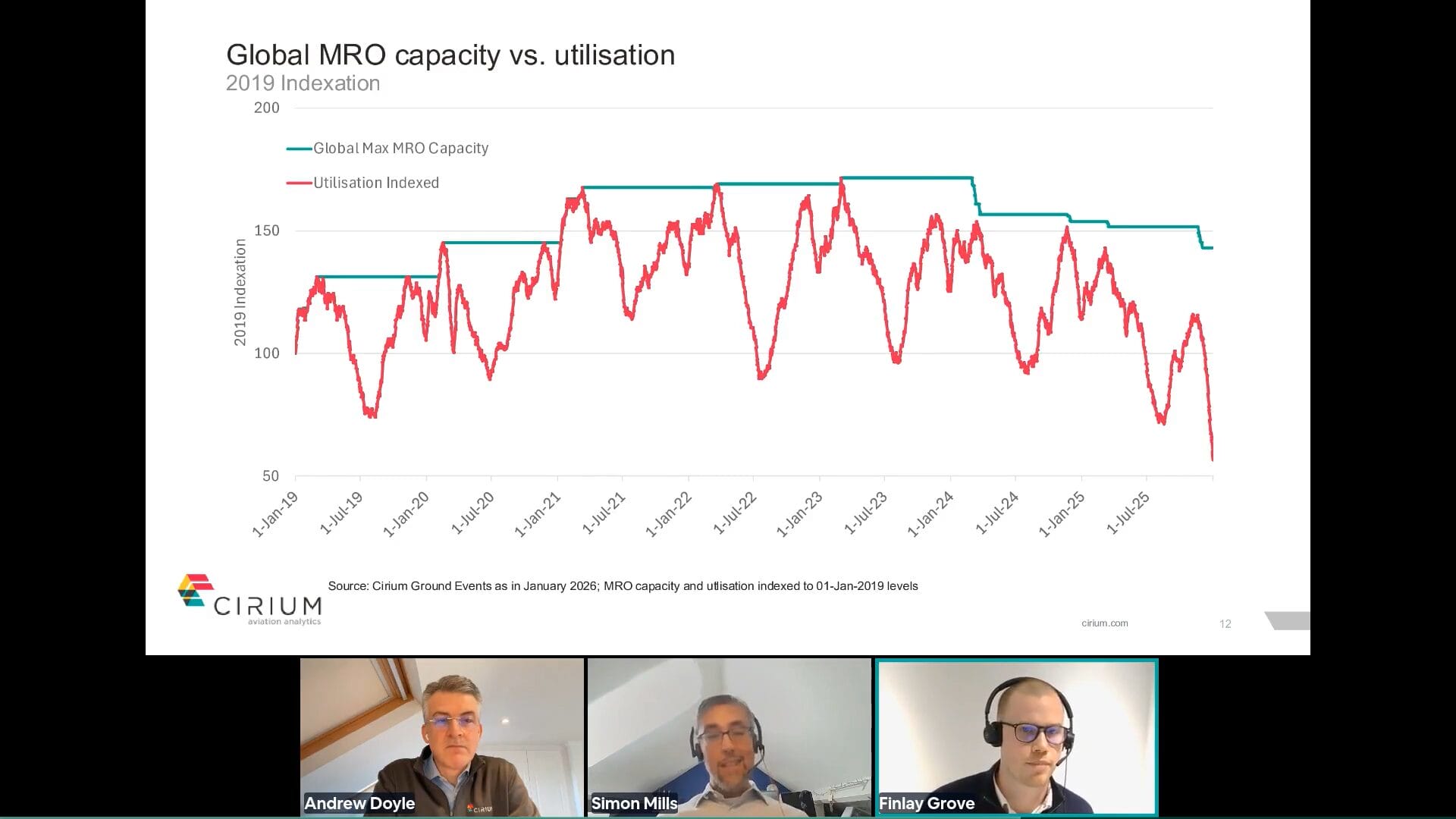
    The maintenance, repair, and overhaul (MRO) sector is navigating a landscape marked by disruption and significant regional power shifts. Cirium’s webinar, Global Airframe MRO Trends: A Deep Dive, offered a detailed analysis of these changes. The session featured insights from Andrew Doyle, Senior Director for Market Development; Simon Mills, Principal MRO Research Specialist; and Finlay Grove, Product Manager, Ascend, who unpacked the data behind global capacity, utilization, and the geographic redistribution of MRO work.

    Key Highlights

    • Market dominance: The Asia-Pacific region is a dominant force in the MRO market, handling 50-70% of heavy checks and holding a 56% market share in widebody maintenance.
    • Capacity shifts: From 2019 to 2025, global MRO maintenance lines grew by 5%. Europe’s capacity increased by 28%, while North America’s declined by 20%.
    • Market concentration: In 2025, just 35 MRO providers were projected to account for approximately half of all observed heavy maintenance events.
    • Narrow-body distribution: Maintenance for narrow-body aircraft is more evenly distributed, with North America and Asia each holding a 34% market share, followed by Europe at 28%.
    • Efficiency gains: Newer generation aircraft are showing a structural reduction in the duration of C-Checks.

    The discussion centered on the significant geographic shifts occurring within the MRO industry. The data reveals a clear displacement of maintenance activity away from the historically strong markets of North America and Europe toward the Asia-Pacific region. Simon Mills highlighted that Asia has invested heavily in infrastructure and labor, enabling it to consistently fill its capacity year-round. This consistency gives the region an advantage over Europe, which experiences more pronounced seasonality with maintenance peaks in the winter.

    Finlay Grove explained that as a region Asia has done the best job of retaining the growth seen during the pandemic. The region’s ability to take on overflow work from North America, particularly for widebody aircraft, has cemented its leading position. This is driven by both capacity and cost, with labour rates in Asia Pacific remaining more competitive than those in Europe and North America.

    A tale of three regions

    While Asia’s growth is a central theme, the dynamics in North America and Europe present a more complex picture. North America has seen a decline in demand and a 20% reduction in maintenance lines since 2019. Despite this, the region maintains a 34% share of the narrow-body market, with airlines operating their aircraft with high traffic density.

    Europe, meanwhile, features a more fragmented market with a higher number of smaller MRO providers, often linked to national flag carriers. This structure supports a large number of seasonal airlines. The region has also seen a significant 28% increase in capacity, indicating ongoing investment and adaptation within its MRO sector. Elsewhere, Latin America is beginning to emerge as a contender in the narrow-body maintenance market. The analysis provided a clear view of a global MRO landscape in transition, where strategic investment and operational consistency are reshaping market leadership.

    To get the analysis and a deeper understanding of the forces shaping the MRO market, you can watch the full discussion on-demand.

  • How the Middle East conflict has hit daily flight hours

    Andrew Doyle
    Andrew Doyle

    Andrew Doyle, Senior Director – Market Development, Cirium

    With just over a week’s worth of utilisation data available since the Iran conflict began on 28 February, we can start to get a sense of the overall impact on daily flight hours trends for the global passenger jet fleet by airframe type and engine fit, writes Cirium Senior Director Market Development Andrew Doyle.

    Cirium fleet and tracking data can be used to calculate the year-on-year percentage changes in total tracked daily flying hours for some of the key aircraft/engine combinations, by comparing the seven-day rolling average for each day since late February 2026 with the equivalent day last year (364 days prior, to align days of the week).

    The chart below illustrates the effect the crisis has had on four-engined Airbus A380 and GE Aerospace GE90-powered Boeing 777 twinjet usage, given the large fleets flown by Middle Eastern carriers, although the lines are beginning to flatten out as Emirates in particular starts to recover its operations.

    Given the number of airlines that usually operate daily flights to Middle Eastern airports, most aircraft types have been negatively impacted to an extent, although for in-production models this has typically resulted in a dampening of year-on-year growth rather than an absolute reduction in total daily flight hours.

    It remains to be seen where these trend lines will settle if attacks continue over the coming days or weeks.

    Year-on-year % change in the seven-day rolling-average of total daily flight hours, by aircraft/engine

  • What’s at stake for commercial aviation amid the Middle East conflict

    Cirium Ascend Consultancy is trusted by clients across the aviation industry to provide accurate, timely, and insightful aircraft appraisals. The team provides the valuations and analysis the industry relies on to understand the market outlook, evaluate risks and identify opportunities.

    Discover the team’s industry reports & market commentaries. Read their latest expert analysis, viewpoints and updates on Thought Cloud.

    Team Perspective

    George Dimitroff, Head of Valuations, Cirium Ascend Consultancy

    As the world tries to grasp the consequences of the escalating conflict in Iran and the wider Middle East, the following sets out Cirium Ascend Consultancy’s early thoughts.

    The conflict affects aviation in three ways:

    1. Airspace closures
    2. Rising fuel prices
    3. Potential for softer demand – both in the region and globally

    Airspace closures

    • These are already affecting the big three Gulf carriers severely (Emirates, Qatar Airways, and Etihad Airways) but there is risk they may extend to others such as Oman Air, Saudia or beyond
    • 20% of all passengers travelling between Europe and Asia-Pacific (incl. Australasia) in 2025 travelled on Middle Eastern carriers – that is 1 in 5 passengers
    • 10% of all US passengers travelling to Asia-Pacific go through the Middle East hubs.
    • Direct flights from Europe to Asia are also affected because they are now limited to just one narrow corridor over Georgia and Azerbaijan, or a longer southern route around Saudi Arabia which adds flight time and fuel burn
    • If Azerbaijan airspace were to close it would put even greater pressure on long-haul flights between Europe and Asia-Pacific, except for those airlines that can overfly Russian airspace (Chinese and Indian carriers, for example)
    • A significant portion of passenger traffic that passes through ME hubs may now decide to avoid the risk of connecting there and book direct flights to their destinations. This could have a positive uplift for European and Asian carriers and could increase demand for long range widebody aircraft especially Airbus A350s, and Boeing 777s and 787s. However, such upside may not materialise if European and Asian economies suffer as a result of higher energy costs and overall demand for travel is affected

    Rising fuel prices

    • The price of a barrel of oil spiked from $60 in January to already exceed $100 – a more than 50% increase
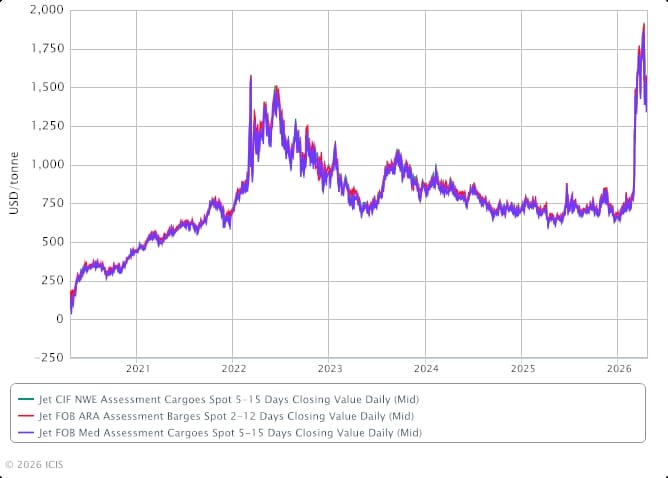
    • While peace negotiations could lead to Brent crude oil prices easing modestly in April, energy information provider ICIS anticipates a “gradually declining but persistent risk premium to remain embedded in prices for the remainder of the year, reflecting continued uncertainty around regional stability”
    • Crack spreads are increasing, meaning Jet A1 fuel is affected even more
    • US airlines are completely unhedged when it comes to fuel price. Southwest Airlines was one of the last to abandon its hedging programme a year ago (March 2025)
    • European and Asian airlines are much better hedged – many have between 45% and 85% of their needs for at least H1 2026 hedged at around $60/bbl or less, some even until the end of the year:
      • Hedged airlines include (but not limited to) Air France-KLM, Air New Zealand, Cathay Pacific, China Eastern, EasyJet, Finnair, Icelandair, Lufthansa, Norwegian, Qantas, Ryanair, Singapore Airlines, Virgin Australia and Wizz Air
      • Hedged airlines will be much less exposed to fuel price increases, while US carriers likely to be impacted harder
      • Some carriers hedge against crude, others Jet A – crude hedges still leave partial exposure to crack spread
    • Cirium analysis and modelling shows that the global airline industry stops making profit (i.e. breaks even) somewhere between $72 and $76 per barrel (sustained, longer term), depending on assumptions. Above that fuel price the industry starts to make losses
    • With higher fuel prices there are two implications to demand for aircraft
      • A greater push for newer-generation, more fuel-efficient aircraft
      • Increased reluctance for airlines to extend leases for previous-generation aircraft or to retain owned aircraft in service for longer
      • In some cases, the increased fuel costs may pressure airlines to offer less in lease rental especially for out-of-production aircraft

    Potential for softer demand

    • There is currently a serious risk of Asian, and to a lesser extent European economies, being affected by both higher energy costs and possibly fuel shortages if the Strait of Hormuz remains de facto closed for longer, and stockpiles run dry
    • For the past few years, we have considered many scenarios that are focussed on aircraft supply increasing to meet demand. For the first time in a while, we must consider the risk of a drop in demand as something increasingly plausible, potentially occurring sooner than expected. This could be especially critical as the manufacturers are making their biggest ramp-up in production over the next three years or so
    • If the conflict extends beyond the next month or two, the risk of an impact on air-travel demand becomes exponentially greater, and could firstly start to impact aircraft lease rates, and eventually aircraft values with previous-generation, out-of-production types being more vulnerable
    • Airlines operating older, less-fuel efficient widebodies on long-haul services would be worst affected, unless they are hedged at low levels
  • The Monthly On-Time Performance Report – February 2026

    View and download Cirium’s full 2025 On-Time Performance Review.

    Download the February 2026 On-Time Performance Report

    When you submit the form, you will be redirected to the latest Monthly On-Time Performance Airline and Airport Report. You will also receive an email with a link to the report for future reference.

    SUBSCRIBE to be the first to hear about new Cirium reports and analyses.

    Global OTP Summary – February 2026

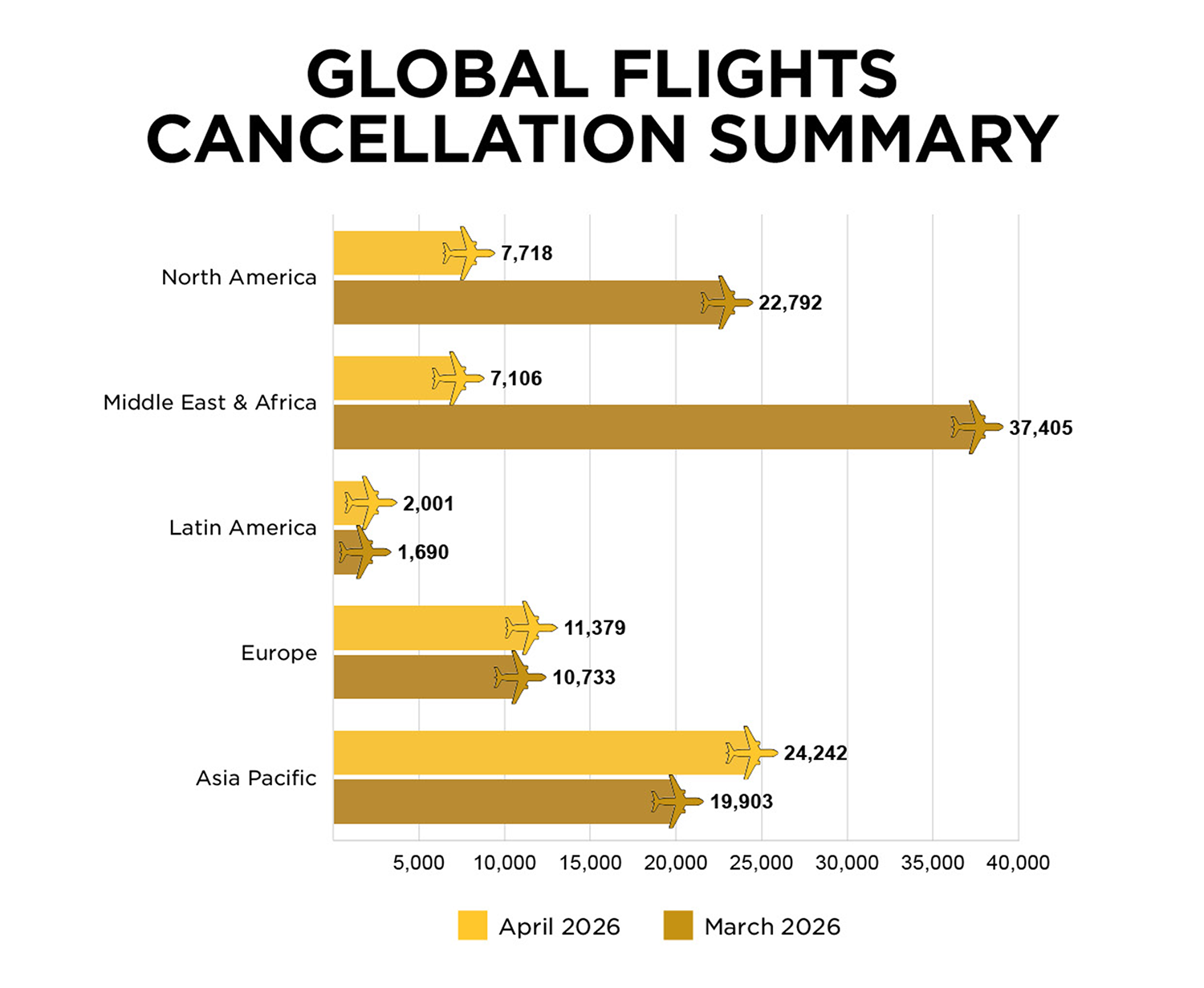
    February marked a significant recovery for the global aviation industry, with flight cancellations dropping by 37%. The number of global cancellations fell from 70,167 in January to 43,904 in February, signaling improved operational stability across airlines and airport operations.

    Examining regional trends, Asia Pacific led with a 40% decrease in flight cancellations, followed by North America at 47% and Europe at 33%. However, not all regions saw declines—Latin America experienced a 13% increase, while the Middle East & Africa recorded a 41% rise in flight cancellations.


    Global Cancellations Report


    Learn more about Cirium On-Time Performance and download 2025 Reports, here.

  • Aviation in 2026: A stable climb or turbulence ahead?

    Aviation enters 2026 with momentum, experiencing resilient demand, persistent supply‑side constraints and an increasingly uncertain macroeconomic environment.

    In The 2026 Aviation Market Outlook broadcast live on 4th February 2026, Stephen Burnside, Richard Evans and Daniel Hall explored the key factors shaping the sector to unpack what this means for airlines, lessors and the wider industry.

    Mixed macro signals leave less room for error

    From a macroeconomic perspective, the headline indicators point to an environment that supports air travel demand. Purchasing managers’ indices (PMIs) remain high, key economies are growing, and productivity metrics are rising sharply – all good news for the aviation industry. As Stephen Burnside noted, “PMIs are doing great… if it’s above 50%, we’re expanding,”

    However, consumer sentiment is weakening, and external shocks threaten to create abrupt economic corrections. “The US is central to our 2026 outlook… we like to keep a very close eye on the US because it does really drive the entire world economy” Stephen explained, adding that the impact of a US policy error impacting trade and undermining economic growth was the “number one risk for our outlook for 2026”. While aviation enters 2026 with momentum, the industry has less margin for error. With debt‑to‑GDP ratios elevated and geopolitical tensions unresolved, any shock could have a faster and more pronounced impact than in previous cycles.

    Demand and capacity appear balanced – regional divergence tells a different story

    After years of disruption and recovery, 2025 marked a return to more conventional aviation market dynamics. Globally, demand and capacity were closely aligned, with only marginal changes in load factors. “If you just stood above, if you didn’t know anything else, you’d say well demand and supply look fairly in balance,” observed Richard Evans, highlighting how far the industry has come since 2019.

    That balance, however, hides a widening gap between regions, markets and segments. Forward schedules show continued growth into 2026, but at a more measured pace, and with clear divergence by geography. Asia‑Pacific, the Middle East and Africa continue to see demand outpacing supply, while North America and Latin America experienced load factor declines earlier in the year.

    This unevenness is set to persist in 2026. International capacity is growing far faster than domestic, while some major markets are barely expanding at all. Airline performance will depend on “whether the market is growing strongly or not, but within that what the balance of competition is and the opportunities for yield expansion on the international side.”

    Aircraft and engine values stay elevated with widebodies scarce

    Tight supply conditions continued to support aircraft and engine values through 2025, with diverging dynamics between segments. After years of suppressed production, widebody availability is now extremely tight as international demand has fully recovered.

    By contrast, the single‑aisle market has moved into a more stable phase, with market values rising only modestly over the past year and lease rates largely unchanged, reflecting improving production visibility and a highly competitive lessor landscape despite ongoing engine‑related constraints.

    In the widebody market, Daniel Hall pointed to twelve months of growing market values, and lease rates rising by more than 14% on average last year. “If you speak to a lessor today and try and get your hands on a widebody under 15 or 20 years of age, I believe there are none available today.” This is pushing airlines to invest heavily in twin-aisle cabin refurbishments and sustaining pricing power for lessors and owners. While production rates are improving, they are not picking up fast enough to rebalance supply and demand in the next twelve months. “We expect similar this year, but maybe at a smaller magnitude; we have to look at the bigger picture” pointing to another year of lease rate growth.

    Watch the webinar on-demand

    To access the full presentation, including analysis of the impact of the GTF engine issues on single‑aisle capacity, fleet availability and lease‑rate dynamics, register to watch the webinar.

  • What Makes Guayaquil’s Olmedo Airport an Operational Leader?

    Isaac Pato, Senior Data Analyst, Cirium

    With an impressive on-time departure rate of 91.47% across 34,068 tracked flights, GYE demonstrated exceptional consistency while serving 19 routes. This achievement underscores the airport’s ability to deliver world-class performance in a category defined by airports handling between 5 million and 15 million seats annually.

    The qualification criteria for this award emphasize comprehensive flight operations and reliability, ensuring recognition for airports that balance regional connectivity with global service standards. GYE’s success is particularly notable given the operational challenges of 2025, including scheduled runway maintenance closures in September that required temporary suspension of all flight operations. These proactive infrastructure upgrades highlight the airport’s commitment to long-term safety and efficiency, even as it maintained industry-leading punctuality throughout the year.

    Small airports often face unique constraints, managing diverse route networks while maintaining reliability.

    GYE’s achievement reflects strategic coordination among airlines, ground handlers, and air traffic control, enabling seamless travel experiences despite seasonal disruptions.

    Its performance outpaced strong contenders such as El Salvador International Airport (SAL), which posted an on-time departure rate of 90.28% across 47,203 flights and 34 routes, and Rio de Janeiro’s Santos Dumont Airport (SDU), which achieved 89.67% punctuality with 58,303 flights and 7 routes. These results highlight the growing emphasis on reliability in Latin America, a region where operational resilience is increasingly critical.

    Beyond Latin America, airports like Stavanger (SVG) and Cape Town (CPT) also demonstrated competitive performance, signaling a global trend toward process optimization and technology-driven efficiency. For travelers and airlines alike, this translates into fewer delays, improved connectivity, and enhanced confidence in regional gateways. The top five airports in this category collectively illustrate how smaller hubs are leveraging innovation and disciplined operations to deliver world-class punctuality.

    Looking ahead, Guayaquil’s leadership in this category illustrates how smaller hubs can achieve excellence through strategic investment and operational rigor. As the aviation industry continues to navigate evolving challenges,

    GYE stands as a model of success, proving that size does not limit the ability to deliver superior performance.

  • FlySafair Leads Middle East & Africa Region in 2025

    Jonathan Robins, Aviation Reporter, Cirium

    Running an airline anywhere is a tricky undertaking, but doing so in the Middle East and Africa (MEA) brings its own unique challenges. Hot and harsh conditions result in vast maintenance requirements for engines and equipment. Aircraft often spend far longer on the ground than in more temperate regions. Then, this year at least, there has been vast geopolitical disruption. Meanwhile competition is fierce. But there are advantages too. The Middle East’s position at the centre of the world makes it an ideal transfer location for the Gulf carriers, who funnel vast numbers of people around the globe, particularly between Europe and Asia. Their stellar earnings since the pandemic are a testament to the success of this strategy. 

    Alongside this, the region is seeing an explosion in air travel demand to, from, and within it. The domestic Saudi Arabian route from Jeddah to Riyadh, for example, is set to become the busiest air corridor in the world by the end of the decade, industry insiders believe, and perhaps well before that. 

    IATA, notably, says that at $29, profit per passenger will be higher in the Middle East next year than anywhere else. That compares with just $7.90 globally. 

    Aviation in Africa lacks the scale of its Middle Eastern rivals. The continent’s airlines lament the extra costs of doing business which includes higher prices for leases, MRO, fuel and insurance. Then there are the wild swings of local currencies, stranded earnings, and problems in retaining skilled staff – many of whom are wooed by the deep pockets of the Gulf. Yet, as the rankings show, there are successes here too, underpinned by an emerging middle class that is seeing Africans fly at scale for the first time. 

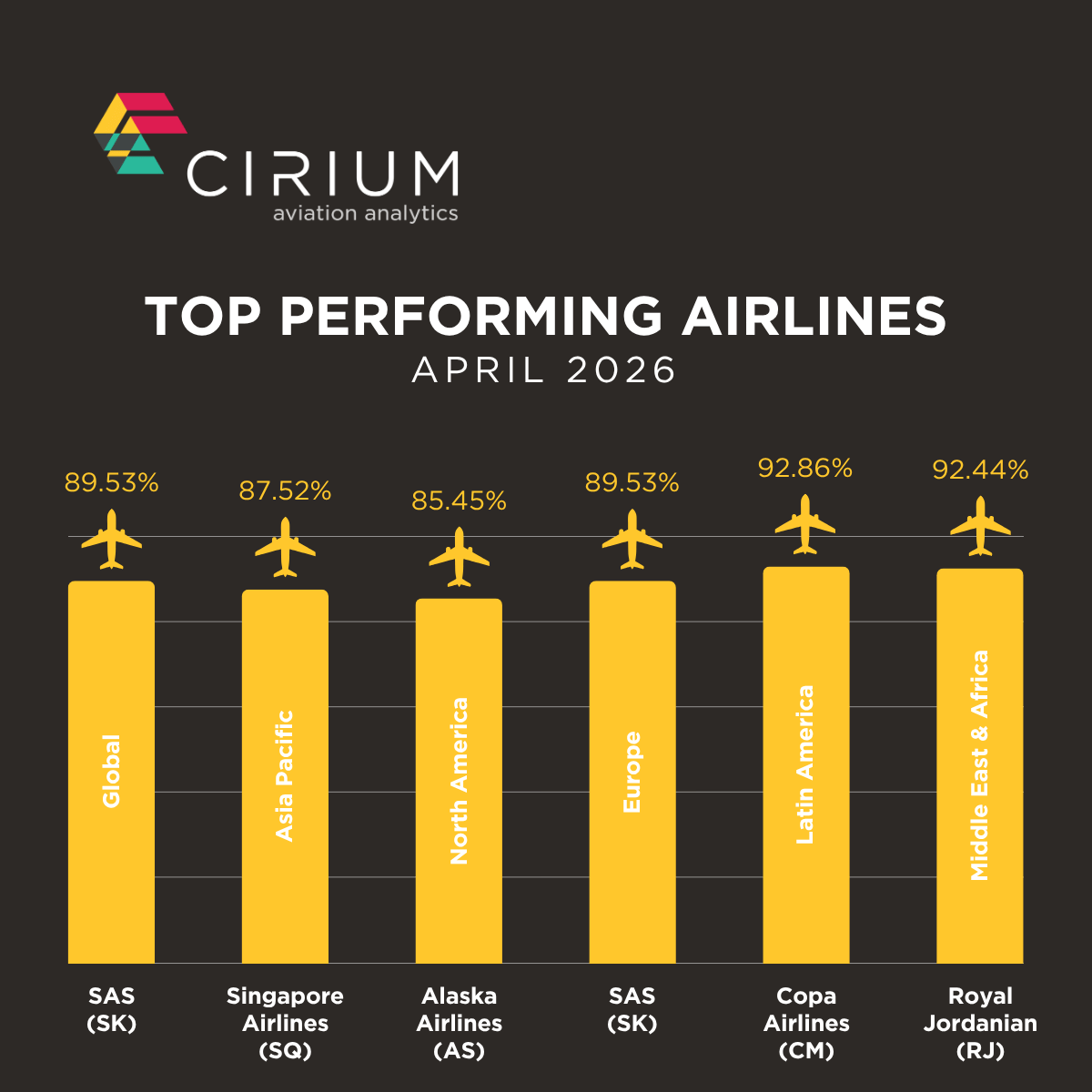
    Topping this year’s OTP rankings is South Africa’s Safair

    Following closely are Aeromexico, Gol, Azul, and LATAM Airlines, reinforcing the region’s reputation for reliability and efficiency. 

    Long a leader in performance, Safair has developed a reputation for precise scheduling and rapid 30-minute turnarounds as befit its low-cost business model, with a heavy use of real-time data. Alongside this, built-in contingency planning enables them to bounce-back rapidly when disruption does occur. 

    It notes that its performance has been underpinned by “strategic investments” in advanced scheduling, as well as “data-driven decision-making, and fleet management practices.” 

    Meanwhile the use of a single aircraft type – the Boeing 737 – has helped to keep maintenance costs down and reduce complexity, enabling flexibility between crews and bolstering utilisation rates. This all filters through to its reliability.   

    Safair has also embedded OTP into its corporate culture, linking employee incentives to their achievements and making it a key performance indicator, meaning that all staff are focussed on getting flights out on time.  

    Close behind is Royal Jordanian. The carrier is undergoing a strategic shift towards inbound tourism and becoming the main player in the Levant region. “That’s obviously a market which we want to dominate in the future,” commercial chief Karim Makhlouf said in November.   

    It plans a fleet expansion from around 23 aircraft currently to 41 by 2028, amid a longer-term goal of 52 by 2032. Passenger numbers are targeted to grow from 3 million to 7.1 million by 2028.  

    Makhlouf added that amid a growth spurt and restructuring it is “super difficult” to make money, but that it had recently reported a nine-month sustainable profit of around $43 million, “which for an airline like Royal Jordanian is quite a significant achievement.” 

  • Latin America: A Rising Star in Global Aviation

    Luis Felipe de Oliveira, Executive Director and CEO, Exactly Consulting and Services SARL

    Beyond growth, Latin America is setting benchmarks in operational excellence. Aeromexico stands out globally, achieving the best On-Time Performance (OTP) among the Global Airline Category, a remarkable feat given its operations from the highly congested Mexico City International Airport. This achievement highlights resilience and world-class standards in a challenging environment. 

    Regionally, Copa Airlines continues to lead OTP rankings, building on its stellar 2024 performance. 

    Following closely are Aeromexico, Gol, Azul, and LATAM Airlines, reinforcing the region’s reputation for reliability and efficiency. 

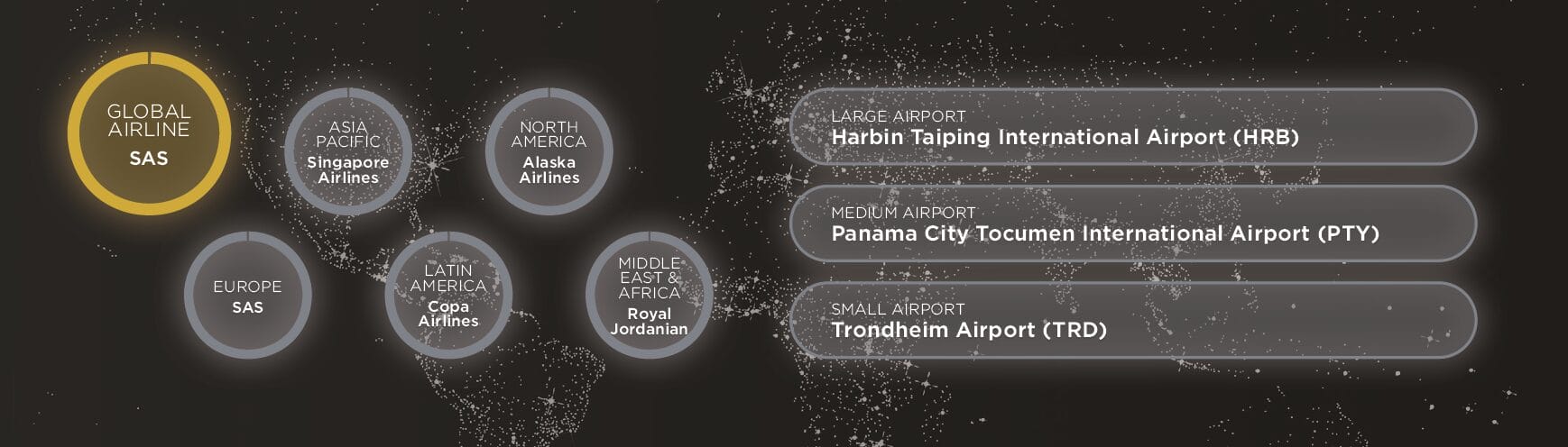
    Airports mirror this success, demonstrating the strong correlation between airline and airport punctuality. Santiago Arturo Merino Benitez International Airport leads all Large Airports globally, while two other Latin American airports feature in the top 10 of this category. The Medium-sized Airport Category shines even brighter: Tocumen International Airport in Panama claims the top spot worldwide, with five regional airports among the global top 10. In the Small Airport category, Guayaquil Airport leads globally, supported by four Latin American airports in the top ten. 

    Congratulations to the winners. 

    These results are more than operational metrics, they are a testament to the region’s commitment to excellence and its role in driving social and economic development. With robust growth, outstanding efficiency, and unparalleled OTP achievements, Latin America is not just keeping pace with global aviation, it is setting new standards.

    The region’s vast and diverse landscape offers immense opportunities, and its aviation sector is poised to be a cornerstone of connectivity and progress for years to come.  

  • On-Time Performance as an Emissions Indicator

    Mike Malik, Chief Marketing Officer, Cirium

    What the Research Actually Shows 

    Our team at Cirium spent months analyzing this relationship across three distance bands: short-haul routes under 1,500 kilometers, medium-haul between 1,500-3,999 kilometers, and long-haul over 4,000 kilometers. We compared July 2019 operations with July 2024. The Cirium EmeraldSky platform let us track 47 operational variables across more than 100,000 daily flights. Everything from gate times and runway waits to specific aircraft configurations and passenger loads. 

    The correlation was consistent where operational changes occurred.

    Routes with improved on-time performance showed measurable drops in flight times and emissions. 

    Routes with declining OTP showed the opposite: longer flights and higher emissions. The pattern held across different airlines and aircraft types. 

    Most emissions calculators rely on simple distance formulas. We’re tracking actual operational data. The factors that determine real fuel consumption. PwC independently verified the methodology to ISAE 3000 standards, which puts it among the most rigorous publicly available datasets on airline emissions. 

    Why Delays Create More Emissions 

    The mechanism is straightforward but often overlooked. Delayed aircraft burn fuel while accomplishing nothing productive. They sit on taxiways with engines running, waiting for clearance. They circle in holding patterns before landing. They take longer routes to dodge congestion. 

    Researchers Brueckner and Abreu quantified this over a 21-year study of 16 US airlines.

    Each percentage point increase in flights delayed more than 15 minutes correlated with a 0.3% jump in fuel consumption and emissions.

    In practice, an airline cutting its delay rate from 22% to 19% (just three percentage points) reduces fuel consumption by roughly 1%. The airlines in that study burned 13.7 billion gallons of jet fuel in 2015. At standard carbon pricing, a three-point improvement delivered $48 million in annual environmental benefits. It’s measurable impact from better operations. 

    Ground Operations Tell the Story 

    Much of the emissions penalty happens before takeoff. European air traffic management analysis (2015-2017) found that routing inefficiencies make flight paths 0.61-0.76% longer than optimal. That translated to 229,000 extra tonnes of fuel and 721,000 additional tonnes of CO₂. The equivalent of four full days of flying across the European Economic Area. 

    At London Heathrow during peak hours, about half the arriving aircraft enter holding patterns averaging six minutes each. During one January 2015 peak hour, those holding patterns alone produced 10 tonnes of CO₂ and 114 kilograms of nitrogen oxides. 

    The 20 most congested US airports generate 6 million metric tonnes of CO₂ annually just from aircraft taxiing. Research shows that eliminating taxi delays could cut overall flight fuel consumption by 1% on average, with some congested airports showing potential reductions up to 2%. 

    Solutions That Already Work 

    Continuous Descent Operations let aircraft descend smoothly with minimal engine thrust instead of the traditional step-down approach with level flight segments. 

    This saves an average of 51 kilograms of fuel per flight, with real-world operations achieving 3.6% fuel burn improvements.

    Full deployment across Europe could deliver 350,000 tonnes in annual fuel savings. 

    Airport Collaborative Decision-Making systems create transparent communication between airlines, ground handlers, and air traffic control. When 17 European airports put these platforms in place in 2016, they saw 7% reductions in taxi time, 10.3% drops in air traffic delays, and 102,700 tonnes of CO₂ saved. 

    The Gap Between Airlines 

    The airline industry improved its carbon output per passenger by 12% between 2013 and 2019. 

    Roughly 2% per year. The variation between carriers tells an interesting story. Our 2024 Flight Emissions Review shows low-cost carriers like Wizz Air (53.9 grams CO₂ per available seat-kilometer) and Frontier (54.4 g CO₂/ASK) substantially outperforming legacy carriers. 

    How they run their operations explains much of this gap. Low-cost carriers typically maintain higher load factors, operate uniform fleets, fly point-to-point networks, and refine procedures more rigorously. These same factors support both on-time performance and efficiency. 

    Why the 3% Matters Right Now 

    Getting aviation to net-zero by 2050 depends heavily on sustainable aviation fuels (65% of the solution) and new propulsion technologies (13%). Operational improvements? Just 3% of the long-term plan. 

    Sustainable fuel production won’t reach meaningful scale until the 2030s. Hydrogen and electric aircraft remain years away from commercial deployment. That makes the 3% from operational improvements the only immediate option for emissions reduction. 

    Better operations are the immediate option for emissions reduction. 

    No new technology required, just better execution of existing procedures. 

    When an airline publishes its on-time performance statistics, it’s revealing more than customer service quality. Those numbers provide a window into how well the airline runs, and that directly affects environmental impact. The data proves the connection. Better on-time performance means lower emissions per passenger. It’s something airlines can improve right now. 

    Report highlights

    If you haven’t read the complete 2024 EmeraldSky Flight Emissions Review, you can download it at the link below. We’re releasing the 2025 edition in early 2026. If you’d like early access when it’s available, scan the QR code below to register your interest and we’ll send it your way. 

    Sources 

    Cirium EmeraldSky Study (2024): Short-haul route analysis comparing July 2019 to July 2024 operations, tracking 47 operational variables across 100,000+ daily flights. Methodology independently verified to ISAE 3000 standard by PricewaterhouseCoopers. 

    Brueckner, J.K., and Abreu, C. “Airline Fuel Usage and Carbon Emissions: Determining Factors.” Journal of Air Transport Management, Vol. 62 (2017), pp. 10-17. Study of 16 US airlines over 1995-2015 period. 

    EUROCONTROL Performance Review Reports (2015-2017): European air traffic management inefficiency analysis, horizontal flight efficiency data, and holding pattern emissions studies. 

    EUROCONTROL A-CDM Impact Assessment (2016): Analysis of 17 European airports implementing Airport Collaborative Decision Making systems. Study developed by Atlas Chase for EUROCONTROL. 

    Cirium Flight Emissions Review (2024): Global airline emissions rankings using flight-specific operational data. Published July 2025. 

    IATA Global Aviation Data (2013-2019): Historical carbon intensity trends for commercial aviation. 

    Air Transport Action Group (ATAG): Waypoint 2050 (2nd Edition, September 2021). Aviation industry net-zero pathway analysis and decarbonization scenarios.