






























Team Perspective
Andrew Doyle, Senior Consultant, Cirium Ascend Consultancy
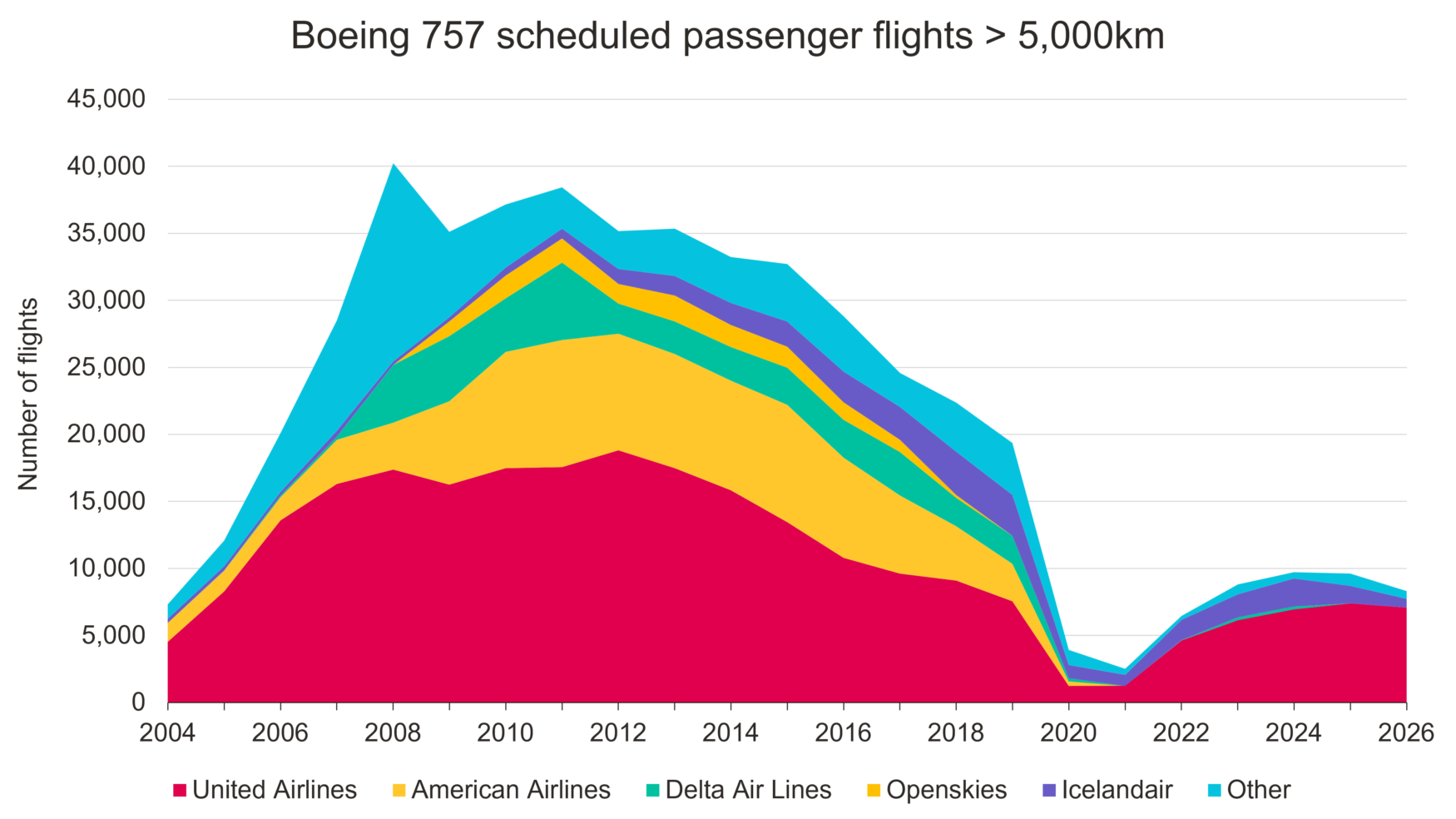
Long-range narrowbody twinjet passenger flights gained in popularity from the early 2000s largely thanks to the unique capabilities of the Boeing 757, but such operations remained limited to the “big three” US global network carriers alongside a patchwork of secondary carriers (e.g. Icelandair) and now-defunct new entrants such as all-premium British Airways offshoot OpenSkies.
Production of the 757 ended in 2004 and the type’s deployment on 5,000km-plus routes went into decline from 2010 before being all but wiped out with the onset of the pandemic in 2020. Only United (also joint largest A321XLR customer) and Icelandair (another client for the new Airbus variant) have kept faith with the venerable Boeing through the post-Covid recovery.
Source: Cirium Diio
Note: United Airlines includes Continental Airlines
While the 757’s extended range capabilities were largely baked into the original design (somewhat compromising its efficiency on shorter sectors), Airbus has pushed the A321 close to the limits of its development potential to create the XLR.
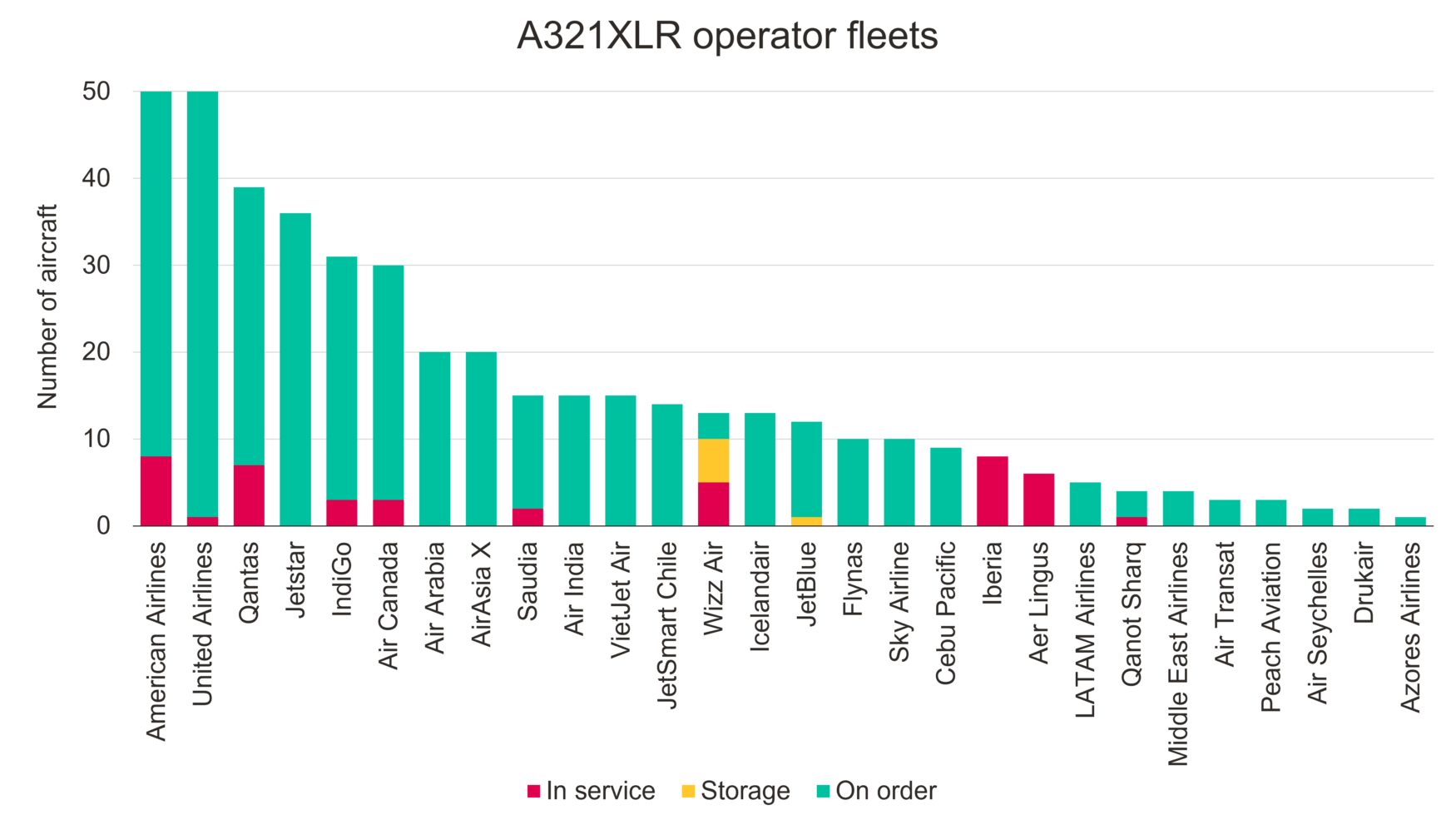
However, the lure of up to 30% lower per-seat fuel consumption versus the 757 coupled with operational synergies for existing operators of large A320neo family fleets has resulted in 28 airlines so far committing to buy or lease a total of 440 A321XLRs, of which 50 have been delivered and 44 are in revenue service. Cirium fleets data shows leasing companies hold a further 40 firm commitments still to be placed with airlines.
Source: Cirium Fleets Analyzer
Boeing’s yet-to-be-certificated 737-10 Max is designed to counter the A321neo in terms of capacity, but the US manufacturer states that the 737-10 can fly up to 3,100nm (5,740km), well short of the XLR’s published 4,700nm. This leaves the 200- to 275-seat, 60.1m (197ft 3in)-span 787-8 widebody as the smallest Boeing offering for operators that need additional range versus the Max.
While there is little publicly available net promoter score (NPS) data to quantify how passengers feel about flying long-haul on narrowbodies, feedback consistently indicates a preference for widebody aircraft due to perceived greater cabin spaciousness and comfort. Offsetting this is that long-range narrowbodies such as the A321XLR can generate strong passenger satisfaction when they enable nonstop service at reasonable fare levels on routes that would otherwise require a connection.
A non-scientific assessment of the main sentiment drivers suggests the strongest “structural” advantage widebodies offer is lower overall aisle congestion due to service carts, passenger lavatory visits and, to a lesser extent, boarding/deplaning (two exit paths rather than one). But twin-aisles do not provide any automatic improvement in seat width, recline or legroom as this is entirely configuration dependent. That said, widebody passengers can perceive greater spaciousness due to overall cabin geometry.
Source: Cirium Core
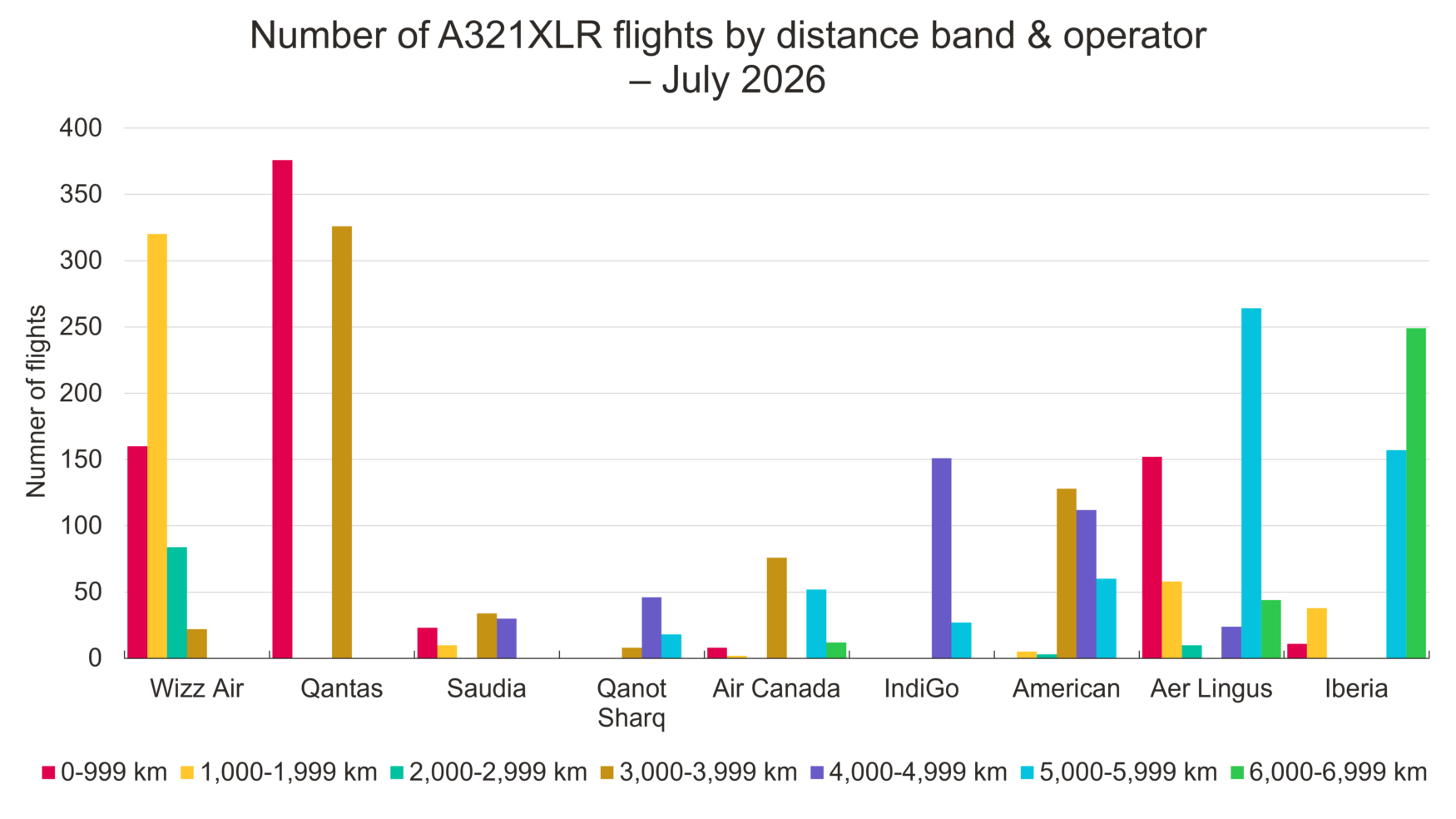
XLR launch operator Iberia, which also has the largest in-service XLR fleet at eight aircraft, has been building its network of long, thin routes since it received its first example in November 2024. By July 2026, it had deployed the variant on more than 400 flights exceeding 5,000km in distance, including some destinations thought initially to sit beyond the XLR’s reach.
“[It’s] even better than originally planned in terms of stage length,” according to Iberia CEO Marco Antonio Trujillo. “In fact, we are operating currently to the Caribbean, San Juan and Santo Domingo, where initially we were not thinking that the range could get over there.”
“In terms of unit cost, [it] is significantly lower than the A330,” said Trujillo, speaking during parent IAG’s H1 2026 results briefing. “It’s counterintuitive. Normally, a smaller aircraft has a higher unit cost, but this is not the case with the A321XLR. Of course, it allows us to open destinations where the demand is too thin to be served by larger widebody aircraft.”
Fellow IAG carrier Aer Lingus has also been an early adopter with its fleet now numbering six. It recorded over 300, 5,000km-plus sectors in July but supplemented this tally with over 200 sub-2,000km flights, demonstrating the variant’s ability to supplement the airline’s short-haul fleet in between transatlantic rotations. While the variant’s mission flexibility is a key strength, this must be balanced against premium customer expectations for seating comfort, particularly for long overnight sectors.
A321XLR cabin configurations – initial operators
| Operator | Total number of seats | Business class seats (lie-flat?) | Premium economy seats (pitch) | Economy class seats (pitch) |
| JetBlue | 138 | 24 (Y) | 114 (32″) | |
| Saudia | 144 | 24 (Y) | 120 (33″) | |
| United Airlines | 150 | 20 (Y) | 12 (37″) | 118 (33″) |
| American Airlines | 155 | 20 (Y) | 12 (37″) | 123 (31″) |
| Iberia | 182 | 14 (Y) | 168 (30″) | |
| Air Canada | 182 | 14 (Y) | 168 (31″) | |
| Aer Lingus | 184 | 16 (Y) | 168 (31″) | |
| Qanot Sharq | 190 | 16 (Y) | 174 (31″) | |
| IndiGo | 195 | 12 (N) | 183 (31″) | |
| Qantas | 197 | 20 (N) | 177 (30″)* | |
| Qantas | 200 | 20 (N) | 180 (30″) | |
| Wizz Air | 239 | 239 (28″) |
* Features additional rear lavatory
Source: Cirium Fleets Analyzer
Accordingly, the majority of XLR operators have installed fully lie-flat business class seats, while United and American also offer dedicated premium economy cabins at 37in (94cm) seat pitch. At the back of the aircraft, Saudia and United provide a generous 33in pitch, versus the more typical 30-31in spacing.
While tracking historical flight deployment is relatively straightforward, divining the forward plan is more challenging as there is no dedicated A321XLR equipment code in published schedules.
However, it is possible to leverage Cirium’s Sky data warehouse and artificial intelligence tools to assemble the global XLR schedule for the coming 11 months with a reasonable level of confidence, based on unique cabin configurations, endurance requirements and observed flight histories.
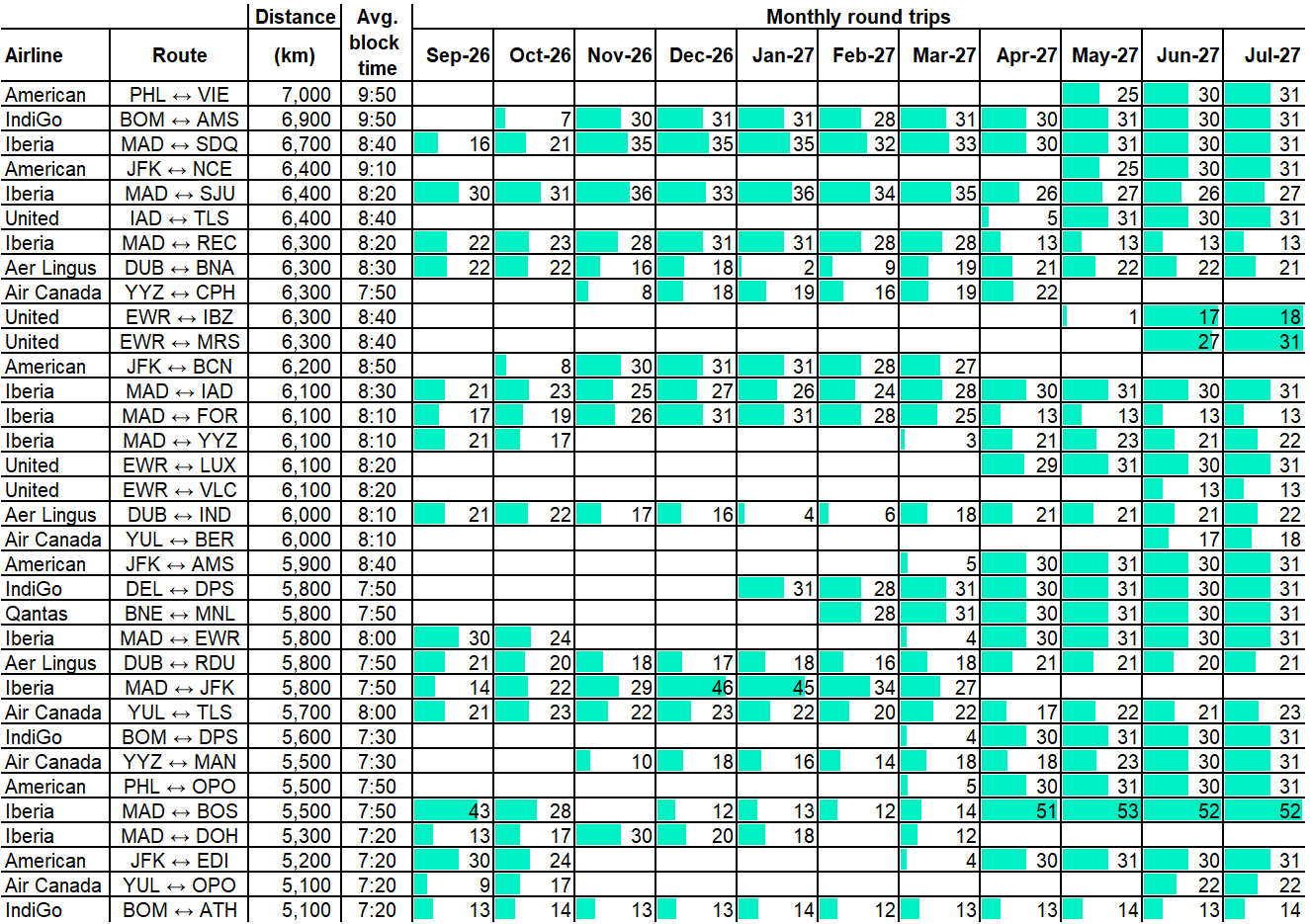
IndiGo’s plan to inaugurate Mumbai-Amsterdam flights with an average block time of almost 10h from October is one of the most ambitious, alongside American Airlines with Philadelphia-Vienna from May next year.
In the nearer term, American will introduce a New York JFK to Barcelona service from October, with an average block time of just under 9h, while Air Canada matches that duration with Toronto-Copenhagen from November.
Cirium’s derived XLR schedule predicts Aer Lingus, Air Canada, American, Iberia, IndiGo and Qantas will collectively operate more than 500 monthly round-trip services between airports more than 5,000km apart by the second quarter of 2027, utilising a combined fleet of over 70 aircraft.
United, meanwhile, is replacing its 40 ageing 757s with A321neos, including 50 XLRs on firm order of which a single example has been delivered. The US carrier will start transatlantic flights with the new variant in December, serving Amsterdam and Dublin. More significantly, it will use what it dubs the “Born to Explore” XLR to open brand new routes to Toulouse, Luxembourg, Marseille, Ibiza and Valencia from summer 2027.
Principal scheduled A321XLR routes exceeding 5,000km
Routes >5,000km. Excludes selected seasonal services with <100 flights.
Source: Cirium Core
United paints a different picture to Iberia’s Trujillo regarding range performance, however. Its SVP global network planning and alliances, Patrick Quayle, said the airline had selected its XLR destinations “conservatively” as the aircraft could no longer fly originally envisaged routes such as those between New York and cities in Italy.
“The routes we’re focused on are Spain and France, which we feel are well within the capabilities of the aircraft,” he said.
So, to what extent should we expect the XLR orderbook to grow from here? While industry executives generally view the aircraft as an effective low-risk route opener for thin, point-to-point international markets, there is a strategic trade-off for airlines that typically derive substantial revenue from flying several tonnes of belly cargo on widebody services.
The XLR’s appeal lies in giving airlines a lower-risk way to test, sustain or increase frequency on routes where demand is too thin for larger aircraft, while preserving sufficient cabin comfort to satisfy passengers if the product is configured carefully.
The next phase of deployment will determine whether the XLR remains a specialist network instrument or becomes a broader catalyst for reshaping long-haul connectivity, particularly between secondary cities that have long sat just beyond the reach of economically viable nonstop service.
This article was first published in Viewpoint 92, the Q3 2026 edition of Cirium Ascend Consultancy’s quarterly commentary and analysis publication.