




























Here is the structural weakness across aerospace today. OEMs, MROs, aftermarket suppliers have deep insight into their own operations but limited visibility into how the wider fleet is behaving. Internal data explains what has already happened. Competitive advantage comes from identifying where utilisation, demand and operational pressure are building before those trends become obvious to the rest of the market.
That blind spot matters because the most valuable opportunities often form outside an organisation’s existing customer base, installed fleet or contracted support programme. Emerging utilisation trends, regional shifts in activity, competitor fleet behaviour and early signs of maintenance pressure can all develop before they appear in internal systems. By the time those signals show up through tenders, customer requests or capacity shortages, the commercial advantage has often already moved elsewhere.
That distinction is now the whole competitive advantage. A broader view on production, maintenance capacity and aftermarket positioning must be aligned before demand fully materialises. The organisations that will pull ahead will be those that can predict how the global fleet will operate, purposing their supply chain, MRO capacity and engineering resources accordingly, and before the demand becomes obvious to everyone else.
Cirium’s analysis tells a story that is not fundamentally about demand, but about aerospace’s growing supply-and-sustainment challenge. Across the industry, supply-chain constraints, delayed aircraft deliveries, engine durability issues and limited maintenance capacity continue to restrict fleet growth. Insights shared during a recent Cirium webinar highlighted that production shortfalls remain significant; hundreds of next-generation aircraft remain grounded awaiting engine work, and airlines are extending the lives of existing fleets well beyond previous expectations. The result is a global fleet that is ageing, flying harder and competing for increasingly scarce maintenance resources.
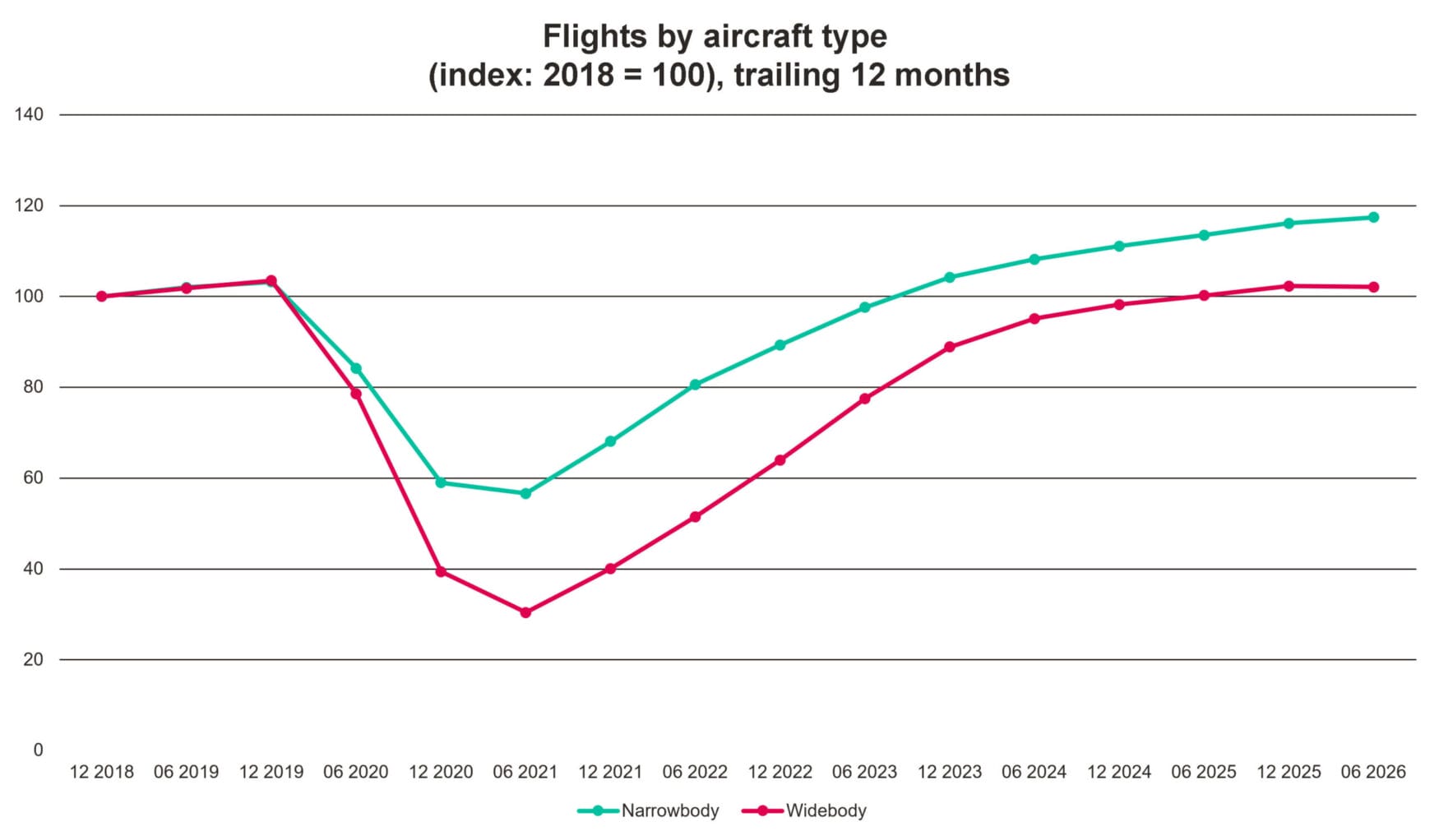
Source: Cirium Schedules. TTM flights.
Flight recovery is not uniform across the fleet. Narrowbody flights now exceed the pre-pandemic baseline, while widebody activity remains broadly flat. That divergence matters for MROs, OEMs and aftermarket suppliers because maintenance demand follows the accumulation of cycles, and not passenger growth in aggregate.
That distinction is becoming increasingly important. As maintenance capacity, engineering resources and critical components become harder to secure, the organisations that outperform will not necessarily be those with the largest operations, but those that identify future maintenance demand earliest. The ability to anticipate where and when aircraft, engines and components will require support is increasingly becoming a source of commercial advantage.
The maintenance bottleneck is one of the clearest examples of this wider visibility challenge. When organisations see only their own customers, contracts and programmes, they miss where demand is forming across the broader fleet. In that environment, the scarcest resource is not just maintenance capacity; it is visibility into where future demand will emerge. The organisations that can recognise demand earliest gain more time to secure work, allocate maintenance capacity, position inventory and engage operators before competitors become aware of the opportunity.
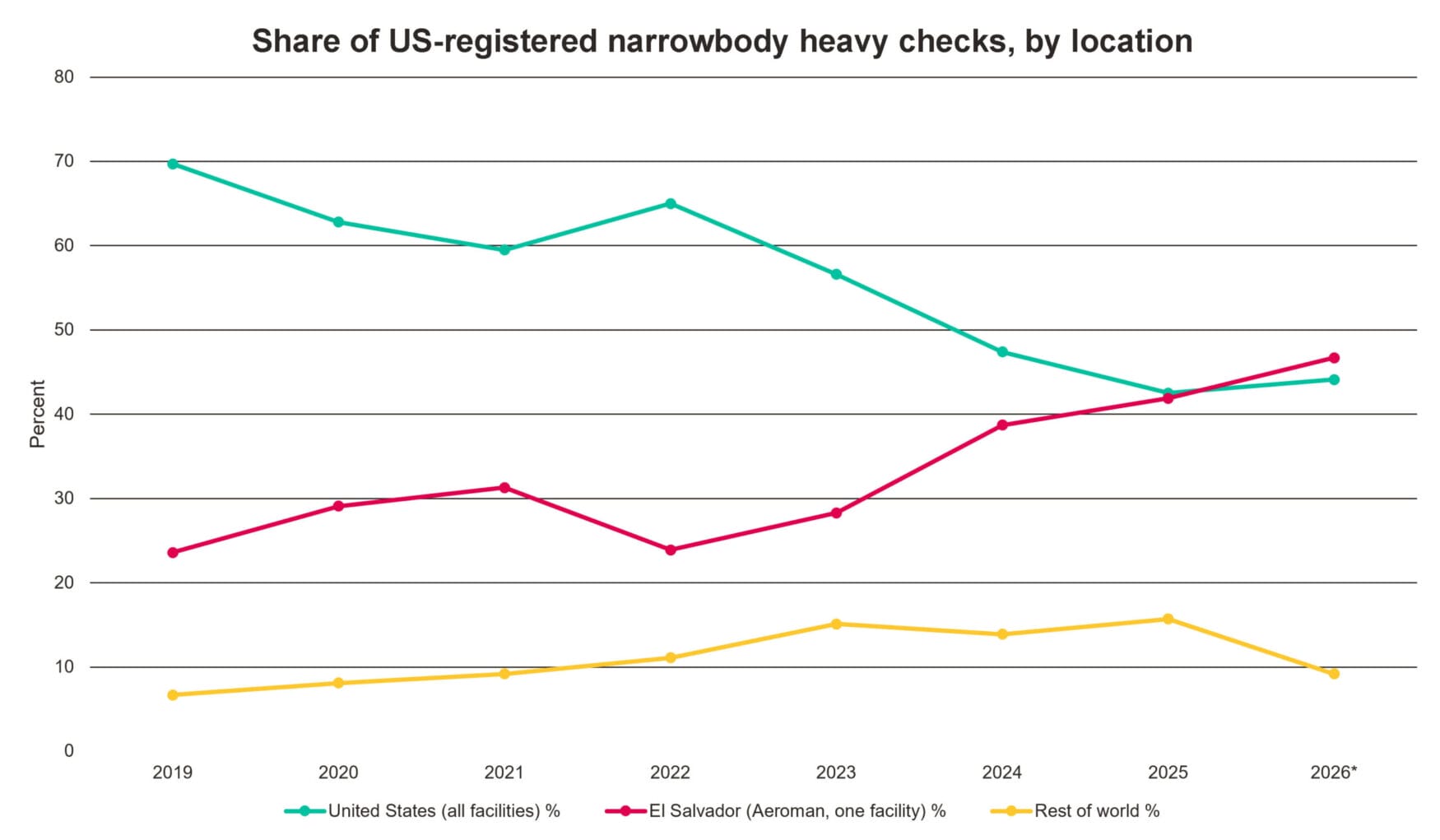
Source: Cirium Ascend Ground Events. Percent of all narrowbody heavy checks per year – n = 3,087 events.
The shift in US heavy maintenance illustrates the point. In 2026, Aeroman in El Salvador performed a larger share of US-registered narrowbody heavy checks than the entire US MRO network combined. What appears as a local capacity challenge in internal systems is often the result of broader market forces that are only visible through wider fleet intelligence.
Ageing aircraft require more maintenance at precisely the moment maintenance capacity is constrained. Engine durability issues, labour shortages (including experienced technicians and training for future requirements), overheads, parts availability challenges and limited hangar capacity are increasing pressure across the aerospace ecosystem. Airlines are keeping aircraft in service for longer while maintenance providers face growing competition for scarce resources. The result is an industry where the key challenge is no longer simply fleet growth but sustaining the fleet already in operation.
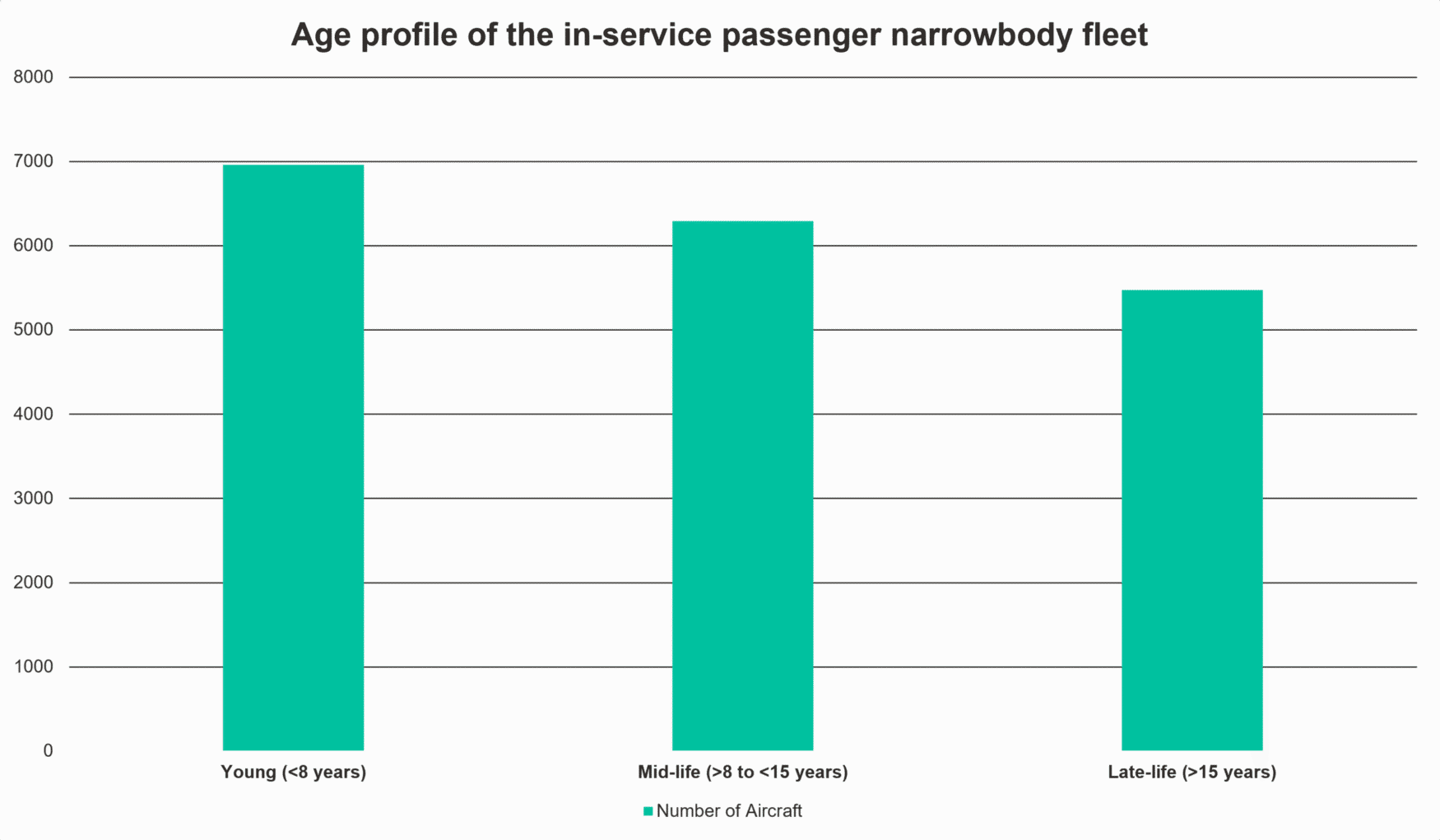
Source: Cirium Ascend Fleet Insights. In-service passenger narrowbody jets, September 2026.
Maintenance exposure extends across a mature fleet. In September 2026, 37.2% of in-service passenger narrowbody aircraft were young, 33.6% were mid-life and 29.3% were late-life. Nearly one-third of the fleet is therefore more than 15 years old, while a further third is between eight and 15 years old. That age profile gives MROs, OEMs and aftermarket suppliers a broader view of where maintenance exposure exists. Combining that view with aircraft utilisation, provides identification of where operational pressure is building and where maintenance capacity, parts and support will be required next.
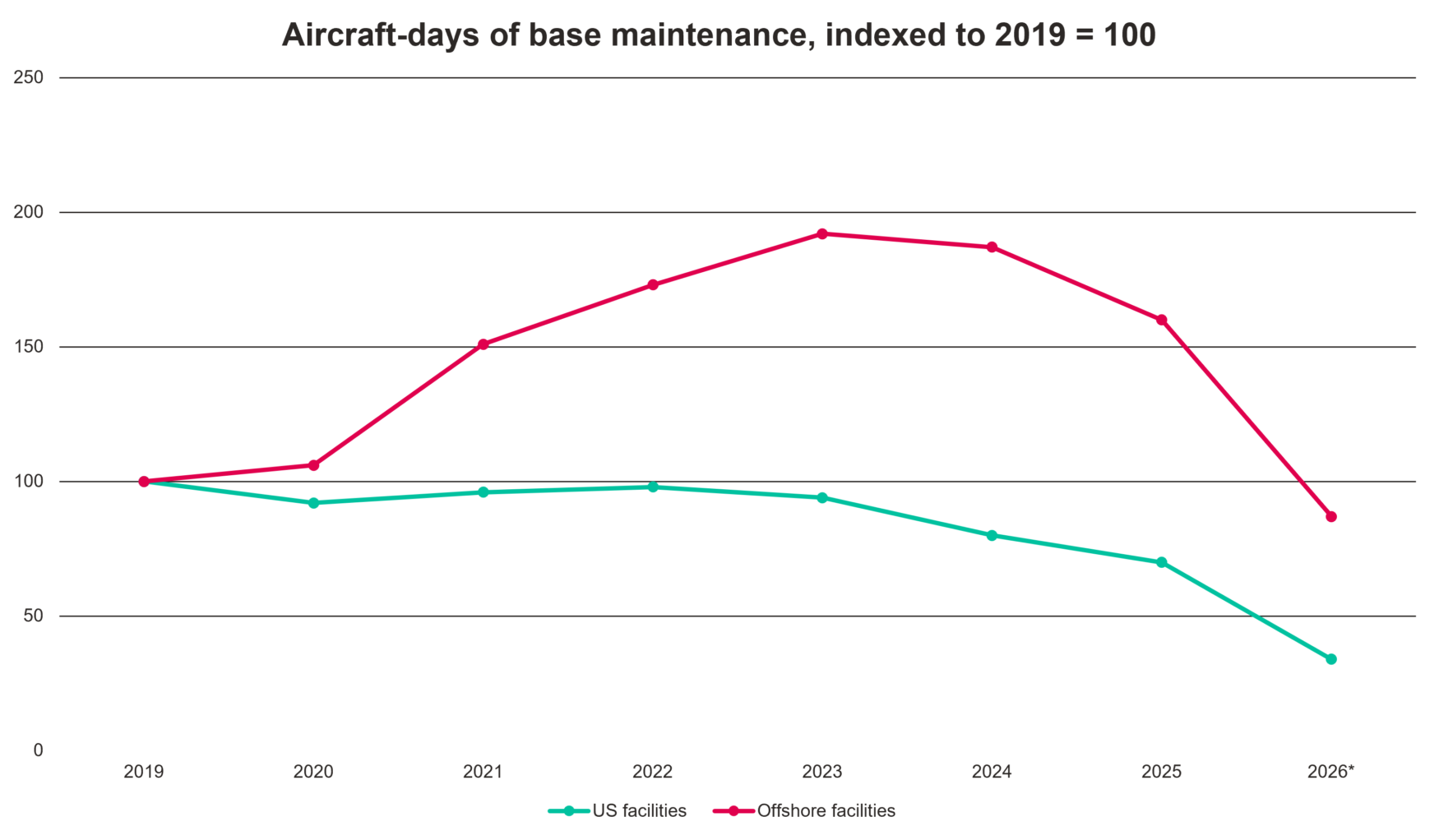
Source: Cirium Ascend Ground Events. Percent of all narrowbody heavy checks per year · n = 3,087 events.
Cirium maintenance data already shows this pressure is reshaping global MRO capacity. Since 2019, domestic US maintenance activity has fallen by 30% while offshore maintenance volume has grown by 60%. Capacity has not disappeared. It has moved, creating a more competitive environment for maintenance slots and increasing the importance of understanding where demand is likely to emerge next. Many MRO facilities are already booked through for 2-3 years ahead so this then becomes about planning for capacity expansion, benchmarking turn-around times alongside optimising resources and revenue opportunities with existing capacity.
Qatar Airways – repeatability under pressure. When Qatari airspace closed in 2026, Qatar Airways’ operation fell to around one-third of scheduled flying before recovering to almost normal levels within weeks. The significance is not the speed of the recovery, but that the operational response was visible in the data as it happened. Those signals help distinguish temporary disruption from structural demand change and provide an earlier indication of where aircraft, engines and components will be needed next.
For MROs, suppliers and aftermarket providers, that insight has direct commercial value. Understanding how fleets are adapting to disruption helps identify where maintenance demand is likely to emerge long before work is formally tendered. Miss those signals and MRO capacity sits misaligned while aftermarket sales turn reactive. Two Cirium case studies show the point in hard numbers. When capacity is scarce, allocation becomes everything; and you cannot allocate what you cannot see.
| Earliest signal | Emerging signal | Confirming signal |
| Forward schedules | Aircraft utilization | Ground events & maintenance activity |
| Where operators plan to fly | How aircraft are being used | Where maintenance demand is already forming |
| Reveals future capacity deployment | Reveals cycles, hours and operational pressure | Reveals downtime, heavy checks and maintenance activity |
Data helps keep maintenance lines full, but the long-term commercial advantage lies in identifying where requirements are likely to emerge next with a higher degree of confidence. Understanding which fleets are accumulating cycles, increasing utilisation or approaching significant maintenance events helps MROs maximise maintenance-line utilisation, focus sales and business-development efforts on the highest-probability opportunities and engage operators before competitors recognise the demand.
Points for consideration when identifying future maintenance demand:
- Can the organisation connect the three signals that reveal demand before it is visible to competitors: where fleets intend to fly, how hard aircraft are working, and which aircraft are already entering, or nearing, a maintenance requirement.
- Is there a signal to point to planned capacity changes indicating where utilisation is likely to increase – particularly when ageing fleets are being deployed more intensively, and future wear, engine cycles and maintenance requirements become more predictable.
- Whether operational behaviour confirms those plans are materialising, with aircraft utilisation showing where and how cycles and hours are accumulating, where pressure is building, and which aircraft / fleets may require intervention sooner than expected.
Maintenance activity is the confirming signal. Ground time, heavy checks and aircraft downtime show where demand has moved from possibility to reality, and where scarce capacity is already being consumed.
The commercial advantage comes from joining the signals early. Planned operations show intent. Aircraft behaviour shows whether that intent is translating into usage. Maintenance events confirm where support is already required. Together, they give MROs, suppliers and aftermarket providers a clearer view of which fleets to target, where to position inventory, how to allocate capacity and when to engage operators before work is formally tendered.
Used well, this becomes a forward-looking demand model rather than a backward-looking operational report. It helps providers move from reacting to known maintenance needs to anticipating where resources, inventory and commercial effort will be required next.
The lesson from the Qatar Airways example is not recovery; it is visibility. Operational behaviour created signals that were visible long before the outcome became obvious. The same principle applies to maintenance demand. Aircraft behaviour often reveals future maintenance requirements before those requirements appear in forecasts, procurement activity or maintenance tenders.
For suppliers and OEMs, the same signals help identify where parts demand and aftermarket activity are likely to develop. Inventory can be positioned closer to anticipated requirements; production aligned with emerging demand and support resources allocated more effectively.
The result is a cumulative advantage. Organisations that identify demand earliest gain more time to secure work, allocate capacity and position resources before competitors recognise the opportunity.
The takeaway
The organisations that outperform over the next five years will not simply be those with the most capacity, the largest installed base or the strongest internal data. They will be those with the clearest view of how the wider fleet is behaving. By combining signals from planned operations, actual utilisation and maintenance activity, MROs, suppliers and OEMs can see where demand is forming beyond their existing customers and programmes, direct commercial resources towards the most promising opportunities, align inventory and production accordingly, and secure work before competitors recognise it. In a capacity-constrained market, predictive intelligence is no longer just an operational advantage; it becomes a commercial advantage.