





























Team Perspective
Povilas Stonys, Aviation Valuations & Consultancy Associate, Cirium Ascend Consultancy
Fleet renewal is reshaping not only what airlines fly, but how intensively they use different aircraft across their fleets. Average aircraft utilization is a key productivity indicator, which has generally increased over time as airlines have become more efficient. It is also an important metric to help understand supply and demand balance. Using Cirium Fleets Analyzer data, this article examines how utilization trends differ across passenger aircraft generations and age groups, highlighting the growing divide.
Flying the future: new-generation aircraft lead utilization trends
While average flight hours declined across all major passenger aircraft types between June 2025 and June 2026, new-generation aircraft consistently maintained higher utilization levels and saw smaller reductions than their legacy counterparts, see the table below.
| Aircraft Type | Average Flight Hours Jun-25 | Average Flight Hours Jun-26 | YoY Change % |
|---|---|---|---|
| 737 NG | 262 | 242 | -7.5% |
| 737 Max-8 | 304 | 301 | -1.3% |
| A320ceo | 253 | 232 | -8.3% |
| A320neo | 280 | 266 | -4.9% |
| A321ceo | 271 | 247 | -8.9% |
| A321neo | 307 | 294 | -4.1% |
| 777-300 | 372 | 355 | -4.8% |
| 787-9 | 381 | 370 | -2.9% |
| A330-300 | 308 | 292 | -5.0% |
| A350-900 | 385 | 381 | -1.1% |
Source: Cirium Fleets Analyzer; Airbus and Boeing passenger aircraft only
New-generation narrowbodies recorded an average utilization decline of approximately 3%, compared with around 8% for legacy aircraft, while new-generation widebodies declined by 2% versus 6% for older aircraft types. The contrast is particularly evident between utilization of the Boeing 737-NG, which fell 7.5% year-on-year to 242 hours per month between June 2025 and June 2026, and the 737-8 Max, which remained comparatively resilient, declining only 1.3% to 301 hours. A similar pattern is visible with Airbus A321neo, which not only operated roughly 19% more hours, but its utilization decline was less than half that of the A321ceo (-4.1% versus -8.9%). The A350-900 demonstrated the largest utilization advantage, with a gap of nearly 90 flight hours per month compared with the prior-generation A330-300, while the gap is narrower between the 787-9 and 777-300ER, new-generation types still maintain a utilization lead with a smaller year-on-year decline. Cirium’s data suggests that growth in total flight hours is being driven primarily by fleet expansion, alongside continued fleet renewal, as airlines increasingly favour new-generation aircraft.
The mid-life squeeze: how fleet renewal is reshaping utilization
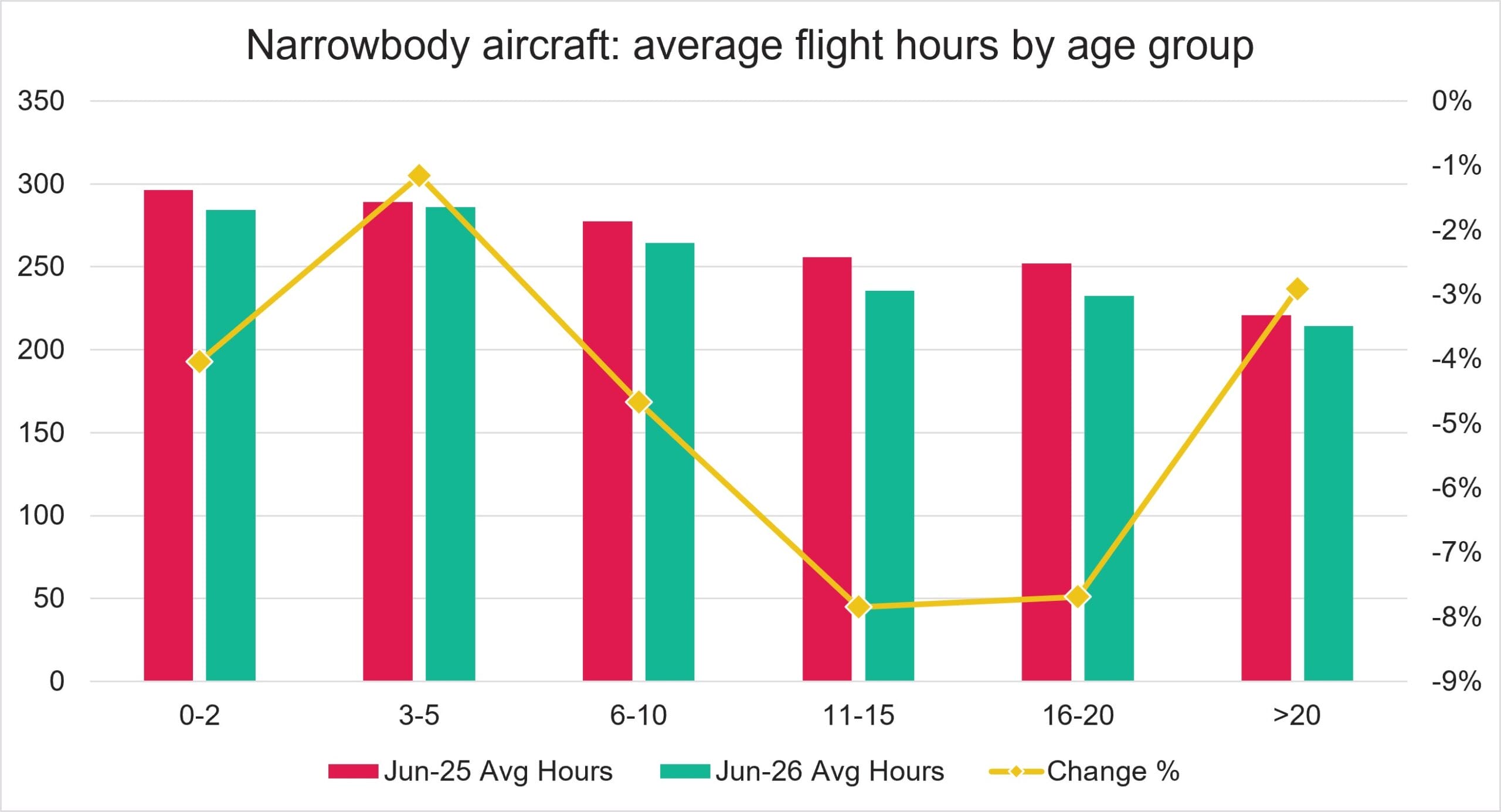
Fleet renewal is not only visible between aircraft generations, but also across aircraft age groups. The data shows that aircraft utilization declined across all age groups, but the decline was not equal. The steepest reductions occurred among mid-life aircraft, suggesting airlines are becoming increasingly selective in strategic fleet allocations.
Source: Cirium Fleets Analyzer; Airbus and Boeing passenger aircraft only
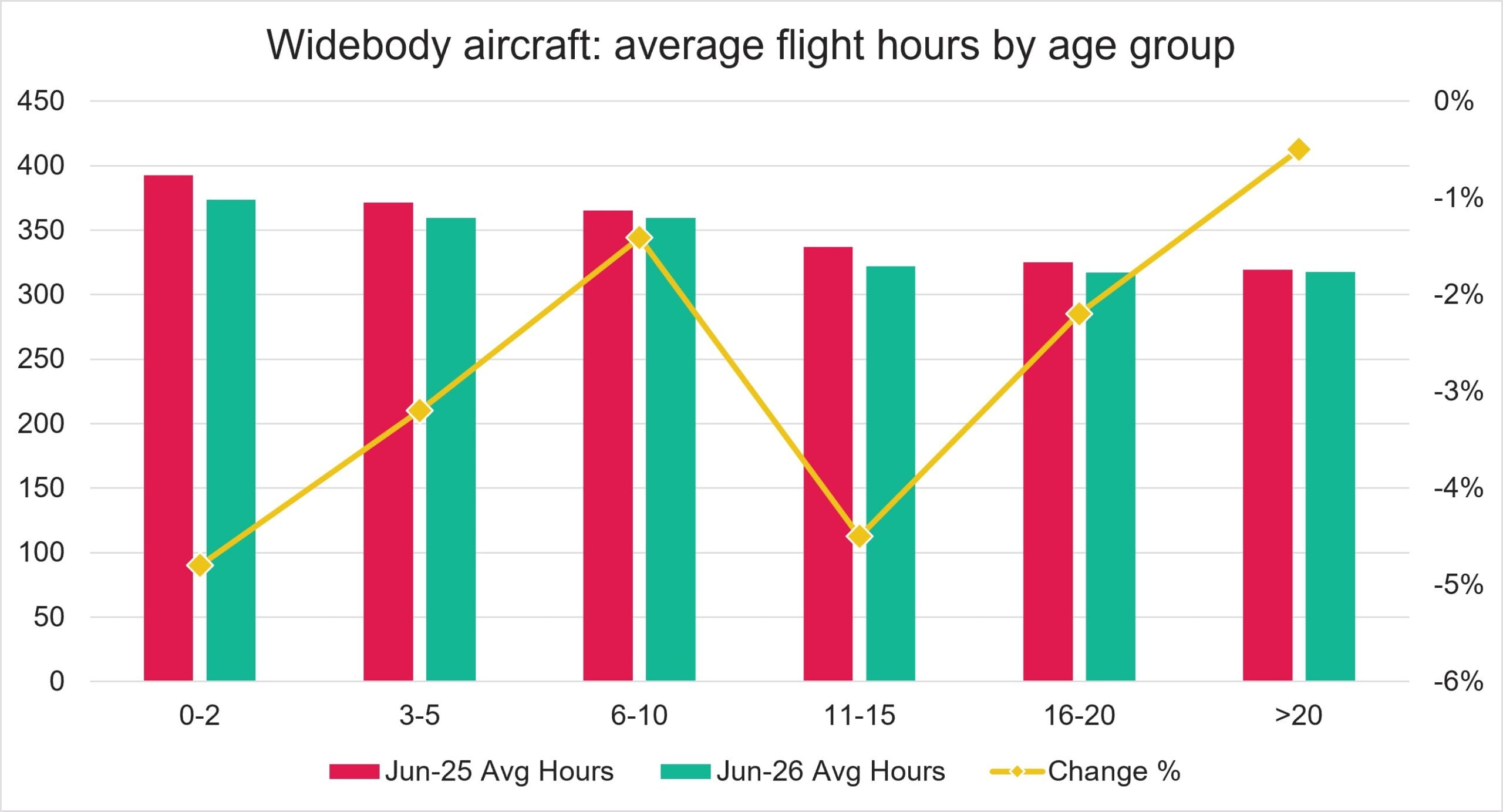
The above chart indicates that narrowbodies aged 11-20 years recorded the sharpest decrease in average flight hours, at 7.8% respectively, compared with 1.2% for fleet aged 3-5 years. By comparison, widebodies showed a more gradual utilization profile across age groups, indicating that mid-life aircraft remain better integrated into airline networks. Nevertheless, 11-15-year-old aircraft experienced a decline in utilization with 4.5%, whereas aircraft aged over 20 years recorded the smallest reduction, declining by just 0.5%, see the chart below.
Source: Cirium Fleets Analyzer; Airbus and Boeing passenger aircraft only
The 11-20-year range appears to be in the industry’s “squeeze zone” which reflects a period where operators increasingly shift flying activity to new-generation aircraft while preparing mid-life fleets for replacement, lease returns, or retirement. Additionally, these aircraft often face heavy maintenance checks, which can further limit utilization. Cirium data challenges the conventional assumption that aircraft become less relevant simply as they age. The utilization profile increasingly resembles a barbell structure, with airlines concentrating flying activity at opposite ends of the aircraft age spectrum. New-generation aircraft continue to attract a growing share of flying activity, but the oldest aircraft demonstrated the greatest utilization resilience.
The survivor effect: older aircraft still earning their keep
Fleet renewal is not eliminating older aircraft uniformly. Instead, a select group of prior generation aircraft types continues to thrive in targeted market segments where economics, performance, or lack of direct replacements support their longevity. In the table shown below, several aircraft over 20 years old recorded utilization growth between June 2025 and June 2026, led by 737-500 (+16%), 757-200 (+12%), A330-200 (+9%), and 757-300 (+8%).
Utilization of passenger aircraft older than 20 years
| Aircraft Type | Average Flight Hours Jun-25 | Average Flight Hours Jun-26 | Change % |
|---|---|---|---|
| 737-500 | 115 | 134 | 16% |
| 757-200 | 237 | 265 | 12% |
| A330-200 | 283 | 308 | 9% |
| 757-300 | 235 | 254 | 8% |
| 777-300ER | 222 | 237 | 7% |
| 747-400 | 229 | 231 | 1% |
| 767-400 | 361 | 362 | 0% |
| 737-900 | 188 | 188 | 0% |
| A321 | 237 | 235 | -1% |
| 777-200 | 364 | 360 | -1% |
Source: Cirium Fleets Analyzer; Airbus and Boeing passenger aircraft only
Aircraft that remain in service beyond 20 years are increasingly the best-maintained and most economically viable examples of their type. With average utilization of 234 flight hours which is already significantly below that of the youngest fleets (296 flight hours), these aircraft have reached a stable operating floor, supporting charter, leisure, regional, and specialist missions where replacement economics are less compelling.
This proves that airlines are not reducing flying activity evenly across their fleets. Instead, utilization trends reveal a clear fleet-renewal story: new-generation aircraft are capturing a growing share of flying activity, while mid-life fleets are increasingly squeezed as carriers transition toward more efficient aircraft. Meanwhile, the oldest aircraft continue to demonstrate strong resilience in specialised operational roles.