



























Michael Gubisch, Aerospace Editor, Cirium
Emirates recently reached a landmark in the progress of a multi-year fleet retrofit programme, disclosing its refurbishment of the first of 15 Airbus A380s previously configured with a two-class cabin layout.
The UAE carrier said that by the end of May it had completed 45 A380s and 53 Boeing 777s, a tally representing more than a third of its in-service fleet. The retrofit programme combines the roll-out of premium-economy seats with a broader cabin overhaul across 110 A380s and 109 777s.
Cirium Ground Events data tracks programme cadence and shows Emirates accelerating 777 refurbishments since 2024. This level of visibility enables airlines and MROs to track retrofit timelines at the aircraft level and plan maintenance capacity with greater precision. A380 upgrades, meanwhile, slowed down after an initial wave in 2023.
The first A380 upgraded as part of the programme was inducted to Emirates’ maintenance facility at Dubai International airport in October 2022, and completed in January 2023, after 65 days in the hangar. It was the first of 19 A380s completed in the course of 2023.
Refurbishment of Emirates’ 777s did not begin until June 2024. The initial aircraft returned to service in August, after 37 days in the hangar. It was the first of 12 777 completions in 2024, followed by 30 in 2025 and 11 so far this year.
Cirium data as of 18 June shows retrofit completions of 45 A380s and 53 777s since 2022 (excluding 17 aircraft with high-density cabins from which Emirates removed a row of business-class seats – without making other interior changes – as these are not part of the retrofit programme). The A380 figure has since reached 48, says Emirates.
The 53 fully retrofitted 777s indicate that the twinjet’s upgrade effort has overtaken the A380’s as a result of a shorter per-aircraft completion time for the twinjets, despite the later start of their retrofitting activity. This shift has implications for maintenance demand, hangar capacity utilisation, and parts planning across the aftermarket.
The number of A380 completions declined from 19 in 2023 to eight in 2024. There were 11 in 2025, and so far this year Emirates has refurbished 10 A380s, in addition to the 11 777s.
A year-on-year slowdown in 777 refurbishments – Emirates had completed 18 in 2025’s first half – may be linked to disruption from the Middle East conflict.
But retrofits of 777s are still progressing faster than those of A380s, suggesting the 777 programme may be prioritised by the airline.
Emirates tells Cirium that the retrofit programme is “proceeding as per our established plans”, adding: “Any slight variation in the schedule and roll-out of aircraft from the programme is dependent on aircraft availability which is in turn subject to operational requirements.”
Turnaround time
Aircraft refurbishments are taking longer than originally projected. At the launch of the programme in 2022, Emirates projected that each A380 refurbishment would take 16 days, and expected to complete the retrofit programme – initially spanning 67 A380s and 53 777s – by April 2025.
In 2024, the carrier expanded the programme to span 110 A380s and 109 777s, without disclosing a new timeline.
During the initial wave of A380 refurbishments in 2023, aircraft turnaround time ranged between 23 days for a pure retrofit and 58 days for a combined heavy check and retrofit event. Excluding the 65-day retrofit of the initial A380 (A6-EVM), the average duration on the ground was 36 days across 18 A380s.
For the eight A380 refurbishments in 2024, average duration widened to 60 days. Hangar visits ranged from 46 to 96 days. It is worth noting that half of the aircraft underwent airframe checks as part of the upgrade.
In 2025, average turnaround time was 52 days, and hangar visits ranged between 22 and 80 days. The data shows that two aircraft underwent airframe checks as part of the downtime, while the other eight received new interiors only.
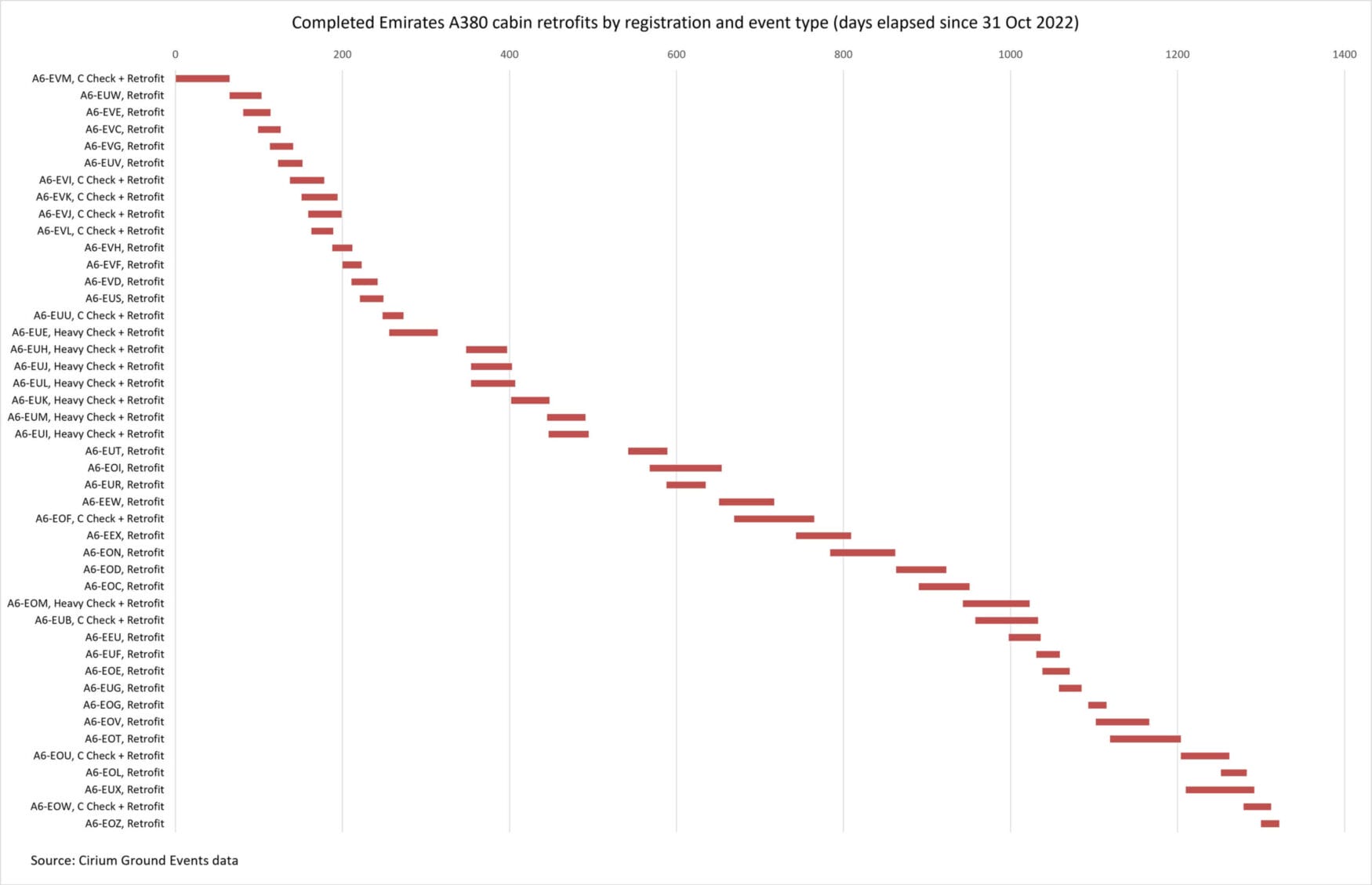
The chart indicates that during the initial wave of A380 refurbishment in 2023, Emirates upgraded up to four A380s in parallel. But as turnaround times became longer, the airline staggered upgrade events, such that only two aircraft upgrades would typically overlap. This reflects the operational trade-offs operators face between downtime, capacity availability, and maintenance throughput.
For the 777, average retrofit duration was 27 days across 12 aircraft in 2024 and 21 days across 30 aircraft in 2025. The airline managed to reduce the single longest downtime to 32 days in 2025, from 37 the previous year. Most of the events across 2024-25 were retrofit events without scheduled airframe maintenance.
Across the 11 777s Emirates had upgraded so far this year at 18 June, turnaround time averaged 22 days, while the seven A380s were in the hangar for an average of 54 days.
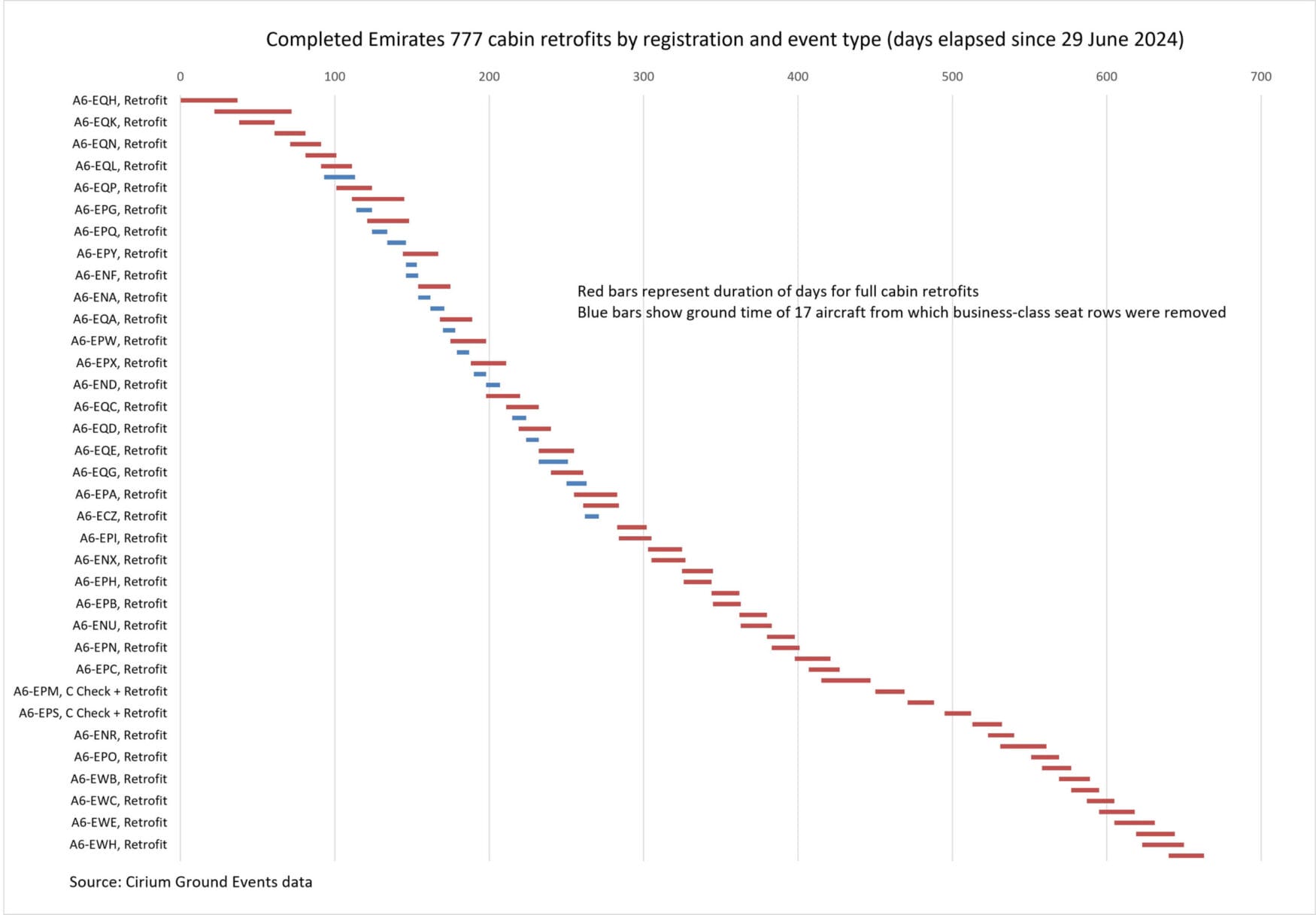
Last year’s 777 retrofit count suggests Emirates may require at least another year to upgrade the remainder of its 777 fleet. For MROs and suppliers, this points to sustained retrofit demand and longer planning horizons for resource allocation. Completion of its A380 fleet, meanwhile, looks likely to take much longer.
But there seems to be no alternative to the refurbishment programme, given the delivery delays for new aircraft and the lack of any like-for-like A380 replacement. The 777 and A380 will remain the backbone of Emirates’ fleet for years to come, as 777-9 deliveries to the airline will not begin until 2027 – seven years after Boeing’s original service-entry target for the new aircraft.
Emirates became a launch customer of the 777X programme in 2013 when it signed for an initial batch of 150 aircraft and took options on another 50. The airline now has 235 777-9s and 35 777-8s on order, with deliveries scheduled through 2040, Cirium data shows.
The 777-9s will likely be used to replace 777-300ERs and A380s, given that the new aircraft is the largest next-generation long-haul jet available to order. But it will provide less capacity than an A380.
Seat capacity
Boeing’s website indicates the 777-9 will have capacity for 426 passengers in a two-class layout. As Emirates is configuring its aircraft with first, business, premium economy and standard coach seats, and has a history of setting new cabin standards – including with onboard showers and lounge areas – its 777-9s will likely be equipped with fewer seats.
Its upgraded A380s are flying with configurations ranging from 484 to 569 seats. A380s still flying with a pre-refurbishment two-class configuration have capacity for 615 passengers. The airline may be able to plug the capacity gap with higher frequencies, but this could be a challenge at slot-restricted airports.
Emirates had 270 passenger jets in its fleet at 1 August: 117 777-300ERs, 10 777-200LRs, 116 A380s and 27 A350-900s. In addition to the 270 777X jets, it has 46 A350-900s on order, as well as 15 787-8s and 15 787-10s.
The carrier also has 17 777 Freighters, one 777-300ER converted freighter, four sub-leased 747Fs and one ACJ319 corporate jet. Its total fleet spans 293 aircraft.
Emirates’ upgraded 777-300ERs are configured with 328 or 332 seats across four classes. 777-300ERs still operating with previous-generation cabins have 354 or 360 seats in three-class layouts, and 421 seats in a two-class configuration.
The airline may be able to replace some of its 777s on thin routes with A350s and, in future, 787s. Emirates introduced A350-900s to its fleet in 2025, as its first new type since the A380 joined its fleet in 2008. However, Emirates opted for a cabin layout without first class on its in-service A350s. The aircraft are configured with 298-312 seats across business, premium-economy and standard coach. Emirates has not disclosed cabin details for its on-order Dreamliner fleet.
The 777-300ER and A380 have made Emirates the airline it is today, and it is by far the largest operator for each type – but keeping them up to date ahead of replacement remains operationally complex, as Cirium data illustrates, reinforcing the need for independent, aircraft-level intelligence to plan upgrades, manage capacity, and reduce disruption.