

























Engine shop visits drive major decisions around capacity, assets and investments. However, forecasting when that shop visit demand will materialize is complex, often relying heavily on assumptions.
Fleet evolution, aircraft utilization, stage length, operating conditions and maintenance intervals can all influence when engines require performance restoration. Rely too heavily on fleet-wide averages, and important differences in the way individual aircraft are operated can be lost – with significant operational and financial consequences.
Cirium understands a defensible view of future engine demand needs to be based on the individual aircraft. That’s why we’ve built an independent, evidence-led view of the market for commercial, operational and finance teams to work from the same forecast rather than competing assumptions.
A new way to understand engine maintenance demand
The Cirium Engine Shop Visit Forecast (ESVF) provides a 10-year outlook of the Performance Restoration Shop Visits required by the global commercial fleet, replacing assumptions with an independent view of future engine maintenance demand.
When an engine may need to visit the shop is only part of the picture. MRO providers, airlines, lessors, OEMs and investors also need to understand the scale, location and potential value of that demand.
By bringing together fleet, utilization and maintenance data with Cirium’s forecasting methodology and specialist engine expertise, the ESVF provides a more defensible view of how many shop visits will be required, where and when demand will occur, and what that demand is worth.

Make decisions you can defend based on future engine shop visit demand
- See demand earlier: Get 10-year visibility by engine series, country and region, with named operators in the near term.
- Size the opportunity: Understand both the number of required Performance Restoration Shop Visits and their estimated annual value.
- Reduce planning uncertainty: Gain an independent view that reflects real-world operating conditions rather than assumptions.
- Save months of modelling effort: Fleet, utilization and maintenance data are brought together, replacing months of data assembly, reconciliation and model maintenance with ready-to-use insights.
What sets the Engine Shop Visit Forecast apart?
The ESVF is built from individual aircraft, not fleet-wide averages, bringing fleet, utilization and maintenance interval data together.
We model the fleet aircraft-by-aircraft, using observed utilization and maintenance intervals derived from Cirium’s engine appraisal work, with the forecast reviewed by engine specialists.
The result is fewer assumptions between the underlying fleet and the decisions made from it.
How it works
The Forecast projects the engine Performance Restoration Shop Visits required by the global commercial fleet over the next 10 years to support forecast fleet utilization.
- Aircraft-level modelling: Every aircraft is modelled using its tracked hours, cycles and average stage length, rather than a fleet-wide average.
- Calibrated maintenance intervals: Time-on-wing curves are calibrated against real market datapoints gathered through Cirium Ascend Consultancy’s work with operators, lessors and MROs.
- Operating conditions accounted for: The model reflects operating environment and stage length, with deliveries and retirements modelled over time.
- Specialist review: every release is reviewed by our engine experts, back-tested against real market datapoints and known shop-visit volumes.
What’s included
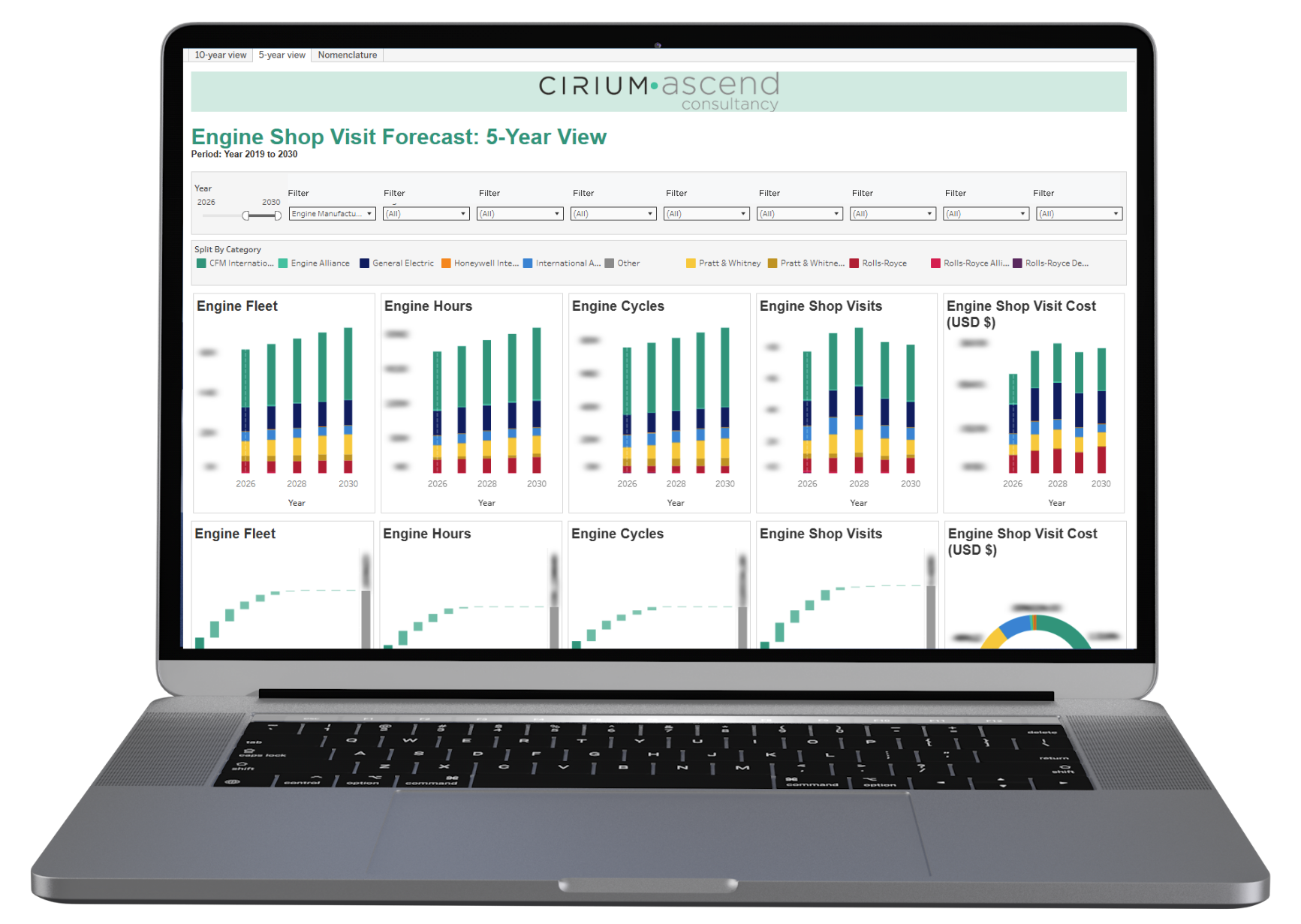
- Interactive dashboard
Filter and slice the forecast by engine series, country, region, operator and year to investigate different programs and markets. - Full underlying data
Every underlying figure, every year, every series, available in a full file export for use in your own models. - Expert interpretation
Access the context and analysis developed by our team of consultants with decades of experience.
Make engine decisions with greater confidence
Discover how Engine Shop Visit Forecast enables your team to spend less time building the number, and more time making decisions from a view you can defend.