






























Team Perspective
Sabrina Ng, Senior Valuations Analyst, Cirium Ascend Consultancy
India is widely expected to be one of the world’s fastest-growing aviation markets. Strong demographic fundamentals and relatively low levels of air travel penetration continue to support a favourable long-term outlook. The 2025 Cirium Fleet Forecast projected that India’s ASK would grow at around 10% per annum in the next 10 years. Near-term data, however, suggests that the long-term growth may be less linear than previously expected, as airlines work through a combination of operational, financial and geopolitical challenges.
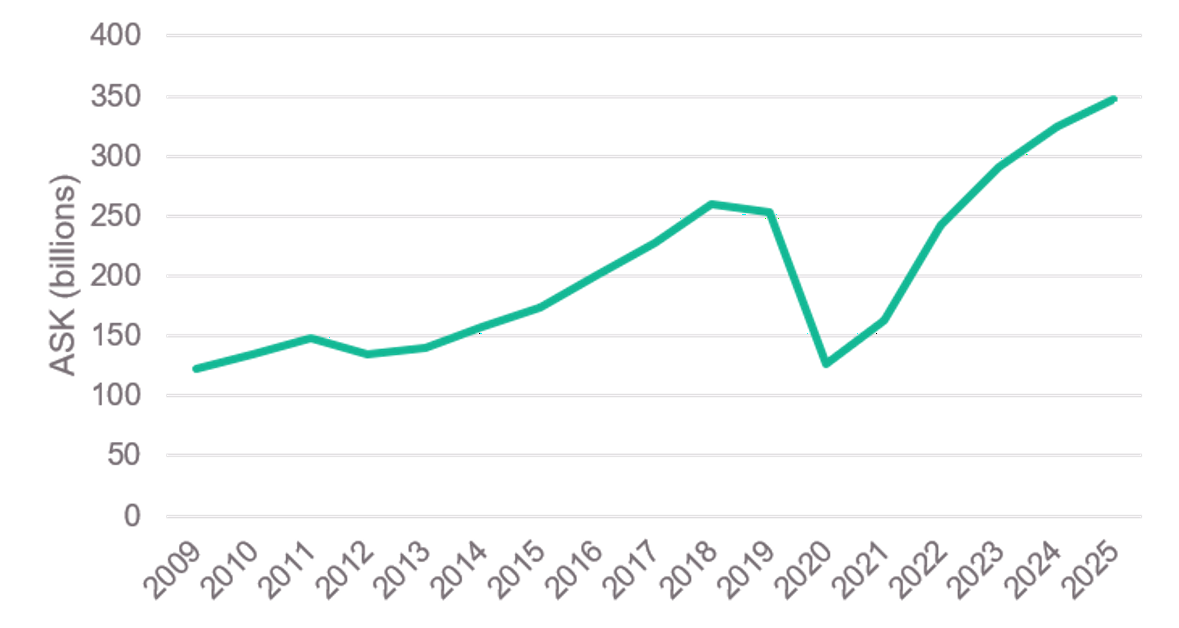
Cirium Tracked Utilisation data suggests that there has been a considerable slowdown in growth since 2024, after compound growth of 10% per annum from 2009 to 2019, and a rapid post-Covid recovery. After growing by a modest 5.8% in 2025, ASK capacity from India moved into contraction, declining by 1.6% in H1 2026. At the airline level, IndiGo’s ASK growth slowed from 13.8% in 2025 to 3.3% YoY in H1 2026, while Air India Group experienced a more pronounced reversal, with its ASK swinging from 30.3% growth to a 16.2% contraction over the same period.
Chart 1: Indian airlines ASKs, 2009–2025
Source: Cirium core, Tracked Utilisation data filed on 22-July-2026 and DGCA traffic data
Multiple factors are converging at once which drives the contraction. Persistent Pratt & Whitney GTF groundings continue to constrain IndiGo’s narrowbody utilisation, while widebody delivery delays and the phased integration of Vistara have limited how quickly Air India can expand its market share. Layered on top are tighter DGCA flight-duty rules that have raised crew requirements, elevated fuel prices, and extended routings following the closure of Iranian and Pakistani airspace amid the Iran conflict. The June 2025 Boeing 787 accident has added a further operational drag on Air India specifically, and newer entrants such as Akasa Air is also intensifying the market competition.
Unlike several emerging aviation markets where state support can absorb periods of weak profitability, Indian airlines remain largely exposed to commercial market forces, and these operational disruptions have quickly translated into financial pressures. IndiGo posted a net loss of around US$250 million in FY2026 ending 31 March 2026, despite remaining operationally profitable when excluding the impact of sharp rupee depreciation. Akasa Air has yet to turn an annual profit, while Air India Group reported a loss of approximately US$2.8 billion for the same period. The Tata Group has since shifted Air India’s focus to prioritise loss reduction over expansion, with plans to defer aircraft deliveries, cut flights and delay network growth. The airline is reportedly in discussion with Airbus and Boeing to slow the delivery of up to 500 aircraft on order.
Against this backdrop, effective yield management has become increasingly important as the airlines seek to preserve or improve profitability. According to Cirium data, revenue per RPK for Indian airlines on long-haul routes, particularly to North America, have failed to keep pace with rising operating costs and longer flight routings, and maintained at similar level compared to 2024 and 2025. By contrast, domestic yields have proven more resilient, rising by around one-third since 2024 despite intensifying competition.
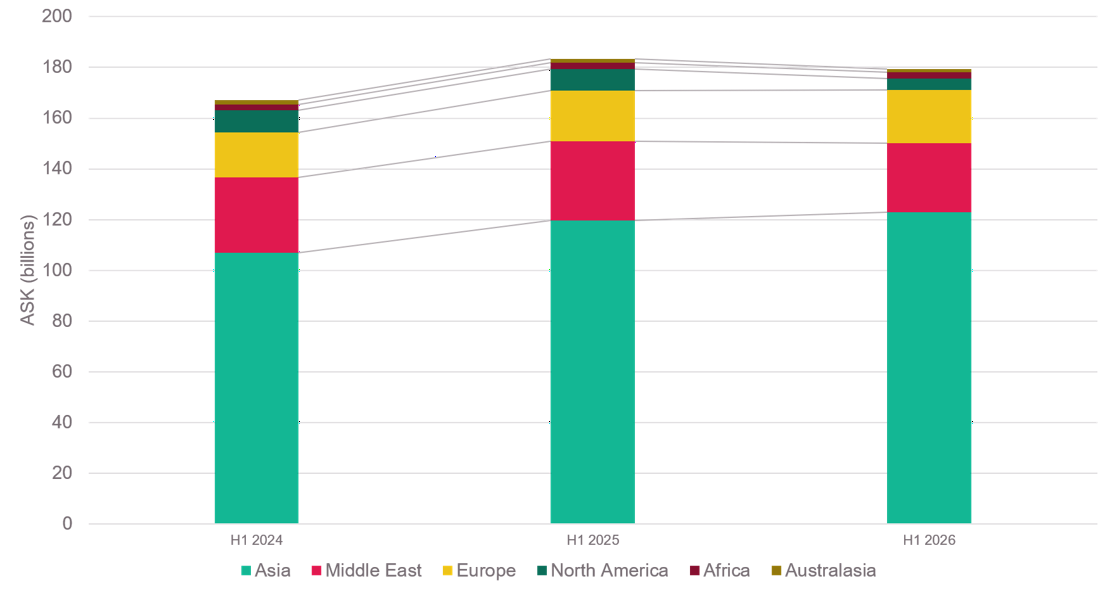
Consequently, Indian carriers are realigning their networks toward routes that optimise utilisation and margins, particularly for Air India given its widebody exposure. According to Cirium’s Tracked Utilisation and Schedule data, India’s capacity to North America has contracted sharply through H1 2026, and is set to decline further in Q3 2026, as extended routings and elevated fuel costs have undermined the economics of many non-stop services. Air India has accounted for much of this reduction.
Chart 2: India-origin ASK distribution by destination region, in H1 2024-2026
Source: Cirium core, Schedule data filed on 05-Jul-2026
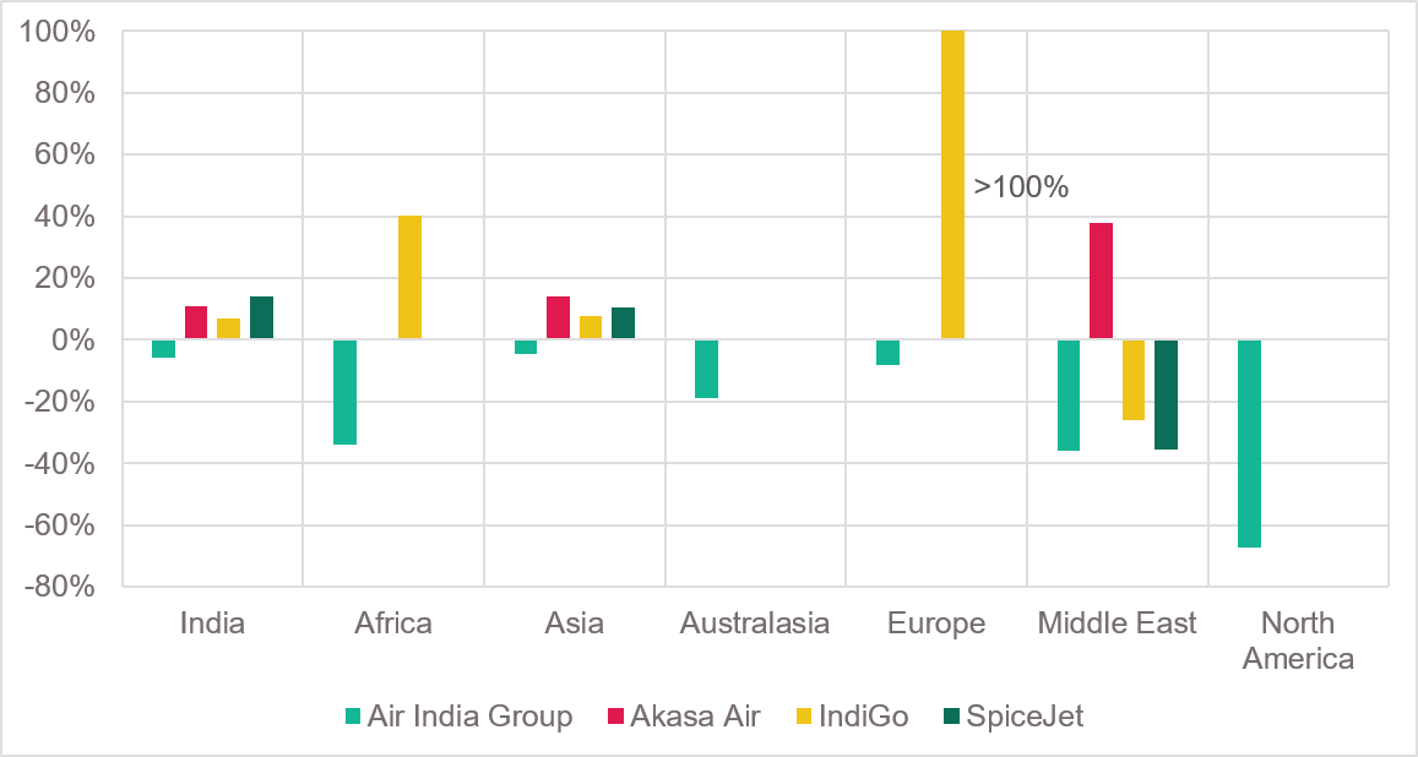
Europe, by contrast, has strengthened its position as India’s key long-haul market and is expected to continue growing in Q3 2026. Indian carriers retain a routing advantage through access to Russian airspace, while European hubs are increasingly serving as gateways to North America. Although elevated operating costs have also prompted IndiGo to return one of its damp-leased 787-9s following the suspension of Manchester and Copenhagen services, Air India has on the other hand redeployed a significant portion of its A350-900 capacity from the reduced North American operation to Europe.
Short-haul international markets have proven more resilient. While capacity to the Middle East was reduced during the Iran conflict, demand from labour, VFR and religious traffic is supporting a recovery. Akasa Air gained share during the disruption, and overall capacity growth is also expected to resume across the market in Q3. Africa has also emerged as a bright spot on the back of strengthening trade and diaspora links. Alongside IndiGo’s increased deployment to the region in H1 2026, Air India is shifting its A320neo capacity from the Middle East competition to Africa.
Domestically, capacity has largely been maintained in line with resilient demand and yields. Notably, Akasa Air and SpiceJet are gaining market share at the expense of Air India, by leveraging the lower operating costs and greater flexibility of narrowbody aircraft on domestic routes.
Chart 3: Percentage change in ASK by destination region of major Indian airlines (H1 2025 vs. H1 2026)
Source: Cirium core, Schedule data filed on 20-Jul-2026
India’s aviation market is undergoing a period of recalibration as illustrated above. While growth has moderated and airlines are reassessing fleet and network expansion plans in favour of stronger financial performance, the longer-term outlook remains compelling. Equally important, the framework supporting future fleet growth is evolving rapidly. New aircraft financing channels, including GIFT City and JOLCOs, alongside Cape Town reforms, are strengthening the market’s ability to fund the next phase of expansion. These developments will be discussed in Part Two.
Read Part Two on how the rapid evolution of the financial and institutional framework supporting fleet growth in the Indian aviation market.