





























Sara Dhariwal, Senior Aviation Analyst, Lead Appraiser – Helicopters & AAM, Cirium Ascend Consultancy
In contrast to the commercial airline sector’s cyclical nature, the civil helicopter market has continued to deliver resilience and stability over the past decade. The fleet shows growth despite the prolonged oil and gas downturn, the Covid-19 pandemic, ongoing instability in the geopolitical climate and persistent supply chain challenges. The market’s defining characteristic been consistent resilience, a trait that is likely to shape its trajectory over the next ten years.
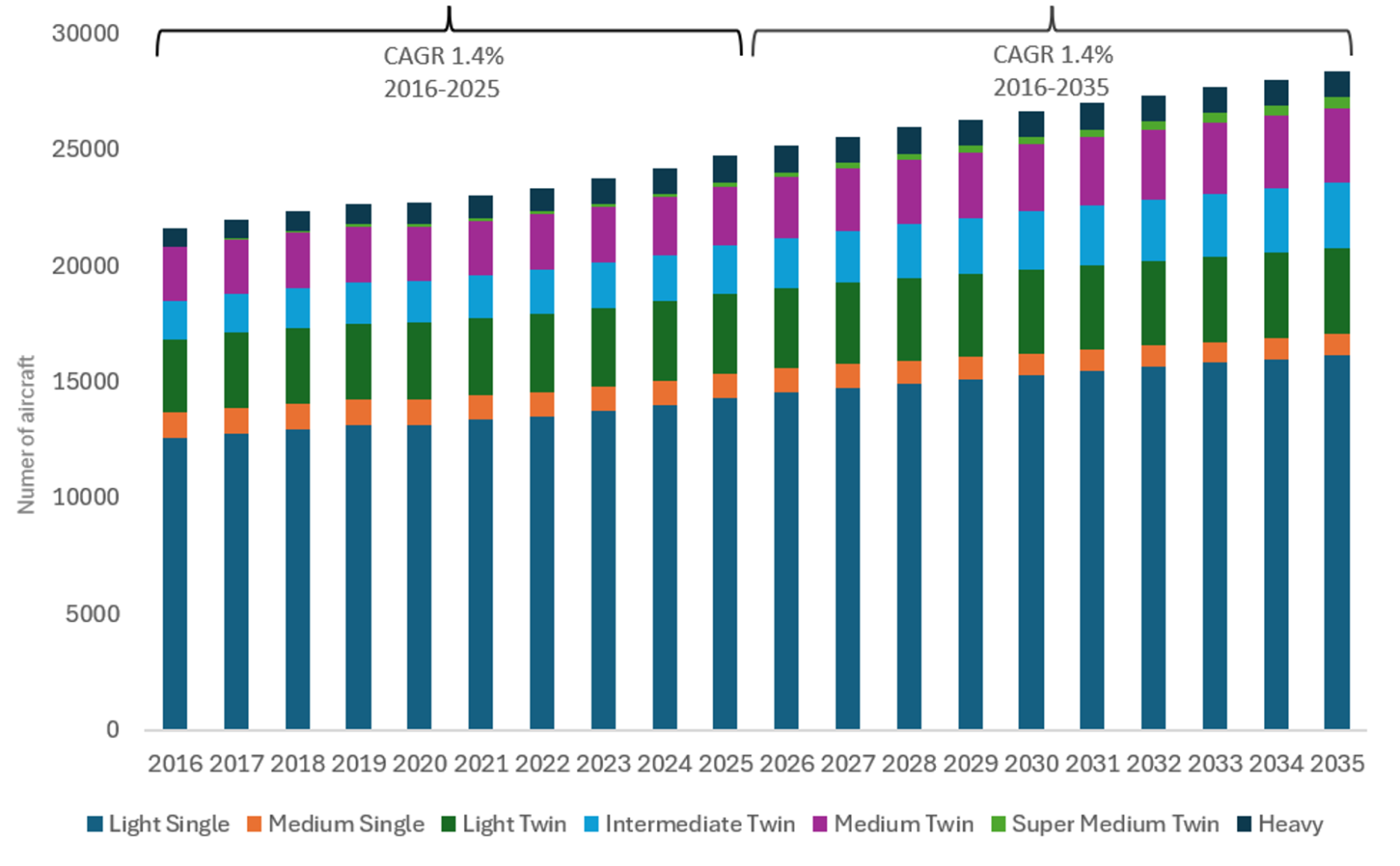
The fleet has grown from roughly 21,600 aircraft in 2016 to 24,700 at the end of 2025, a CAGR of around 1.4%, and it grew in every one of those years, including 2020. In 2025 it added almost 540 aircraft, or 2.2%, the strongest rate of the decade.
Cirium Ascend Consultancy forecasts around 7,640 new civil turbine helicopter deliveries worth some $56 billion over 2026–2035. Similar to the 2025 forecast, 53% of deliveries are predicted to be for replacement and 47% for growth. Consequently, the global fleet is projected to expand at around 1.4% annually, consistent with the trend observed over the previous decade.
Chart 1: Fleet evolution 2016-2035
Source: Cirium Helicopter Forecast 2026
One of the helicopter market’s key strengths is the longevity of the assets. Around 90% of helicopters delivered over the past 30 years remain in existence, and the average in-service aircraft is now 33.5 years old with the oldest still flying over 60. That longevity underpins the strong residual-value retention that makes helicopters attractive to financiers.
On the other hand, this longevity also reduces replacement pressure, as operators can often defer replacement for extended periods by extending service lives through overhaul and upgrades, rather than buying new. The result is a large pool of older aircraft that is ripe, but not required, for replacement. The past 10 years have recorded continuously low retirement rates at around 1% of the fleet each year. Cirium forecast the rate to continue at a modest 1.6% year on year with a replacement demand for some 4,010 helicopters. The expectation is that annual retirements will climb towards 500 by 2035.
Overall, the next decade is expected to be driven by fleet renewal. A focus of the OEM’s will be to convert an ageing installed base into replacement orders, supported by new-generation products such as the H160, H140, AW09, R88 and Bell 525. Equally important will be the availability of financing solutions, with lessors likely to play an increasingly significant role in supporting fleet modernisation and fleet growth.
Operating leasing has become an increasingly important source of financing within the helicopter sector. The leased fleet now approaches 1,000 aircraft, representing around 4% of the global fleet. SMFL’s acquisition of Macquarie Rotorcraft and LCI in 2025, resulting in approximately 60% of the leased fleet being controlled by two major lessors reflects the growing maturity of the leasing sector and the availability of substantial capital.
In terms of deliveries, the focus will continue to be on Light Single-engine types which are forecast to take 53% of deliveries, sustained by sub-$2 million machines such as the Bell 505 and Robinson R66 and the workhorse H125. But volume and value tell different stories.
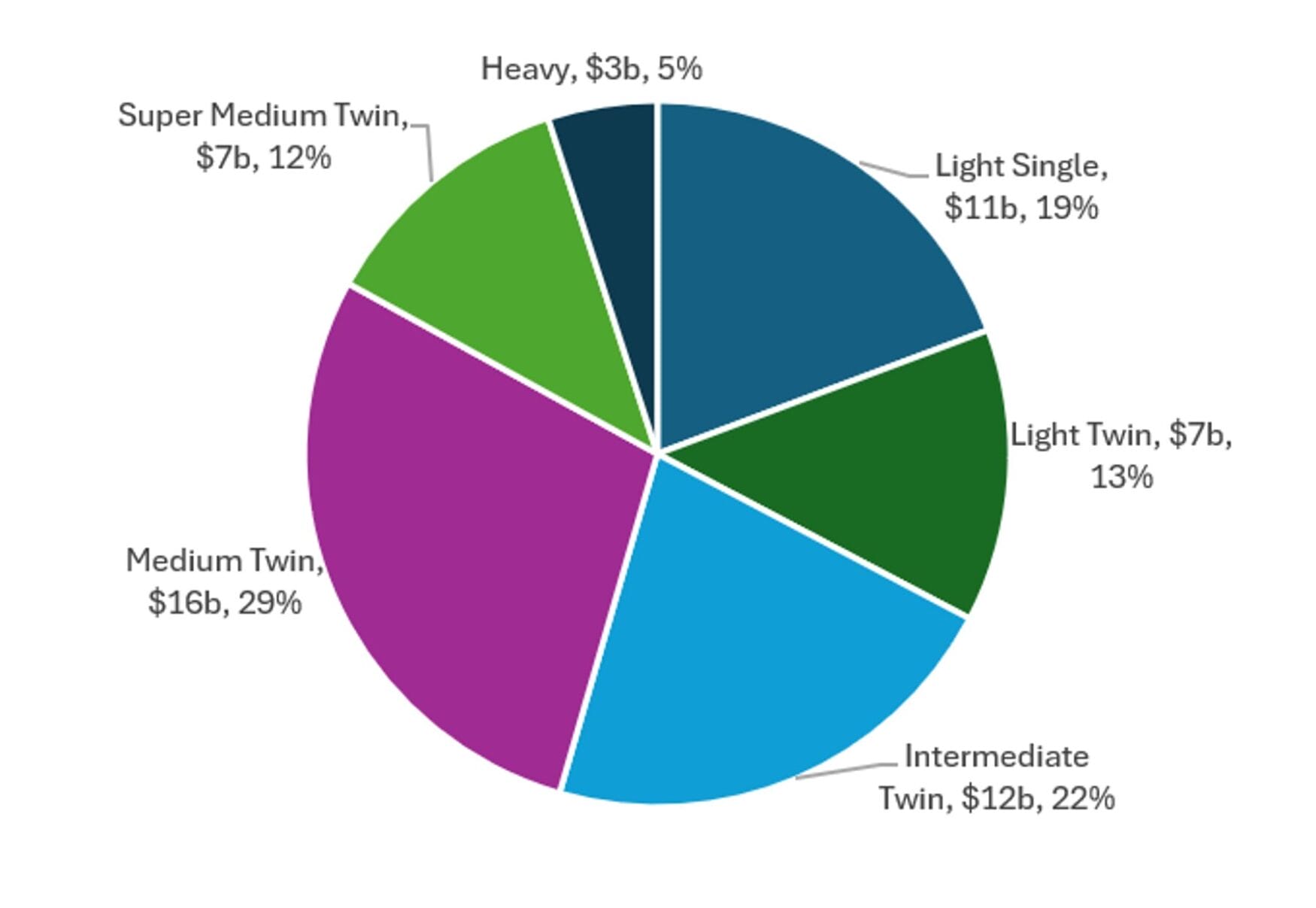
Chart 2: Delivery value by segment
Source: Cirium Helicopter Forecast 2026
Medium Twins is expected to take just 14% of deliveries by volume but almost 30% by value — around $16 billion — led by the AW139 and the Airbus H160. By manufacturer, Airbus is forecast to lead with 47% of delivery value, ahead of Leonardo at 29% and Bell at 16%.
Advanced Air Mobility (AAM) also remains an area to monitor. While around 15,000 provisional eVTOL orders have been announced and certification progress has been achieved in several programmes, the sector continues to face development and certification challenges.
Indeed, the pattern of repeated certification delays looks strikingly familiar to anyone who has watched a conventional helicopter programme mature. Cirium’s view is that any meaningful impact on helicopter demand is unlikely before the 2030s, concentrated in selected air-taxi and light-utility niches.
The helicopter market’s defining characteristic over the past decade has been resilience, and there is little in the current outlook to suggest that will change. The coming years are expected to be characterised by steady, replacement-led demand rather than transformational growth, with success hinging on the industry’s ability to translate a large and ageing installed base into fleet renewal. For OEMs, financiers and lessors alike, the opportunity lies not in creating demand, but in unlocking it.