































Team Perspective
Sabrina Ng, Senior Valuations Analyst, Cirium Ascend Consultancy
In Part One, we explored how operational constraints, financial pressures and shifting market economics have prompted Indian airlines to recalibrate growth plans and reallocate capacity toward more profitable opportunities. Yet the recent slowdown tells only part of the story, and India’s long-term aviation outlook remains robust. The reason lies not only in demand fundamentals, but also in the rapid evolution of the financial and institutional framework supporting fleet growth.
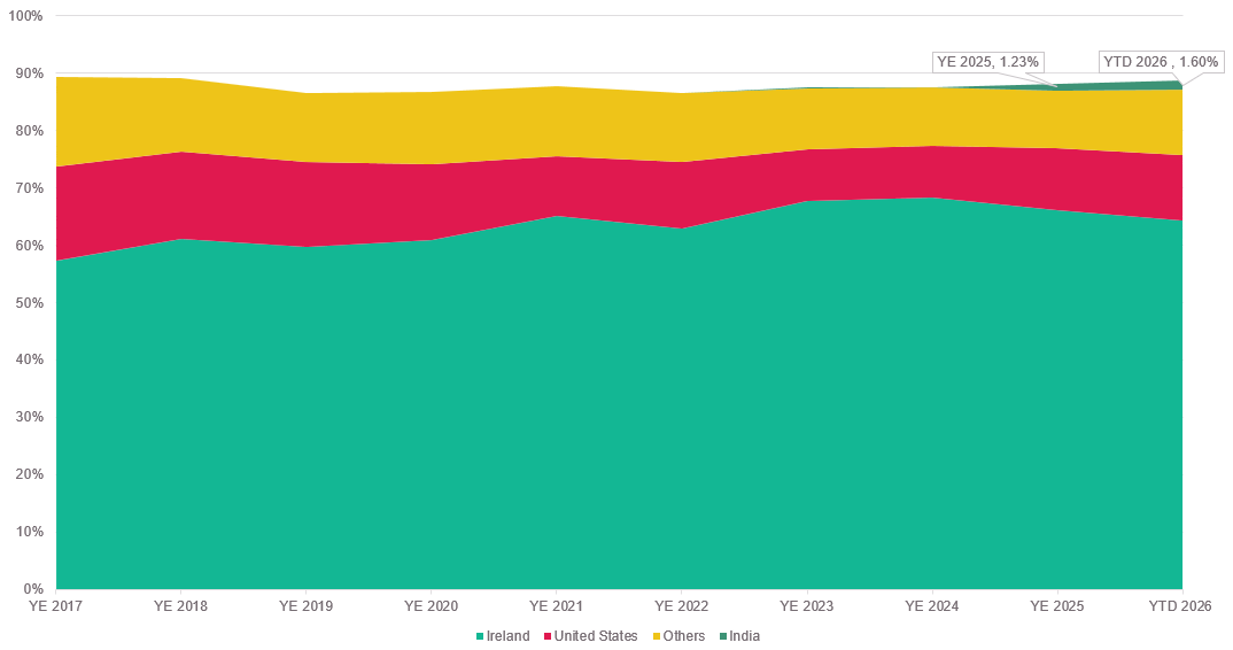
GIFT City, home to India’s International Financial Services Centre (IFSC) and regulated by IFSCA, has emerged as an increasingly credible hub for aircraft leasing and financing. The development is particularly significant given that more than 85% of India’s commercial fleet is operated under lease, with the majority historically financed and owned through offshore leasing centres such as Ireland.
Recent reforms have expanded GIFT City’s role beyond tax incentives, introducing a 20-year tax holiday, removing tax deduction at source (TDS) on qualifying lease rentals, and establishing dedicated frameworks for leasing SPVs, trustee services and corporate administration. Together, these reforms aim to provide lessors and financiers with greater tax certainty, improved cash-flow efficiency and internationally recognised financing structures that enhance creditor confidence. At the 2nd India Aircraft Leasing and Financing Summit in May 2026, it was reported that over 370 aviation assets worth approximately USD 5.8 billion had been leased through the IFSC framework, supported by more than 30 registered lessors. Indian carriers are increasingly sourcing leasing and financing capacity through GIFT City, including transactions involving SMBC Group and Standard Chartered, while institutions such as Natixis have established a local presence to participate in the market.
Chart 1: Commercial aircraft operated by Indian airlines under lease, by lease owner jurisdiction
Source: Cirium core, Fleets Analyzer, data filed on 24-Jul-2026
Concurrently, India has narrowed the jurisdictional risk premium by putting the Cape Town Convention onto a statutory footing. The Protection of Interests in Aircraft Objects (PIAO) Act and its corresponding 2026 Rules explicitly override previous conflicts with the Insolvency and Bankruptcy Code (IBC) moratorium. By enforcing the Convention’s Alternative A remedy, including its two-month waiting period and mandated Irrevocable De-registration and Export Request Authorisation (IDERA) processing, these reforms have consolidated the Aviation Working Group’s earlier compliance upgrade and materially strengthened lessors’ confidence in their asset repossession rights. While the new framework has not yet been tested through a major airline insolvency, its significance lies in providing clear statutory support for Cape Town remedies and IDERA enforcement, addressing many of the legal uncertainties exposed by the Go First collapse.
The combined framework is best illustrated by IndiGo’s landmark Japanese Operating Lease with Call Option (JOLCO) transaction covering two Airbus A320neo aircraft, arranged by SMFL on the equity side and SMBC on the debt side. As the first JOLCO ever closed through GIFT City, the deal demonstrates that foreign financiers, including traditionally risk-averse Japanese investors, are beginning to view the Indian regulatory and tax architecture as a credible framework for cross-border aircraft financing. Over time, the legal certainty provided by the PIAO Rules should compress the Indian lessor risk premium, translating into more competitive lease rentals for Indian carriers and gradually repositioning Indian aviation assets as a more investable credit.
2026 is best understood as a period of recalibration for the Indian aviation market. Near-term data justifies more measured growth assumptions for the remainder of FY2026 and into FY2027. However, the structural drivers underpinning the sector, namely a deep passenger base, unparalleled orderbooks and an increasingly enforceable creditor framework, remain intact. Taken together, these developments suggest that Indian aviation is entering a more mature phase of development. Growth may be slower than recent expectations, but it is increasingly supported by a stronger financing ecosystem, more predictable creditor protections and a broader pool of capital. The next chapter will be defined by how these foundations are tested, adopted and ultimately validated by market participants.