





























Guillermo Ochovo, Head of Market Analysis, Cirium Ascend Consultancy
The Federal Aviation Administration’s decision to allow Boeing to certificate up to 35 additional 777Fs after the end of 2027 gives cargo operators greater flexibility as they await the next generation of large widebody freighters. The exemption covers first airworthiness certificates issued from 1 January 2028 through 1 January 2031, helping bridge the gap to the 777-8F’s anticipated entry into service in 2029.
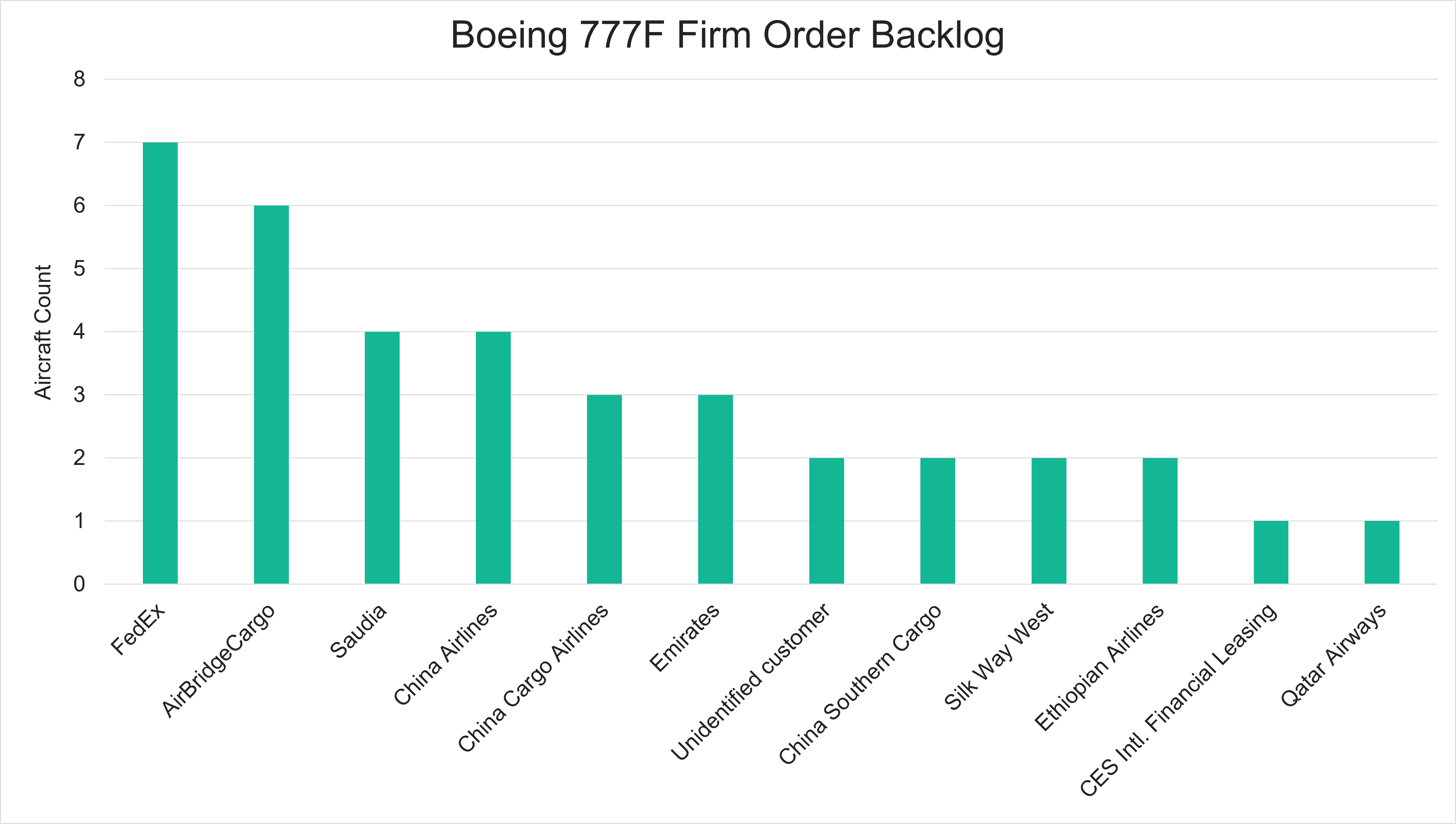
Cirium Fleets Analyzer shows that the 777F firm order backlog stands at 37 aircraft (see chart below), including seven for FedEx, four for Saudia and three for Emirates. Eleven are attributed to unidentified customers, while six remain listed against AirBridgeCargo, which are dormant amid uncertainty over whether they will be delivered. Excluding the Volga-Dnepr aircraft, Cirium Fleets Analyzer estimates the remaining 31 orders will be delivered by December 2027. This backlog should therefore not be read as demand for the 35 additional aircraft allowed under the exemption.
Source: Cirium Fleet Analyzer
The waiver also comes against a very strong market backdrop. 777F market values are well above base values, and prices for both new and used aircraft remain firm. Cirium Values Analyzer shows a brand new 777F at almost $179 million, compared with about $126 million for a 2020 aircraft and $112 million for a 2015 aircraft (half-life). Even a 2008 vintage aircraft is valued at around $92 million, and some 10-year-old aircraft are almost trading at what they cost new (after adjusting for maintenance condition). The fleet is fully utilized, with no aircraft in storage. Operators clearly need the lift, which supports the case for further orders under the exemption.
It remains unclear whether Boeing will use the full 35-aircraft allowance. A more conservative estimate would be around 15-16 additional orders, although this is a market assessment rather than confirmed demand. Much will depend on pricing, available delivery slots and when airlines need to replace older freighters. Engine supply could also be a constraint, with industry stakeholders questioning the availability and cost of additional GE90s as production winds down. International acceptance is another consideration. The US exemption does not override other countries’ requirements, leaving operators responsible for obtaining the necessary foreign approvals.
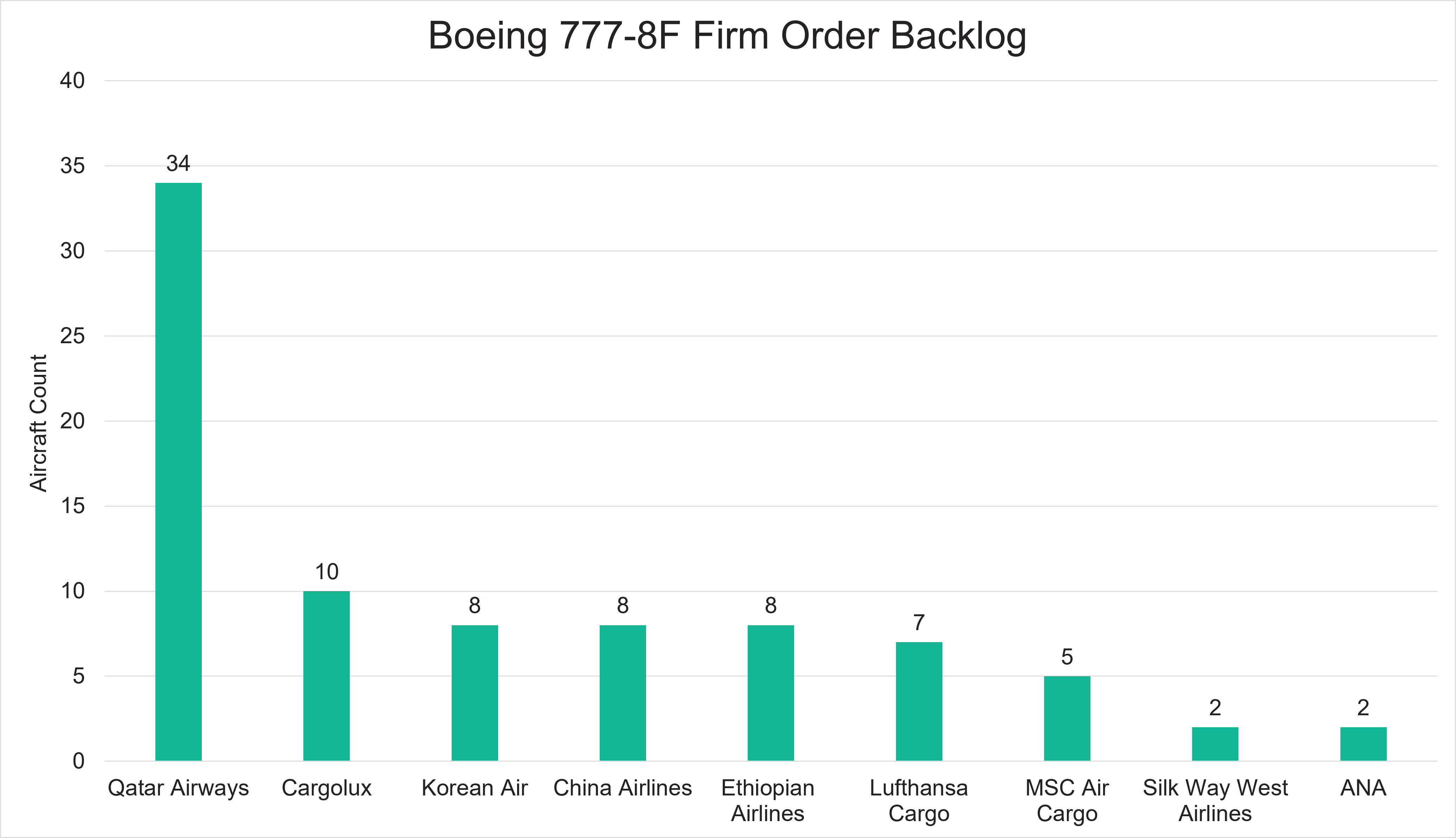
Meanwhile, the 777-8F firm order backlog chart shows 84 aircraft across nine customers, led by Qatar Airways with 34 and Cargolux with 10. Korean Air, China Airlines and Ethiopian Airlines each account for eight. These orders show clear demand for Boeing’s next-generation freighter, but the programme, like the 777-9, has been subject to repeated delays. Boeing now expects first 777-8F deliveries around two years after the first 777-9, which it anticipates in 2027. That puts entry into service in 2029, having originally been targeted for 2027 and later 2028. How quickly production will ramp up after that remains unclear, and the certification schedule has yet to be finalized. The 777F extension gives Boeing and its customers some protection against uncertainty during that transition.
Source: Cirium Fleet Analyzer
The timing of this transition also matters for 777 conversion programmes, which compete for some of the same fleet replacement and growth requirements. Recent customer discussions suggest that several buyers were waiting for the waiver decision before choosing between production 777Fs and conversions. Continued availability of factory-built aircraft could slow new conversion commitments.
However, conversion providers already have an established base of commitments, with 86 firm orders across the IAI, Mammoth Freighters and KMC programmes. Major customers include AerCap, Hongyuan Group, Jetran and Emirates. Individual feedstock aircraft have not been identified for all these commitments, and securing suitable aircraft remains a challenge. High acquisition costs, strong demand for passenger widebodies and delays to the passenger 777X are keeping 777-300ERs and 777-200LRs in service for longer, limiting their availability for conversion. The in-service 777 converted freighter fleet currently stands at 12 aircraft: seven with Kalitta Air, two each with Air Atlanta Europe and Challenge, and one with Emirates.
For conversion providers, securing further orders will depend on attractive acquisition and conversion costs alongside reliable redelivery schedules. The waiver may divert individual sales campaigns, but the shortage of available capacity in the large widebody freighter segment continues to support the case for conversions. A limited extension of 777F production is unlikely to meet every replacement and growth requirement, leaving a role for conversions alongside both generations of production freighters.