











Category: Topic

  • How do you build a foundation for trustworthy aviation data?

    Aviation runs on complex, fast-moving data. Every decision requires high levels of precision, and the interconnected nature of the industry means that data quality impacts operational, financial, and safety outcomes.

    To address how organizations can manage this critical asset, Sarah Davis, VP for Data at Cirium, and Candice Parfitt, Head of Data Governance at Cirium, recently presented the Data Governance 101: Aviation Foundations webinar. They shared how Cirium structures its internal data governance and why establishing a solid data framework is essential for modern aviation operations.

    Key highlights

    • Trust is paramount: Data governance involves aligning the right people, processes, and technology to build reliable, accurate datasets.
    • AI requires a solid foundation: Artificial intelligence magnifies data issues. Effective AI governance starts with trustworthy underlying data.
    • Start small: Organizations should evaluate their maturity and tackle governance initiatives in small increments to provide immediate value.
    • Human oversight remains necessary: While AI can augment governance by detecting inconsistencies, human review is crucial for accountability and accuracy.

    Defining governance for aviation

    Aviation data must meet the same rigorous standards as the industry itself regarding reliability and safety. Poorly governed data creates significant exposure. Data governance is not about adding layers of bureaucracy; rather, it is a strategic necessity that defines how good data needs to be for specific use cases.

    Effective governance ensures that data management becomes an embedded practice rather than an afterthought. Organizations need to consider governance at the point of data inception. By implementing data literacy programs, companies can help their teams understand the connections between data quality, ethics, and responsible data use.

    The cost of inaction

    When data governance is absent, the first symptoms are usually confusion and a lack of trust in the numbers. Teams start working in silos, relying on tribal knowledge instead of a single source of truth.

    Without clear data ownership, issues bounce between departments. This creates operational friction and delays time-sensitive decisions. Over time, this lack of clarity prevents organizations from fully leveraging their data assets and makes it nearly impossible to scale advanced analytics or AI capabilities confidently.

    Real-world cases at Cirium

    Cirium applies these governance principles internally to maintain its data credibility. One key initiative is the introduction of Data Product Managers and Data Governance Councils. These roles provide strategic oversight and embed data governance throughout the organization. Data Product Managers build relationships across teams, foster trust, and explain the concrete value of data sharing.

    Even simple issues require governance. For instance, industry acronyms can carry different meanings depending on the department. Establishing agreed-upon definitions eliminates misunderstandings and aligns cross-functional teams. By partnering closely with product teams, Cirium identifies new use cases and ensures its data processes remain robust and relevant.

    The role of technology

    Technology operationalizes governance strategies. Cirium utilizes Collibra as a central platform to manage data governance at the appropriate level. A major focus is data observability—monitoring data quality continuously from the moment of ingestion all the way to product surfacing.

    For operational aviation data, such as flight times, there is rarely a single ground truth. Governance technologies help define authoritative sources for specific purposes while documenting differences in timing, scope, and context. Furthermore, while AI can suggest classifications and detect anomalies, it serves to augment rather than replace human oversight. AI systems will produce confident answers even if the input data is wrong, making a governed data foundation the prerequisite for any AI initiative.


    Building a mature data governance framework takes time, but the value of accurate, trustworthy data is clear. Tackling governance in thin slices allows organizations to build momentum and establish a culture of data literacy. By focusing on clear purposes and guidelines, the aviation industry can continue to improve through secure, reliable data sharing.

    To explore these strategies deeper and evaluate your own organization’s governance maturity, watch the full webinar recording on demand: Data Governance 101: Aviation Foundations.

  • How the Middle East conflict has hit daily flight hours

    Andrew Doyle
    Andrew Doyle

    Andrew Doyle, Senior Director – Market Development, Cirium

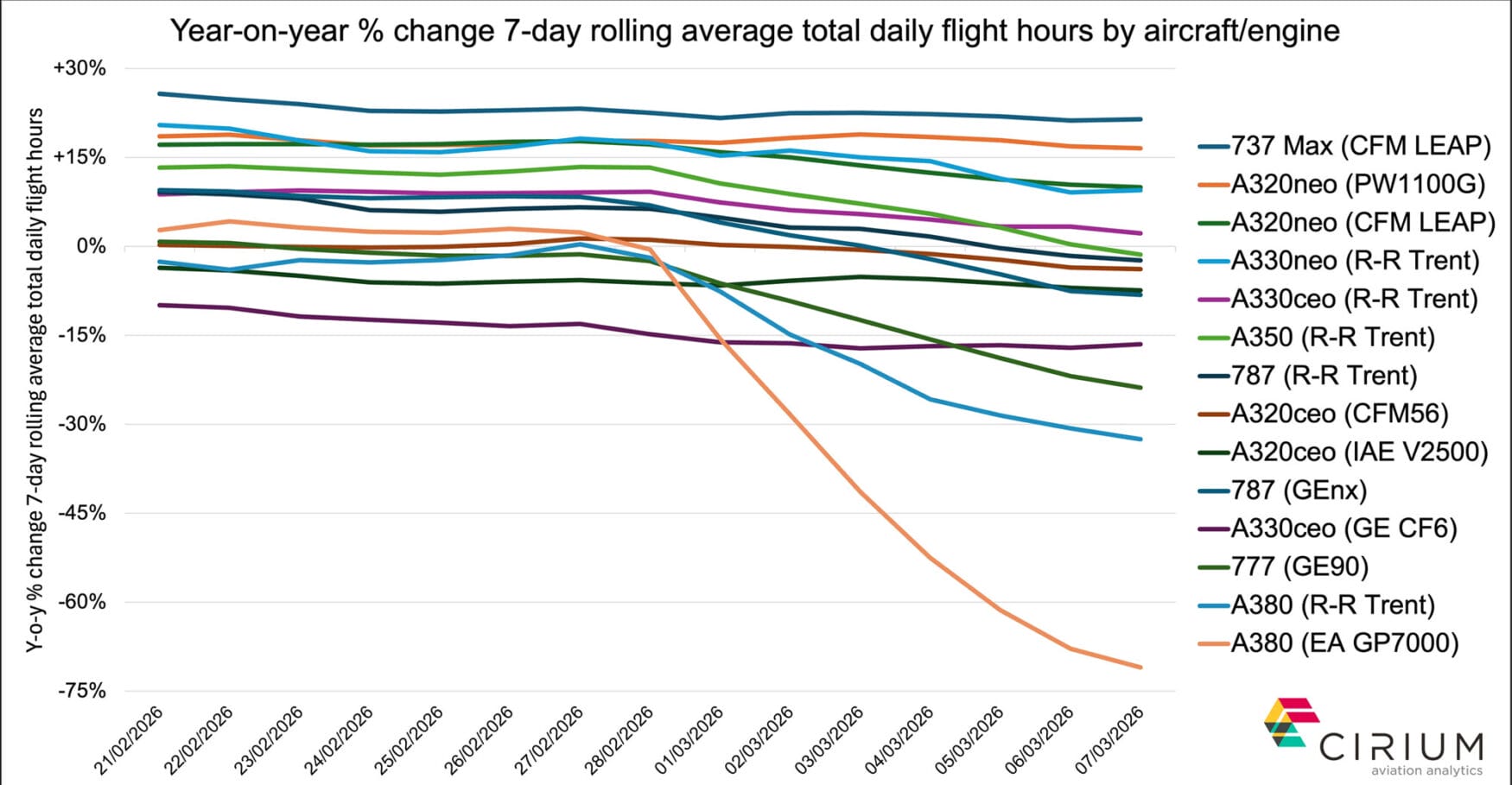
    With just over a week’s worth of utilisation data available since the Iran conflict began on 28 February, we can start to get a sense of the overall impact on daily flight hours trends for the global passenger jet fleet by airframe type and engine fit, writes Cirium Senior Director Market Development Andrew Doyle.

    Cirium fleet and tracking data can be used to calculate the year-on-year percentage changes in total tracked daily flying hours for some of the key aircraft/engine combinations, by comparing the seven-day rolling average for each day since late February 2026 with the equivalent day last year (364 days prior, to align days of the week).

    The chart below illustrates the effect the crisis has had on four-engined Airbus A380 and GE Aerospace GE90-powered Boeing 777 twinjet usage, given the large fleets flown by Middle Eastern carriers, although the lines are beginning to flatten out as Emirates in particular starts to recover its operations.

    Given the number of airlines that usually operate daily flights to Middle Eastern airports, most aircraft types have been negatively impacted to an extent, although for in-production models this has typically resulted in a dampening of year-on-year growth rather than an absolute reduction in total daily flight hours.

    It remains to be seen where these trend lines will settle if attacks continue over the coming days or weeks.

    Year-on-year % change in the seven-day rolling-average of total daily flight hours, by aircraft/engine

  • On-Time Performance as an Emissions Indicator

    Mike Malik, Chief Marketing Officer, Cirium

    What the Research Actually Shows 

    Our team at Cirium spent months analyzing this relationship across three distance bands: short-haul routes under 1,500 kilometers, medium-haul between 1,500-3,999 kilometers, and long-haul over 4,000 kilometers. We compared July 2019 operations with July 2024. The Cirium EmeraldSky platform let us track 47 operational variables across more than 100,000 daily flights. Everything from gate times and runway waits to specific aircraft configurations and passenger loads. 

    The correlation was consistent where operational changes occurred.

    Routes with improved on-time performance showed measurable drops in flight times and emissions. 

    Routes with declining OTP showed the opposite: longer flights and higher emissions. The pattern held across different airlines and aircraft types. 

    Most emissions calculators rely on simple distance formulas. We’re tracking actual operational data. The factors that determine real fuel consumption. PwC independently verified the methodology to ISAE 3000 standards, which puts it among the most rigorous publicly available datasets on airline emissions. 

    Why Delays Create More Emissions 

    The mechanism is straightforward but often overlooked. Delayed aircraft burn fuel while accomplishing nothing productive. They sit on taxiways with engines running, waiting for clearance. They circle in holding patterns before landing. They take longer routes to dodge congestion. 

    Researchers Brueckner and Abreu quantified this over a 21-year study of 16 US airlines.

    Each percentage point increase in flights delayed more than 15 minutes correlated with a 0.3% jump in fuel consumption and emissions.

    In practice, an airline cutting its delay rate from 22% to 19% (just three percentage points) reduces fuel consumption by roughly 1%. The airlines in that study burned 13.7 billion gallons of jet fuel in 2015. At standard carbon pricing, a three-point improvement delivered $48 million in annual environmental benefits. It’s measurable impact from better operations. 

    Ground Operations Tell the Story 

    Much of the emissions penalty happens before takeoff. European air traffic management analysis (2015-2017) found that routing inefficiencies make flight paths 0.61-0.76% longer than optimal. That translated to 229,000 extra tonnes of fuel and 721,000 additional tonnes of CO₂. The equivalent of four full days of flying across the European Economic Area. 

    At London Heathrow during peak hours, about half the arriving aircraft enter holding patterns averaging six minutes each. During one January 2015 peak hour, those holding patterns alone produced 10 tonnes of CO₂ and 114 kilograms of nitrogen oxides. 

    The 20 most congested US airports generate 6 million metric tonnes of CO₂ annually just from aircraft taxiing. Research shows that eliminating taxi delays could cut overall flight fuel consumption by 1% on average, with some congested airports showing potential reductions up to 2%. 

    Solutions That Already Work 

    Continuous Descent Operations let aircraft descend smoothly with minimal engine thrust instead of the traditional step-down approach with level flight segments. 

    This saves an average of 51 kilograms of fuel per flight, with real-world operations achieving 3.6% fuel burn improvements.

    Full deployment across Europe could deliver 350,000 tonnes in annual fuel savings. 

    Airport Collaborative Decision-Making systems create transparent communication between airlines, ground handlers, and air traffic control. When 17 European airports put these platforms in place in 2016, they saw 7% reductions in taxi time, 10.3% drops in air traffic delays, and 102,700 tonnes of CO₂ saved. 

    The Gap Between Airlines 

    The airline industry improved its carbon output per passenger by 12% between 2013 and 2019. 

    Roughly 2% per year. The variation between carriers tells an interesting story. Our 2024 Flight Emissions Review shows low-cost carriers like Wizz Air (53.9 grams CO₂ per available seat-kilometer) and Frontier (54.4 g CO₂/ASK) substantially outperforming legacy carriers. 

    How they run their operations explains much of this gap. Low-cost carriers typically maintain higher load factors, operate uniform fleets, fly point-to-point networks, and refine procedures more rigorously. These same factors support both on-time performance and efficiency. 

    Why the 3% Matters Right Now 

    Getting aviation to net-zero by 2050 depends heavily on sustainable aviation fuels (65% of the solution) and new propulsion technologies (13%). Operational improvements? Just 3% of the long-term plan. 

    Sustainable fuel production won’t reach meaningful scale until the 2030s. Hydrogen and electric aircraft remain years away from commercial deployment. That makes the 3% from operational improvements the only immediate option for emissions reduction. 

    Better operations are the immediate option for emissions reduction. 

    No new technology required, just better execution of existing procedures. 

    When an airline publishes its on-time performance statistics, it’s revealing more than customer service quality. Those numbers provide a window into how well the airline runs, and that directly affects environmental impact. The data proves the connection. Better on-time performance means lower emissions per passenger. It’s something airlines can improve right now. 

    Report highlights

    If you haven’t read the complete 2024 EmeraldSky Flight Emissions Review, you can download it at the link below. We’re releasing the 2025 edition in early 2026. If you’d like early access when it’s available, scan the QR code below to register your interest and we’ll send it your way. 

    Sources 

    Cirium EmeraldSky Study (2024): Short-haul route analysis comparing July 2019 to July 2024 operations, tracking 47 operational variables across 100,000+ daily flights. Methodology independently verified to ISAE 3000 standard by PricewaterhouseCoopers. 

    Brueckner, J.K., and Abreu, C. “Airline Fuel Usage and Carbon Emissions: Determining Factors.” Journal of Air Transport Management, Vol. 62 (2017), pp. 10-17. Study of 16 US airlines over 1995-2015 period. 

    EUROCONTROL Performance Review Reports (2015-2017): European air traffic management inefficiency analysis, horizontal flight efficiency data, and holding pattern emissions studies. 

    EUROCONTROL A-CDM Impact Assessment (2016): Analysis of 17 European airports implementing Airport Collaborative Decision Making systems. Study developed by Atlas Chase for EUROCONTROL. 

    Cirium Flight Emissions Review (2024): Global airline emissions rankings using flight-specific operational data. Published July 2025. 

    IATA Global Aviation Data (2013-2019): Historical carbon intensity trends for commercial aviation. 

    Air Transport Action Group (ATAG): Waypoint 2050 (2nd Edition, September 2021). Aviation industry net-zero pathway analysis and decarbonization scenarios. 

  • Transforming investment strategy with granular aviation intelligence

    In an industry defined by high-value assets and complex operational variables, the difference between the certainty needed and the upside sought often lies in the depth of data available. While established financial analysis provides a baseline, it typically lacks the performance variables required to capitalize on market inefficiencies or model scenarios in asset performance accurately.

    For financial investors, navigating the current aviation landscape requires more than just capital; recent Cirium forecasts estimate 46,500 new aircraft worth $3.4 trillion will be delivered globally over the next 20 years. Such market scale amplifies the need for trusted, asset-level data that can be directly integrated into investment thesis. By leveraging Cirium’s proprietary analytics, investors gain a distinct advantage in deal structuring, risk management, scenario modeling, and portfolio optimization.

    Precision in deal origination and structuring

    For debt providers, structuring terms with relevant and granular deal specific data to gain an understanding of risk variables can be transformative. It removes the discomfort of relying on generalized market assumptions. Advanced analytics offer visibility into specific airlines, routes, and aircraft types, drilling down to exact aircraft and engine utilization.

    This level of detail allows for more accurate deal structuring. In place of relying on broad assumptions about asset depreciation, investors can manage investments by tracking performance on multi-level indicators – from airlines and micro- or macro-market dynamics through to exact asset utilization and understanding the CapEx on maintenance events.

    Cirium’s latest 20-year fleet forecast underscores the volume and value of deliveries. The magnitude of opportunity and risk for aviation financiers with single-aisle aircraft projected to account for 71% of the global fleet, understanding the nuances of these delivery patterns is critical for long-term financing.

    This precise data enables the customization of strategy to more accurately reflect the realized risk profile of the collateral. It moves the conversation from general market sentiment to empirical market and asset health overlain by your institutional view, reflecting the necessary pricing and lending covenants. Furthermore, private capital can utilize data-driven insights to facilitate faster and more accurate validation of investment theses, allowing focus on the highest-potential opportunities.

    Predictive power for risk mitigation

    Risk understanding in aviation finance does not yet embrace the anticipation of operational shifts that impact asset value. Hedge funds benefit significantly from predictive capabilities. By analyzing global fleet data, flight schedules, and historical utilization trends, investors (banks, Institutional Investors, NBFIs) can spot early warning signs that traditional financial analysis of creditworthiness might miss.

    The engine market challenge

    Today’s engine market presents unique risks and opportunities. While new-generation engines deliver greater fuel efficiency, they also bring higher fragility, maintenance costs and reliability challenges. Cirium data shows that maintenance costs for newer engine types are expected to remain above those for current-generation engines, despite ongoing advancements.

    As referenced in recent market observations, ongoing reliability issues have meant some airlines have parted-out relatively young aircraft to sustain fleet operations – a phenomenon driving up lease rates and values, especially for well-known engine types like the CFM56.

    For investors, this translates to:

    • Values spiking: Maintenance constraints and supply chain issues are escalating engine and part values.
    • Operational risk: Asset management now demands a nuanced approach, accounting for engine depreciation and secondary market volatility.

    With Cirium’s high-fidelity data, investors can now model and respond to these developments – adjusting exposure by scenario modeling adverse events impact on asset values. This predictive edge is especially critical for managing downside risk in illiquid environments.

    Operational value creation and exit timing

    The value of robust data and analytics extends well beyond the initial transaction. For asset managers and private equity firms, the post-acquisition phase is where returns are realized.

    Investors can track the operational KPIs of their investment in real-time and compare them against global benchmarks. This is crucial for identifying underperformance and implementing corrective strategies, whether it involves broadening the counterparties, ensuring lease agreements are market appropriate, or timing asset disposals and acquisitions to match market developments.

    Monitoring Demand Signals

    While recent fluctuations suggest softening US capacity growth, Cirium data confirms global demand remains solid, with scheduled Available Seat Kilometers (ASKs) growth holding between 4% and 6% throughout the year. This context is vital for portfolio positioning and ongoing investment in aviation.

    Regional disparities – such as the difference between US / Asia-Pacific / European markets – underscores the importance of up-to-date, granular data. Cirium’s schedules, aircraft utilization, traffic, valuations and sentiment insights support evidence-driven pricing and entry/exit timing, ensuring realized value accurately reflects expected investment returns.

    Bridging the gap between finance and operations

    Ultimately, the role of accurate aviation data is the bridge that connects financing requirements and operational or market realities. It is also the element that is often missing. Cirium’s data acts as this bridge, translating complex aviation metrics into actionable financial insights.

    This integration enables investors to move with greater agility and confidence, reducing reliance on anecdotal evidence and replacing it with a credible and independent source of truth that is respected across the industry. Whether deploying capital into infrastructure, managing a financial portfolio of aircraft, or trading aviation-backed securities, access to trusted data ensures that every decision is grounded in reality.

    By integrating Cirium’s intelligence and the latest sector-wide forecasts – including delivery pipelines, engine reliability trends, and global demand signals – financial investors are positioned not just to participate in the market, but to lead with clarity.

    Find out more about how Financial Investors use aviation data.

  • Avianca Scales Connectivity While Cutting Emissions

    In commercial aviation, growth and emissions usually move in the same direction. Airlines add more flights, burn more fuel, and produce more carbon. This pattern has held true for decades, which is why Avianca’s performance since 2019 is so striking.

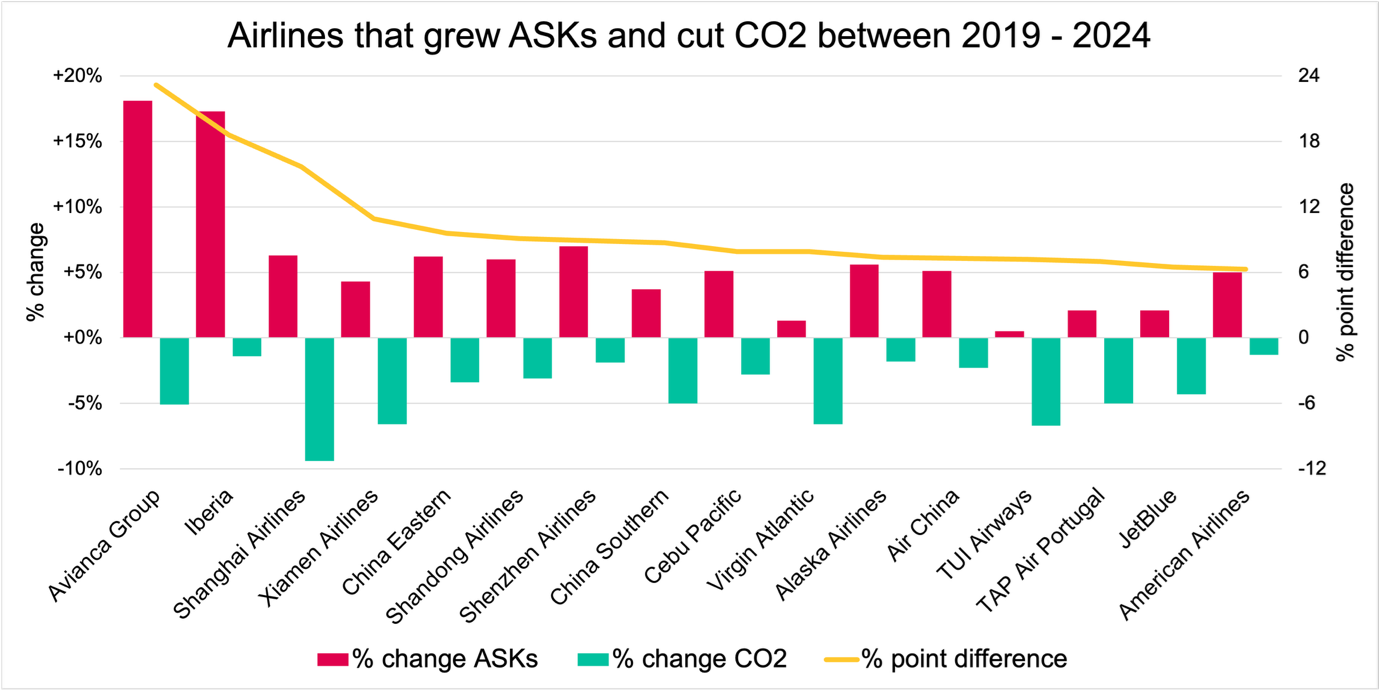
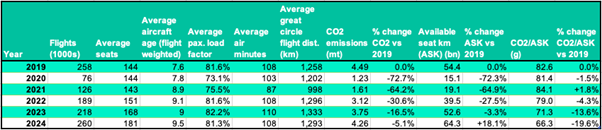
    According to EmeraldSky data, Avianca stands apart from every other large carrier. During the past five years, the airline increased its overall capacity by more than eighteen percent (18.1%) while also reducing total carbon emissions by more than five percent (5.1%). This combination simply does not happen often.

    The natural question is how Avianca achieved something that most airlines still describe as a long-term aspiration rather than an immediate reality.

    A Fleet That Looks Very Different Today

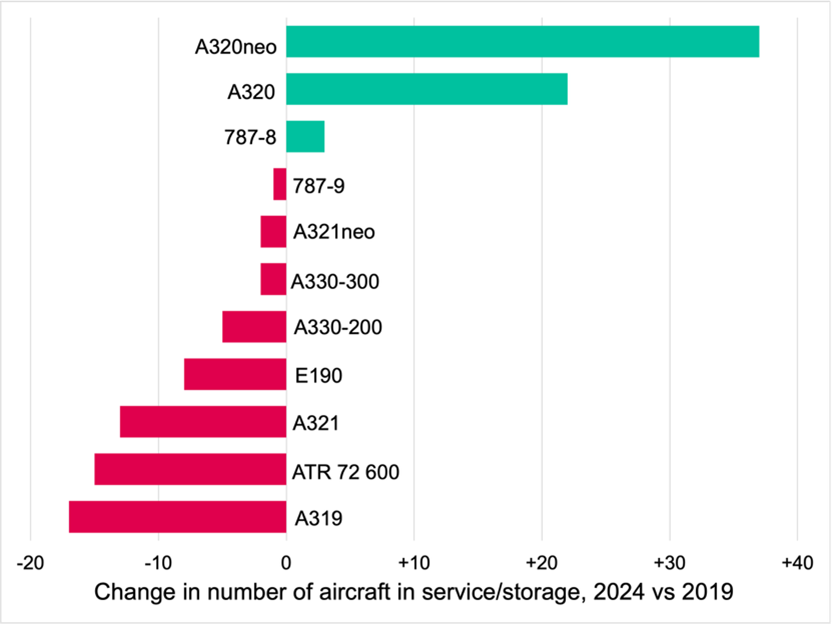
    Every story about emissions begins with the fleet. Avianca made a series of bold and disciplined choices that reshaped the aircraft it flies. Nearly two thirds of its Airbus A319 aircraft left the operation along with its entire group of A321 aircraft. In their place the airline introduced a significantly larger number of A320neo aircraft and additional A320ceo aircraft.

    The long-haul operation changed as well. Older A330 aircraft departed while the Boeing 787 fleet grew. Avianca also left behind its regional jet and turboprop operations, choosing to simplify and focus on aircraft that deliver stronger fuel performance.

    One of the most important results is the increase in average aircraft size. The typical Avianca aircraft carried 144 seats in 2019. Today that figure is 181. This was achieved by reconfiguring all its fleet, both narrow and wide bodies airplanes. Although the average age of the fleet increased slightly to nine and a half years, which reflects global supply chain issues that affected all airlines, the overall efficiency of the fleet still improved meaningfully.

    More Seats and More Efficiency

    By 2024 Avianca had restored its flight activity to the same level it operated in 2019. The difference is that the airline generated far more capacity because it was flying larger aircraft and flying them slightly farther on average. The removal of turboprop flying also meant that flight time did not materially increase even as stage length grew.

    This resulted in an 18.1% increase in available seat kilometers. At the same time the shift toward newer and more efficient aircraft produced a reduction in absolute carbon emissions of 5.1%.

    When combined, these factors created a major improvement in carbon intensity. Avianca moved from 82.6 grams of carbon per available seat kilometer to 66.3 grams. This represents a reduction of nearly 20%, which very few global airlines have managed to achieve on this scale.

    A Model for Responsible Growth

    Avianca’s experience shows that it is possible to grow and still reduce the environmental impact of flying. It requires discipline in fleet planning, a willingness to retire older aircraft, and a long-term commitment to efficiency.

    The journey for the aviation industry is not finished, but Avianca has shown what is possible when strategy and execution come together with clarity of intent. The airline is not only growing. It is growing in a more responsible way, and that achievement deserves attention.

  • Istanbul Airport wins the 2025 Platinum Award

    Mike Malik, Chief Marketing Officer, Cirium

    That infrastructure milestone, combined with sustained performance across the full year, has earned Istanbul Airport Cirium’s 2025 Platinum Award for the world’s best-performing airport. 

    Istanbul handles over 84 million passengers annually across 330 destinations through 116 airlines. Positioned at the crossroads of Europe, Asia, the Middle East, and Africa, the airport manages dense connectivity patterns, complex wave structures, and high daily aircraft movements. At this intensity, minor disruptions propagate quickly across regions and time zones without active management. 

    In June 2025, ACI Europe’s Airport Industry Connectivity Report named Istanbul Airport the world’s most connected hub, overtaking Frankfurt after a 59% increase in global hub connectivity since 2019. The airport also leads Europe in direct connectivity. 

    The Platinum Award measures more than on-time departure percentages. Cirium’s analysis evaluates delay severity, the airport’s ability to limit prolonged disruption, and how effectively operations preserve schedule integrity across the wider network. Performance is assessed across the full calendar year, not isolated peak periods. 

    Istanbul distinguished itself through consistency across changing seasonal demand and varying congestion levels. The additional airside capacity reduced peak-period congestion and strengthened the airport’s ability to absorb disruption without allowing delays to escalate. 

    Large, complex airports inevitably face weather events, airspace constraints, and downstream delays. What separates strong operations from exceptional ones is the response when pressure builds. Istanbul’s 2025 performance reflected management that limited delay severity and reduced passenger disruption, even during peak demand. 

    The runway upgrade required coordination across multiple stakeholders. Airlines adjusted gate assignments and taxi procedures. Ground handlers modified turnaround sequencing. Air traffic control refined departure spacing. The capacity expansion delivered value because the airport’s operations adapted to use it effectively. 

    This achievement comes as airport performance faces increasing scrutiny. Passenger expectations continue rising, airline networks operate closer to capacity, and tolerance for disruption is diminishing. Airports now play a central role in safeguarding aviation system reliability, with their performance directly influencing airline outcomes and customer trust. 

    Cirium’s Platinum Airport Award provides an independent, data-driven benchmark for excellence. Using globally consistent methodologies and verified operational data, the award recognizes airports that deliver reliable performance at scale across an entire year. 

    By earning the 2025 Platinum Airport Award, Istanbul Airport demonstrates that scale and complexity can coexist with consistency and control. The combination of infrastructure investment and operational discipline sets a clear benchmark for major hub airports navigating sustained pressure on global aviation infrastructure. We congratulate Istanbul Airport’s management and operational teams for earning this prestigious distinction. 

  • The Red Bird Soars

    Lydia Webb, Marketing Director – Americas & Strategic Programs, Cirium

    In 2024, Virgin Atlantic reported an OTP of 74.02% and did not qualify for the top 20 ranking in the Europe region based on total flight volume. However, this year, the airline not only met the qualifications but also secured the #4 position in the region with an impressive 83.45% OTP across 26,359 flights; a 9.43 percentage points gain over last year.  This accomplishment extends beyond the European context, positioning Virgin Atlantic among the leading airlines globally. It further highlights the organization’s commitment to overcoming challenges and continuously improving its operational standards. 

    Virgin Atlantic consistently mainted high on-time performance scores throughout 2025, registering OTPs above 80% – except January and December.  The airline is committed to being a challenger and a leader in its field and have made significant investments in fleet modernization, premium experience for guests, its people, and the communities it serves. 

    A Year for Change 

    In 2025, Virgin Atlantic focused on improving its on-time performance and underwent major developments across the business. The airline formed new interline and codeshare agreement with Caribbean Airlines, expanded its network and also joined a strategic partnership with IndiGo, Delta Air Lines, and Air France-KLM to link India’s expanding economy with North America and Europe.  

    The airline also announced a partnership with Joby Aviation, to provide zero-emission, short-range trips between Virgin Atlantic’s hubs at Heathrow and Manchester Airport and other regional destinations. 

    To complete its fleet modernization initiative, Virgin Atlantic Airways secured $745 million in financing from Apollo-managed funds, leveraging its London Heathrow slots. The funds will strengthen the airline’s finances and support upgrades, including Boeing 787-9 refurbishments, new Airbus A330neo aircraft with expanded premium cabins and Retreat Suites from 2026, and fleet-wide Starlink-powered Wi-Fi.  Virgin Atlantic will be the first UK airline to introduce free, streaming-quality, unlimited Wi-Fi throughout its fleet, using Starlink technology, with rollout completing in 2027. 

    Leading Into The Future 

    Virgin Atlantic’s Board has announced that Shai Weiss will step down as CEO at the end of 2025, and Corneel Koster will take over the position. Koster, who was formerly Chief Customer and Operating Officer, played a key role in overseeing operations, enhancing customer experience, guiding the airline through the pandemic, introducing the A330neo aircraft, and advancing digital transformation initiatives. Under Koster’s leadership, the airline aims to keep its commitments and achieve new standards in operational performance. 

    A Job Well Done 

    In today’s highly competitive airline industry, maintaining an on-time performance above 80% for domestic, regional, and long-haul flights is no easy task—especially if the starting point falls short of that benchmark. Virgin Atlantic has demonstrated through its accomplishments why it stands out as both a challenger and an industry leader. The airline’s dedication to improvement has not gone unnoticed. Cirium extends its congratulations to the entire Virgin Atlantic team for earning the title of Most-Improved Airline of the year—a recognition that is truly well earned. We look forward to seeing even greater achievements in the future. 

  • Qatar Airways’ 2025 Platinum Performance: What the Data Shows 

    Mike Malik, Chief Marketing Officer, Cirium

    The Platinum recognition goes to one carrier annually based on a proprietary algorithm that weighs reliability, operational precision, disruption recovery, and performance at scale. The question is straightforward: which airline demonstrates the strongest operational control and consistency when you look at the complete picture. 

    The Performance Case 

    Qatar Airways delivered 84.42 percent on-time performance in 2025 under Cirium’s methodology, up from 82.83 percent in 2024 across roughly 198,303 flights.

    That improvement matters because it came on top of an already strong base while maintaining completion factor close to 100 percent. Improving OTP when you’re already in the low 80s is harder than moving from the 70s—there’s less margin for gains, and the operational discipline required is tighter. 

    The scale context makes the numbers more meaningful. Qatar operates a tightly banked hub at Hamad International Airport serving over 170 destinations, running long haul and multistop journeys across multiple regions and time zones. Each connection bank multiplies operational risk because aircraft positioning, crew availability, passenger flows, and ground services all must align repeatedly throughout the day. Keeping delays and cancellations low in that environment requires precision that most network carriers struggle to maintain. 

    What Qatar Actually Did 

    The execution comes down to realistic planning and disciplined operations control. Qatar built turn times and connection windows that work in practice, not just on paper. When disruptions hit in 2025, including airspace constraints from geopolitical issues, weather volatility, and aircraft availability problems, the carrier protected key connection flows and used operational data to retime and reroute during irregular operations. 

    That approach kept cancellations low and gave passengers a higher probability of completing their journey as booked, even on difficult days. The completion factor numbers confirm this wasn’t theoretical; Qatar got passengers where they needed to go. 

    The A30 numbers tell the recovery story more clearly.  Qatar Airways maintains one of the lowest A30 rates among global network carriers which means very few flights arrive more than 30 minutes late. That metric reveals operational discipline that goes beyond preventing delays; it’s about containing them when they occur. In a banked hub operation where one delay can cascade through multiple connections, keeping severe delays low requires tight control over recovery decisions such as aircraft swaps, crew repositioning, passenger reprotection, and ground coordination. Qatar’s A30 performance indicates they’re making those decisions well under pressure, consistently. 

    The operational focus appears to be a deliberate priority backed by investment in schedule planning, day of operations control, and analytics capabilities. You can see it in how Hamad International’s operations coordinate with the airline’s schedule, and the hub has grown over the past few years without the reliability of degradation that typically comes with expansion.  

    What This Signals 

    Looking at 2025’s operational data across global carriers, Qatar’s performance demonstrates that a large, complex network can still be run with discipline and predictability in a volatile environment. That’s not a given anymore. Many network carriers have accepted that operational variability is simply the cost of scale and complexity. 

    Qatar’s numbers suggest otherwise. The combination of high OTP, near-perfect completion, and performance improvement year over year at this scale indicates that operational control remains achievable when it’s treated as non-negotiable rather than a metric to track. 

    For the industry, that’s the real takeaway. Network complexity and operational volatility are facts, but they don’t have to determine outcomes. Qatar Airways proved that in 2025. 

  • Aeromexico Named Most On-Time Airline; Qatar Airways Wins Platinum

    LONDON (Jan. 2, 2026) – Aeromexico maintained a 90.02% on-time performance to claim the world’s most on-time global airline title for the second consecutive year, according to Cirium’s 2025 On-Time Performance Review released today. 

    The Mexican carrier becomes only the second airline to achieve consecutive global wins since Cirium launched the program in 2009, operating 188,859 flights across 23 countries while maintaining industry-leading schedule reliability.

    Aeromexico Holds Global Lead; Regional Champions Crowned 

    Aeromexico secured the global airline title with 90.02% on-time performance, holding off strong competition from Saudia in second place with 86.53% and SAS with 86.09% in third. The margin between first and third place was 3.93 percentage points, reflecting rising operational standards across the industry. 

    Regional winners included: 

    • North America: Delta Air Lines won for the fifth consecutive year with 80.90% on-time performance 
    • Europe: Iberia Express (International Airlines Group) defended its title for the third consecutive year with 88.94% performance
    • Asia-Pacific: Philippine Airlines claimed the regional title for the first time with 83.12% on-time performance
    • Latin America: Copa Airlines achieved its 11th win, the most of any airline since Cirium’s program launched in 2009 with 90.75% on-time performance 
    • Middle East and Africa: Safair topped the regional rankings with 91.06% on-time performance

    Qatar Airways Wins Airline Platinum Award 

    Qatar Airways captured Cirium’s Platinum Award, recognizing the Doha-based carrier’s operational excellence across its global hub network. The airline achieved 84.42% on-time performance across more than 198,303 flights spanning six continents. 

    Virgin Atlantic Claims Inaugural ‘Most Improved’ Award 

    Virgin Atlantic won Cirium’s new ‘Most Improved’ award, demonstrating the largest year-over-year operational performance gain among global carriers. The UK-based airline improved its on-time performance from 74.02% in 2024 to 83.45% in 2025—a 9.44 percentage point increase year-over-year. 

    The new award recognizes airlines that have achieved meaningful operational scale (minimum 70% baseline performance) while delivering substantial improvements, ensuring the honor reflects genuine operational excellence, rather than recovery from poor prior performance. 

    Strong Global Airport Performance in 2025 

    Santiago Arturo Merino Benitez International Airport wins the Large Airport category, with 87.04% of flights departing on time.

    Panama’s Tocumen International Airport won the Medium Airport category, with 93.34% of flights departing on time. Ecuador’s Guayaquil José Joaquín de Olmedo International Airport claimed the Small Airport title for the second year in a row, with 91.47% of flights departing on time. 

    Istanbul Airport won Cirium’s Airport Platinum Award, which evaluates operational complexity, passenger impact during disruptions, and growth trajectory. Last year’s Airport Platinum winner was El Dorado International Airport in Bogotá, Colombia. 

    Industry Context and Analysis 

    About the On-Time Performance Review 

    Now in its 17th year, the Cirium On-Time Performance Review analyzes flight data from over 600 real-time sources including airlines, airports, global distribution systems, and civil aviation authorities. An independent advisory board of aviation industry veterans provides oversight and guidance. 

    An on-time flight arrives within 14:59 minutes of scheduled gate arrival time. Airport punctuality measures flights departing within 14:59 minutes of scheduled departure time. The Platinum Awards for both airlines and airports consider operational complexity, network scale, passenger impact during disruptions, and consistency throughout the year. 

    The Most Improved award, introduced in 2025, requires carriers to demonstrate at least 70% baseline on-time performance in the prior year to ensure recognition reflects operational excellence rather than recovery from poor performance. 

    Complete 2025 Rankings 

    Top 10 Global Airlines

    RankingAirlineOn-Time ArrivalsTotal Flights
    1(AM) Aeromexico90.02%188,859
    2(SV) Saudia86.53%202,864
    3(SK) SAS86.09%249,674
    4(AD) Azul85.18%304,625
    5(QR) Qatar Airways84.42%198,303
    6(IB) Iberia83.52%188,447
    7(LA) LATAM Airlines82.40%580,707
    8(AV) Avianca81.73%266,921
    9(TK) Turkish Airlines81.41%421,087
    10(DL) Delta Air Lines80.90%1,800,086

    Top 10 North American Airlines

    RankingAirlineOn-Time ArrivalsTotal Flights
    1(DL) Delta Air Lines80.90%1,800,086
    2(AS) Alaska Airlines79.20%453,031
    3(NK) Spirit Airlines78.83%218,265
    4(UA) United Airlines78.77%1,732,450
    5(WN) Southwest Airlines77.04%1,422,405
    6(AA) American Airlines76.43%2,259,576
    7(B6) JetBlue74.66%313,318
    8(WS) WestJet73.58%205,501
    9(AC) Air Canada73.26%383,819
    10(F9) Frontier Airlines72.14%208,987

    Top 10 European Airlines

    RankingAirlineOn-Time ArrivalsTotal Flights
    1(I2) Iberia Express88.94%37,119
    2(SK) SAS86.09%249,674
    3(OS) Austrian83.74%124,457
    4(IB) Iberia83.52%188,447
    5(VS) Virgin Atlantic83.45%26,359
    6(FI) Icelandair83.23%39,425
    7(VY) Vueling82.20%228,611
    8(TK) Turkish Airlines81.41%421,090
    9(D8, DY) Norwegian80.96%150,784
    10(AY) Finnair79.67%116,652

    Top 9 Latin American Airlines 

    RankingAirlineOn-Time ArrivalsTotal Flights
    1(CM) Copa Airlines90.75%133,748
    2(AM) Aeromexico90.02%188,859
    3(G3) Gol87.75%238,182
    4(AD) Azul85.18%304,625
    5(LA) LATAM Airlines82.40%580,707
    6(H2) Sky Airline82.39%55,116
    7(AV) Avianca81.73%266,921
    8(JA) JetSmart Chile76.91%90,460
    9(AR) Aerolineas Argentinas76.54%107,490
    Only 9 airlines qualified in the region  

    Top 10 Asia-Pacific Airlines

    RankingAirlineOn-Time ArrivalsTotal Flights
    1(PR) Philippine Airlines83.12%116,268
    2(NZ) Air New Zealand79.29%171,216
    3(NH) ANA78.88%309,998
    4(SQ) Singapore Airlines78.58%121,293
    5(JL) JAL78.25%313,410
    6(6E) IndiGo78.12%802,418
    7(CX) Cathay Pacific76.78%119,193
    8(VA) Virgin Australia76.54%155,038
    9(QF) Qantas76.51%276,859
    10(KE) Korean Air75.34%133,252

    Top 10 Middle East and Africa Airlines 

    RankingAirlineOn-Time ArrivalsTotal Flights
    1(FA) Safair91.06%62,805
    2(RJ) Royal Jordanian90.73%37,524
    3(F3) Flyadeal86.54%69,971
    4(SV) Saudia86.53%202,864
    5(4Z) Airlink84.47%84,361
    6(QR) Qatar Airways84.42%198,303
    7(WY) Oman Air83.10%38,828
    8(SA) South African Airways81.26%24,461
    9(EY) Etihad Airways81.06%100,620
    10(KU) Kuwait Airways79.50%29,977

    Top 10 Large Airports

    RankingAirportOn-Time DeparturesTotal Flights
    1(SCL) Santiago Arturo Merino Benitez Intl Airport87.04%153,326
    2(RUH) Riyadh King Khalid International Airport86.81%264,614
    3(MEX) Mexico City Benito Juarez International Airport86.55%295,737
    4(HNL) Honolulu International Airport86.51%156,139
    5(OSL) Oslo Gardermoen Airport86.00%204,882
    6(LIM) Lima Jorge Chavez International Airport85.54%183,137
    7(SLC) Salt Lake City International Airport85.04%243,848
    8(CPH) Copenhagen Airport84.72%236,903
    9(DOH) Doha Hamad International Airport84.70%251,864
    10(ARN) Stockholm Arlanda Airport83.59%181,238

    Top 10 Medium Airports

    RankingAirportOn-Time DeparturesTotal Flights
    1(PTY) Panama City Tocumen International Airport93.34%148,065
    2(BSB) Brasilia International Airport88.36%114,481
    3(JNB) Johannesburg O.R. Tambo International Airport86.22%189,542
    4(ITM) Osaka Itami International Airport86.04%136,489
    5(DMM) Dammam King Fahd International Airport85.15%94,768
    6(GIG) Rio de Janeiro Galeao International Airport85.13%115,384
    7(PDX) Portland International Airport85.02%159,964
    8(VCP) Viracopos-Campinas International Airport84.55%111,758
    9(SJC) San Jose Mineta International Airport83.66%99,182
    10(CNF) Belo Horizonte International Airport83.57%113,857

    Top 10 Small Airports

    RankingAirportOn Time DeparturesTotal Flights
    1(GYE) Guayaquil Jose Joaquin de Olmedo Intl Airport91.47%34,068
    2(SAL) El Salvador International Airport90.28%47,203
    3(SDU) Rio de Janeiro Santos Dumont Airport89.67%58,303
    4(SVG) Stavanger Airport89.55%38,894
    5(UIO) Quito Mariscal Sucre International Airport89.45%42,911
    6(CPT) Cape Town International Airport88.72%82,030
    7(KOA) Ellison Onizuka Kona Intl Airport at Keahole88.48%32,702
    8(SSA) Salvador International Airport87.32%55,594
    9(TRD) Trondheim Airport86.95%47,291
    10(AMM) Amman Queen Alia International Airport86.82%76,734

    Cirium’s full 2025 On-Time Performance Review is available at www.cirium.com/on-time-performance.


    For Cirium media inquiries please contact media@cirium.com

    Notes to editors 
    *An on-time flight is defined as a flight that arrives within 15 minutes of the scheduled gate arrival. For an airport, it is defined as departing within 15 minutes of its scheduled departure. 

    About Cirium 
    Cirium® is the world’s most trusted source of aviation analytics. The company delivers powerful data and cutting-edge analytics to empower a wide spectrum of industry players. It equips airlines, airports, travel enterprises, aircraft manufacturers, and financial entities with the clarity and intelligence they need to optimize their operations, make informed decisions, and accelerate revenue growth. 

    Cirium® is part of LexisNexis® Risk Solutions, a RELX business, which provides information-based analytics and decision tools for professional and business customers.  The shares of RELX PLC are traded on the London, Amsterdam and New York Stock Exchanges using the following ticker symbols: London: REL; Amsterdam: REN; New York: RELX. 

    For more information, follow Cirium® on LinkedIn or visit cirium.com.

  • Future Flight: Transforming Travel with Aviation Analytics

    After a period of significant disruption, global travel demand has not only returned but is also setting a new trajectory. Growth is now driven by resilient structural demand, evolving passenger expectations, and ongoing supply-side pressures. For operators, the imperative is clear: data-driven strategies are essential to achieve operational efficiency, enhance future readiness, and improve the passenger journey in a rapidly shifting market. 

    The Cirium webinar, Future Flight: Shaping Traveler Experiences with Aviation Analytics, explored forces shaping commercial aviation as the industry approaches 2026. Drawing on insights from panelists representing various aviation sectors and the latest aviation data, the session covered the global demand outlook, operational responses to emerging pressures, and the expanding role of aviation analytics in strengthening airport resilience and enhancing the passenger experience.  

    The global travel outlook: a new trajectory 

    The outlook for global air travel has shifted as the industry moves beyond pandemic recovery. Global revenue passenger-kilometers (RPKs) have surpassed 2019 levels, reflecting strong demand. However, the industry still trails its pre-covid growth trajectory, representing about four years of lost progress.  

    The rapid growth seen after borders reopened has eased, and demand is being driven by fundamental market forces than by deferred travel. In this climate,  commercial aviation is forging a distinctly new path.  

    An uneven recovery landscape 

    Joanna Lu from Cirium Ascend Consultancy presented 2026 Travel Market: Robust demand in a constrained operating environment 


    While there is a macro picture of strong growth, the patterns remain uneven between markets.  

    Capacity on transatlantic and Europe–Asia routes has surpassed pre-pandemic benchmarks, while in contrast, transpacific traffic and China’s international network still lag compared to 2019 levels. This divergence highlights the impact of persistent structural factors, such as strategic fleet deployment, changing traveler behavior, and ongoing geopolitical challenges.  

    The evolving traveler: new demands and behaviors 

    Demand drivers are shifting. Surveys consistently highlight a growing emphasis on unique travel experiences, even as inflation acts as a headwind for some travelers. Moreover, flexible and hybrid work patterns continue to blur the line between leisure and business trips, creating more diverse travel profiles and shifting travel seasonality.  

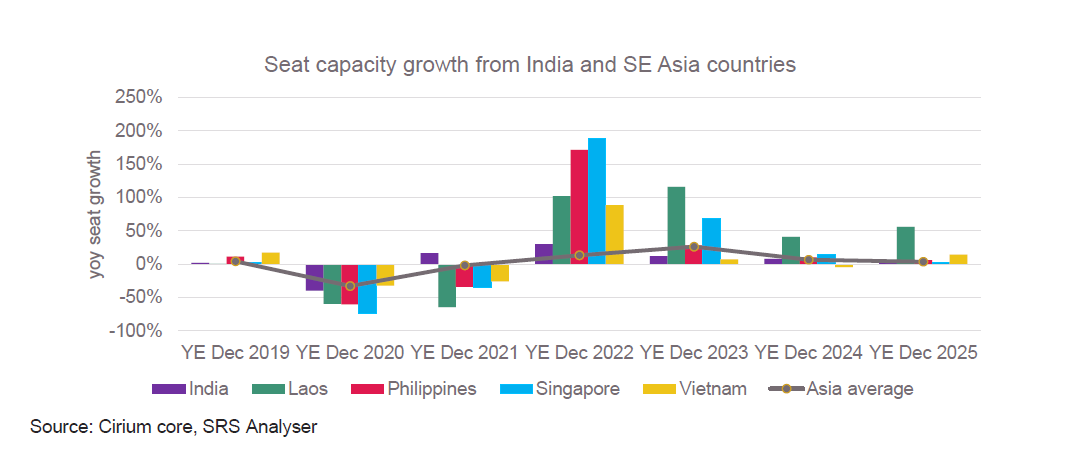
    Alongside these behavioral shifts, the rise of Asia’s expanding middle class—particularly in India and Southeast Asia—is fueling demand growth. Visiting Friends and Relatives (VFR) travel remains a key driver, offering a resilient source of underlying traffic as other segments fluctuate. Combined with the ongoing trend toward short-haul regional journeys, these factors are prompting airlines and airports to revisit network structures and tailor their offerings to better match these evolving passenger expectations.  

    The operational imperative: reliability in an era of growth 

    As network capacity expands to meet renewed demand, maintaining operational reliability continues to be a key challenge. Forecasts for the first quarter of 2026 indicate a 5% increase in capacity across Asia, equating to about 31 million additional passengers. 

    While this demonstrates strong market momentum, it places more pressure on infrastructure, processes, and resources that are already under strain.  

    Leading the panel discussion was Ellis Taylor of Cirium joined by colleague Hamsin Nashrudin, and guest speakers Anthony Cicuttini from Brisbane Airport and Nate Srinath from Inxee.


    Despite network expansion continuing reliability remains a central concern. Cirium data shows that flight cancellation rates in 2025 remain above the pre-pandemic baseline of roughly 1–1.5%. Even a small uptick results in tens of thousands of additional monthly cancellations, directly affecting passenger experience and operational stability. As the sector scales up, reinforcing reliability shifts from operational concern to a strategic priority – and a key competitive advantage.  

    Ongoing supply chain challenges and aircraft delivery delays are set to further constrain available fleet growth, despite infrastructure investments. The recent addition of airports in markets such as Navi Mumbai and Noida adds needed capacity, but these projects must be matched with adequate aircraft resources and integrated networks to realize their full benefits. 

    Driving operational efficiency in aviation 

    Airports are responding to capacity and reliability pressures by leveraging advanced analytics and artificial intelligence (AI) to streamline operations, alongside strategic infrastructure enhancements.  

    The emphasis is on maximizing efficiency from existing assets, while new facilities like Navi Mumbai and Noida expand capacity. However, technology and infrastructure must advance together to achieve measurable improvements in performance.  

    From docking systems to intelligent hubs 

    A clear example of this transition is the evolution of Visual Docking Guidance Systems (VDGS). Once limited to basic stand guidance, next-generation VDGS platforms now serve as intelligent operational nodes. AI enables these systems to go beyond traditional roles by automating billing with precise arrival timestamps and reducing revenue discrepancies from manual reporting. This digital transformation helps resolve longstanding operational inefficiencies and lays a foundation for broader process innovation.  

    Critically, these intelligent platforms are transforming airport turnaround performance by capturing granular timestamps for each step of the process, creating robust datasets for targeted operational analysis—from chocks-on and aerobridge placement to passenger transfer, refueling, and baggage movement. Ready access to these detailed metrics empowers teams to identify bottlenecks and inefficiencies, supporting continuous improvement in processes and asset utilization.  

    Enhancing safety and efficiency 

    AI-enabled systems also play a crucial role in enhancing airside safety. The latest smart VDGS platforms can automatically identify aircraft types and verify wingtip clearance during docking, reducing collision risk and protecting operational integrity. By streamlining processes and improving reliability, these technologies strengthen the resilience of the airport environment.  

    Brisbane Airport: a case study in data-driven strategy 

    With traffic projected to reach 35 million passengers over the next decade, Brisbane Airport (BNE) uses Cirium’s FM Traffic and SRS Analyzer to conduct data-driven assessments that allow it to proactively manage its relationships with airlines, and make infrastructure investment decisions. 

    Using Cirium’s FM Traffic and SRS Analyser, BNE compares individual routes across an airline’s portfolio and identify opportunities for new services or increased frequency by combining real-time passenger flow with detailed schedules. 

    This analytical approach reshapes how BNE develops airline partnerships. Rather than relying on anecdotal feedback, the airport enables collaborative, evidence-based discussions on network performance and shared opportunities. They effectively identify key drivers and co-develop actionable strategies—whether refining capacity allocation or launching targeted joint marketing campaigns. 

    Building the Future of Air Travel

    Successfully navigating this landscape requires adopting integrated, intelligence-led operational models. Aviation analytics now underpin decision-making across key areas—demand forecasting, network optimization, turnaround management, and safety protocols. Embedding data-driven insights into strategy and execution enables stakeholders to respond proactively to changing conditions, mitigate disruptions, and chart a path toward resilient, efficient, and effective operations.  

    In the evolving landscape of commercial aviation, organizations that put analytics at the core of their operations are best positioned for long-term success. The future of air travel will be defined not just by volume, but by how intelligently and efficiently each journey is enabled.   

    Airports and airlines that leverage real-time intelligence and predictive analytics drive operational excellence, strengthen network resilience, and consistently deliver a reliable, seamless passenger experience.

    Watch the Webinar on Demand 

    The full webinar is now available on demand, along with the presentation deck. Watch it here.  

  • Cirium Data Powers Perk’s Next-Gen Flight Emissions Tracking

    London, 04 December, 2025: Cirium, the global leader in aviation analytics, has announced a major step forward in sustainable travel, as it signs a landmark deal with Perk, the intelligent platform for unified travel and spend management.

    Through this agreement, Perk’s customers now benefit from Cirium’s advanced flight emissions data – delivered via EmeraldSky, Cirium’s revolutionary flight emissions tracking tool. It enhances visibility into the environmental impact of flight choices, helping businesses and travelers make smarter, sustainability-led decisions. 

    For the first time Cirium’s flight-specific emissions data is marking a major leap forward for Corporate travel. The solution delivers unrivalled precision in CO₂ tracking, thanks to Cirium’s fusion of comprehensive flight data, science-led methodology, and real-time analytics. 

    Perk, one of the world’s fastest-growing travel management platforms, is now leveraging Cirium’s forecast and flown emissions insights to provide travelers and businesses with accurate, transparent CO₂ estimates at point of search. Post travel, these insights feed into Perk’s intelligent reporting suite, supporting sustainability tracking and regulatory compliance for the 10,000 companies the platform supports worldwide. This integration strengthens Perk’s position as the go-to platform for companies aiming to reduce business travel emissions responsibly and at scale.

    JEREMY-BOWEN Cirium
    JEREMY-BOWEN Cirium

    This builds on Cirium’s long-standing relationship with Perk, and follows the Group’s 2025 acquisition of AmTrav, an existing Cirium customer, which focuses on the US market.

    Launched in 2024, Cirium’s EmeraldSky is an innovative platform, powered by a revolutionary methodology. It analyzes each flight’s specific aircraft type and configurations, combined with real-time operational data and flight conditions, ensuring unparalleled accuracy and reliability in emission tracking. As businesses face increasing pressure to reduce emissions, Cirium offers a future-proof solution for carbon accountability – empowering companies to meet internal targets while providing travelers with transparency and choice.

    EmeraldSky seamlessly integrates Cirium’s comprehensive data, advanced analytics, and data science techniques to achieve unmatched precision in measuring both forecast and flown CO₂ flight emissions.

    Unlike traditional carbon calculators that depend on broad estimates and generic assumptions – such as using  great circle distance instead of actual flown flight paths, and ignoring variables like wind speed, direction, and actual airframe and engine maintenance records – EmeraldSky provides emissions results based on the seat in a specific class of service and sets a new standard in aircraft emissions measurement.  

    To learn more about Cirium’s comprehensive aviation analytics and detailed insights, visit www.cirium.com.


    For Cirium media inquiries, please contact:
    media@cirium.com

    About Cirium 
    Cirium® is the world’s most trusted source of aviation analytics. The company delivers powerful data and cutting-edge analytics to empower a wide spectrum of industry players. It equips airlines, airports, travel enterprises, aircraft manufacturers, and financial entities with the clarity and intelligence they need to optimize their operations, make informed decisions, and accelerate revenue growth. 

    Cirium® is part of LexisNexis® Risk Solutions, a RELX business, which provides information-based analytics and decision tools for professional and business customers.  The shares of RELX PLC are traded on the London, Amsterdam and New York Stock Exchanges using the following ticker symbols: London: REL; Amsterdam: REN; New York: RELX. 

    For more information, follow Cirium® on LinkedIn or visit cirium.com.

    About Perk
    Perk (formerly TravelPerk) is the intelligent platform for travel and spend management, built to eliminate the hidden, manual tasks that drain productivity and morale – Perk calls these ‘Shadow Work’. By automating travel bookings, expenses and invoice processing, the platform gives teams back time to focus on real work, with real impact. Trusted by more than 10,000 companies worldwide – including Wise, On Running, Breitling and Fabletics  – Perk is tackling the 7 hours of lost productivity per employee each week, a $1.7 trillion problem revealed in The Cost of Shadow Work report. Founded in 2015, the global company combines innovation, control, and simplicity to transform how businesses work today and in the future. Perk’s mission is to power real work by removing the invisible tasks that slow teams down.

    Visit www.perk.com for more information.

  • WestJet’s Climb to the Top: What It Really Takes to Lead North America in On-Time Performance

    Mike Malik, Chief Marketing Officer, Cirium

    I’ll be honest—when I saw WestJet’s October numbers come across my desk, I had one thought: Good grief, this is fantastic. 84.66% on-time performance. Number one in North America. Not just good—the best.

    Here’s what makes that achievement so impressive: just over a year ago, WestJet was posting around 71% on-time arrivals across nearly 192,000 flights. That put them near the bottom of major North American carriers—a tough place to be when your customers, your employees, and your investors are all watching the same scorecards.

    Every month, I review on-time performance results with our committee and board. We see incremental improvements, seasonal dips, weather recoveries—the usual rhythm of airline operations. But October 2025 wasn’t usual. This was different. We all felt it was a big deal, and I don’t think most people truly understand what it takes to post these kinds of numbers.

    What Most People Don’t See

    When passengers see an 84% on-time rate, they might think: “Pretty good odds I won’t be delayed.” And they’re right—but they’re missing the real story.

    What that number actually represents is thousands of people doing hundreds of things right, repeatedly, under pressure. It’s gate agents, dispatchers, maintenance crews, pilots, and operations centers all executing with precision. It’s schedules built with discipline. It’s recovery plans that actually work when things go sideways.

    You don’t get to 84.66% OTP by hoping for good weather. You get there through relentless operational focus and a culture that treats reliability as non-negotiable.

    Leadership That Gives Credit Where It’s Due

    I’ve met a lot of airline CEOs over the years. Some are brilliant strategists. Others are financial experts. A few are operations specialists.

    Alexis von Hoensbroech, who became WestJet’s CEO in February 2022, is something different—and refreshingly so. When I met him at a conference, what struck me wasn’t just his impressive background (a physics PhD from the Max Planck Institute, years at Boston Consulting Group, sixteen-plus years in senior roles at Lufthansa Group including CEO and CFO of Austrian Airlines). It was how genuinely warm and personable he was—surprisingly so for a CEO with those credentials.

    More importantly, when he talks about WestJet’s operational progress, he consistently gives credit to the teams doing the work. That kind of humility from a leader with his accomplishments says a lot about how he’s building the airline’s culture.

    His approach appears to focus on two principles: shared accountability across the operation, and schedule discipline as the foundation of everything else. Those aren’t just words at WestJet—they’re visible in the month-over-month data.

    Alexis von Hoensbroech 
CEO, WestJet

    Alexis von Hoensbroech
    CEO, WestJet

    Building the Foundation

    WestJet’s network today spans major hubs in Calgary, Toronto Pearson, and Vancouver, with extensive transborder and leisure flying. That’s a complex operation—the kind that exposes any weakness in your processes.

    The airline is also midway through significant fleet modernization. In 2025, WestJet announced an order for 67 Boeing aircraft—60 737-10 MAX jets and 7 787-9 Dreamliners, with deliveries through 2034. Modern fleets don’t guarantee operational excellence, but they certainly help create the conditions for it.

    September’s numbers already showed momentum—roughly 84.5% OTP, putting WestJet among the month’s top performers. October confirmed it wasn’t a fluke.

    Why This Matters

    Airlines around the world take on-time performance seriously, and they should. It affects brand reputation, investor confidence, and employee morale. When I see results like WestJet’s, it makes me proud that Cirium’s data plays a role in helping airlines benchmark and improve.

    But more than that, I genuinely want to see the industry succeed. Every carrier doing well lifts the entire sector. And when an airline posts numbers like this—especially after climbing from a challenging baseline—it proves something important:

    You can fix an airline. It takes clear leadership, operational discipline, fleet investment, and teams committed to execution. It doesn’t happen quickly, and it doesn’t happen by chance. But it can be done.

    What Comes Next

    The coming months will tell us whether October represents WestJet’s new normal or an early chapter in a longer story. Either way, this moment matters.

    It’s proof that when airlines focus on the fundamentals—schedule integrity, operational coordination, and accountability at every level—the results show up in the data. And when those results are sustained, everything changes: customer trust rebuilds, brand strength returns, and business resilience grows.

    Congratulations to Alexis and the entire WestJet team. October 2025 will be remembered as the month you reached the top of North American on-time performance.

    And from where I sit, that’s fantastic news for everyone.

  • Number of UK domestic flights halves in the last 20 years

    Data from aviation analytics firm Cirium reveals that the number of domestic UK flights has more than halved over the past 20 years, with 214,796 flights scheduled throughout 2025, compared to a peak in 2006 of 454,375 flights.

    This equates to almost 240,000 fewer flights scheduled in 2025 than 2006, amounting to an average daily reduction of 657 flights across the UK.

    A combination of higher Air Passenger Duty tax, shifting environmental concerns and the ability for airlines to make greater profits from short-haul services beyond the UK have contributed to the decline.

    The reduction in domestic flights has impacted regional airports with several UK hubs closing their commercial operations over the past 20 years, including Doncaster Sheffield in 2022, Blackpool in 2014 and Plymouth in 2011.

    The demise of Flybe, once the UK’s largest domestic operator, during the pandemic in 2020 will also have affected the number of available flights. However, the decline was already prevalent prior to Flybe entering administration and a number of routes previously operated by the carrier have since been taken over by other airlines.

    2025 will see 74,125 fewer flights compared to pre-pandemic levels.

    The number of available seats has significantly decreased during the past 20 years, dropping 35% from 39.1 million in 2006 to 25.5 million seats in 2025. This represents a drop of 37,000 fewer passengers flying on internal flights each day within the UK. 

    More recently, flights have decreased since 2024, with almost a million fewer seats available for domestic UK travel this year.

    The general reduction of internal flights across the UK is driven by a change in customer demand and shifting strategy among airlines which have dropped domestic services following the doubling of Air Passenger Duty rates in 2007.

    Jeremy Bowen, Cirium CEO, said: “This reduction over the past two decades shows a staggering change in the way we travel throughout the UK. Passengers are looking at more sustainable and affordable ways to travel domestically, so airlines have responded by reducing their internal services and prioritising more popular destinations including Spain, France and Italy.”

    This substantial change in the way people travel throughout the UK coincides with a rise in rail travel, according to the Office of Rail and Road’s (ORR) Passenger rail usage statistics. The ORR has seen a 50% increase in rail travel from 1.15 billion passengers in 2005/6 to almost 1.73 billion in 2024/5.

    See the full dataset below, and further sustainability analysis is available using Cirium’s EmeraldSky tool:


    About Cirium 
    Cirium® is the world’s most trusted source of aviation analytics. The company delivers powerful data and cutting-edge analytics to empower a wide spectrum of industry players. It equips airlines, airports, travel enterprises, aircraft manufacturers, and financial entities with the clarity and intelligence they need to optimize their operations, make informed decisions, and accelerate revenue growth. 

    Cirium® is part of LexisNexis® Risk Solutions, a RELX business, which provides information-based analytics and decision tools for professional and business customers.  The shares of RELX PLC are traded on the London, Amsterdam and New York Stock Exchanges using the following ticker symbols: London: REL; Amsterdam: REN; New York: RELX. 

    For more information, follow Cirium® on LinkedIn or visit cirium.com.

  • My top 10 predictions for how GenAI will reshape aviation

    Niha Shaikh, VP of Product, Cirium Journey

    It’s 06:15 at the hub. The night bank is running late, one arrival’s still holding short, another’s waiting on a tow, and crew duty windows are closing fast. Stand 32 hasn’t cleared, catering’s behind on the next outbound, and the phone won’t stop ringing. No one in the ops room is asking for “AI.” They want answers at speed. What changed? Which flight is now at risk? What’s the knock-on for the next wave? That’s where GenAI earns its keep: not with buzzwords, but by cutting through the noise and surfacing the right context, right when it matters.

    The aviation industry is entering a new level of digital transformation where GenAI will reshape the way we work. Aviation doesn’t lack data; it lacks time, context, and confidence when decisions are time‑critical. GenAI won’t replace domain expertise, and it certainly won’t bend curfews, duty limits, or slot programs, but it will change how we model, govern, query, and operationalize data. These are ten shifts I expect to stick, based on what we’re building, piloting, and seeing with customers across the industry.

    1. From data lakes to data conversations
    Natural language interfaces will replace dashboards and SQL queries. Teams across commercial, finance, and ops will ask questions like “Which routes underperformed last quarter?” and get answers instantly.

    2. Calculated fields will become strategic assets
    Data points like delay codes, lease terms, fuel burn metrics once buried in backend systems will be surfaced and standardized. GenAI thrives on structured nuance, and calculated fields will become the backbone of predictive planning and compliance reporting.

    3. Unstructured content will be searchable and actionable
    Legacy PDFs, maintenance logs, training manuals and consultancy reports will be transformed into structured, searchable data. This unlocks decades of institutional knowledge for route planners, asset managers, regulatory teams and more importantly fresh talent entering the industry.

    4. Data architecture will shift from ownership to usability
    Instead of siloed schemas, we’ll see unified, product-ready datasets. The focus will be on usability, not just making data accessible but usable to humans and machines, across departments from network planning to finance.

    5. Scenario planning will become a daily habit
    GenAI will enable rapid modeling of “what if” scenarios: what if fuel prices spike, what if a hub closes, what if a competitor launches a new route? This will empower strategic teams to test ideas before committing resources.

    6. AI agents will initiate, and drive workflows
    AI agents are evolving from passive tools into proactive workflow initiators. GenAI will not just sit alongside users, it will kickstart tasks, retrieve relevant data, surface insights, and draft reports before a human even asks. These agents will become trusted collaborators for analysts, planners, and commercial teams, anticipating needs and accelerating decision-making.

    7. System silos will start breaking down
    Analysts will query across scheduling, crew, finance, and commercial systems as if they were one, pulling competitor insights, fleet availability, and cost implications together without manual exports or waiting on IT. As AI agents mature, these connections will become autonomous. This doesn’t replace human expertise; it eliminates the friction between questions and answers.

    8. Data governance will be a shared responsibility
    As GenAI democratizes access, aviation organizations will need clearer rules around data usage, interpretation, and accountability. Expect more collaboration between product, legal, and engineering.

    9. The role of the analyst will evolve
    Analysts won’t disappear, they’ll become curators, storytellers, and quality controllers. GenAI will handle the grunt work, freeing up time for deeper thinking and better questions.

    10. We’ll rediscover the value of “why”
    In a world of instant answers, asking the right question becomes even more important. GenAI will help us explore not just what happened, but why, and what we can do about it. The winners won’t be those with the biggest models. They’ll be the teams that combine trusted data, clear semantics, and disciplined operations to answer the right questions, faster. GenAI is the accelerator. Your people and data foundation are the engine.