










Category: Program

  • Royal Jordanian Airlines: 95% OTP. A Middle East Success Story

    Mike Malik, Chief Marketing Officer, Cirium

    Finding Space Between the Giants

    While Gulf carriers built empires on long-haul wide-body operations, Royal Jordanian identified a different opportunity in the early 2000s. The airline positioned itself as the region’s connectivity specialist, deploying efficient regional jets to secondary cities that larger carriers couldn’t economically serve with 777s and A380s. Routes across the Middle East, North Africa, and the Gulf that seemed too small for the big players collectively created a robust feeder system.

    This wasn’t just about filling gaps—it enabled frequency. More daily departures mean flexibility for business travelers, and flexibility converts to loyalty faster than price alone ever will.

    Global Reach Through Strategic Leverage

    The regional focus provided foundation, but Royal Jordanian’s 2007 entry into Oneworld transformed its competitive position. Suddenly, a carrier focused on short-haul connectivity could offer seamless global itineraries. A passenger could fly Royal Jordanian from a secondary Middle Eastern city through Amman, then connect onward via British Airways, American, or Cathay Pacific—all on one ticket with reciprocal benefits.

    The alliance delivered network scale without requiring capital-intensive fleet expansion. Royal Jordanian maintained operational control over what it does best while gaining access to hundreds of global destinations through partnership infrastructure.

    Differentiation Through Service Quality

    When Air Arabia, flydubai, and Jazeera Airways disrupted the market post-2008 with aggressive pricing, Royal Jordanian faced a choice: compete on price or compete on value. They chose value.

    The airline upgraded cabins, enhanced ground services at Queen Alia, and strengthened the Royal Club loyalty program while maximizing Oneworld benefits. The bet was straightforward—there’s a segment willing to pay more for reliability, comfort, and convenience, even in price-sensitive markets.

    That positioning creates breathing room. Low-cost carriers optimize for different economics and different passengers. Full-service carriers that try to match LCC pricing while maintaining legacy cost structures can lose twice—once on margin, once on brand clarity.

    The Operational Discipline Behind the Rankings

    Royal Jordanian operates over 500 weekly flights with more than 110 daily departures from Amman, spanning four continents. That operational intensity requires precision, and the 2025 performance data demonstrates sustained execution:
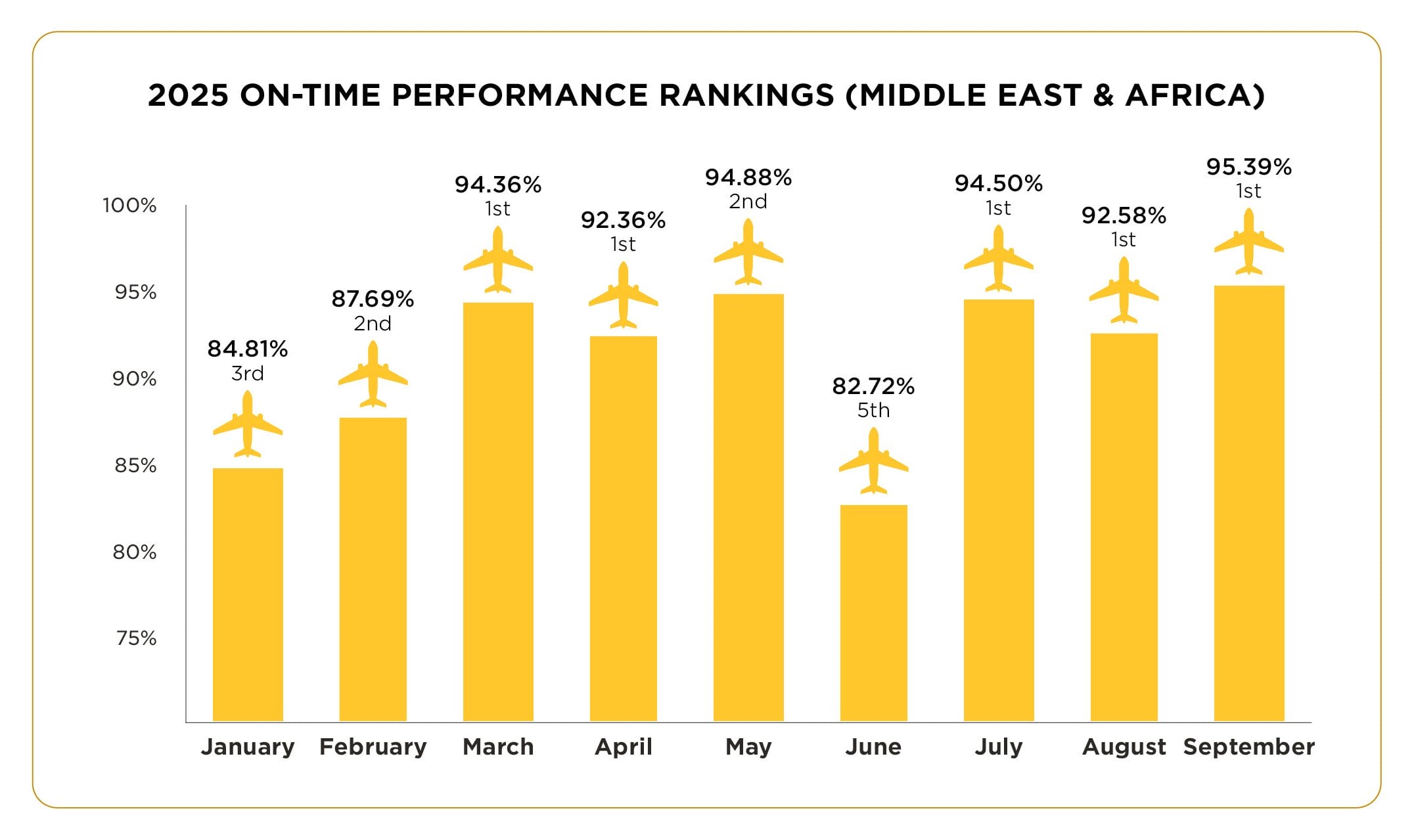
    Looking at these month-by-month results, what stands out isn’t just the peaks—it’s the consistency. Using Cirium’s definition of on-time arrivals within 15 minutes of schedule, Royal Jordanian maintained discipline even when they slipped to 5th in June. The airline had finished 3rd regionally in the 2024 Annual Review with 87.02% OTP and 99.31% completion rate.

    These aren’t isolated wins. They represent systematic process management across route planning, turnaround operations, and real-time decision-making under operational pressure.

    Leadership and Execution

    What changed under Chairman Said Darwazeh and CEO Samer Majali wasn’t the strategy—Royal Jordanian’s regional focus predates their tenure. What changed was execution discipline. Majali, who returned to Royal Jordanian in 2021 after leading Gulf Air and SaudiGulf Airlines, brought additional operational discipline that shows in the numbers.

    The 2024 results tell the story: operating profit jumped 260% to JD11.8 million on revenues of JD745.6 million, while carrying 3.7 million passengers. More telling—the airline is self-funding fleet modernization rather than relying on government capital injections. The leadership has plans to have had 70% of the fleet renewed by year-end.

    Fleet decisions drive operational performance. Based on the most current information from Cirium Fleets Analyzer, the airline operates 35 Aircraft currently with 11 on order. Order book includes a six B787-9’s, three A321’s, one A320 and one E195 E2. The average age of the current fleet is 8.7 years. This fleet mix is clearly about matching equipment to mission—and creating the frequency advantage that built the business model in the first place.

    Lessons for Mid-Sized Carriers

    H.E. ENG. SAMER ABDELSALAM MAJALI, Vice Chairman / Board Designee CEO, Royal Jordanian

    Royal Jordanian’s performance offers a template, particularly for mid-sized carriers navigating between legacy constraints and LCC disruption. The lessons are transferable:

    Strategic focus beats scale ambition. Trying to compete everywhere usually means winning nowhere. Royal Jordanian identified underserved regional routes and dominated them rather than fighting for share on contested long-haul corridors.

    Alliances multiply capability without multiplying cost. Oneworld membership gave Royal Jordanian global network reach without the capital requirements of building it organically. For carriers lacking the resources of Gulf super-connectors, alliance leverage becomes essential infrastructure.

    Service differentiation requires operational proof. Promising better service means nothing if flights don’t depart on time. Royal Jordanian’s OTP performance validates their service positioning—customers paying premium fares need reliability first.

    Strategic Clarity in a Crowded Market

    Royal Jordanian didn’t try to become Emirates or match Ryanair’s cost structure. They carved out defensible territory and executed with precision. What strikes me about their approach is the clarity—in an industry where many carriers struggle to articulate what makes them different, Royal Jordanian’s focus is unmistakable.

    That September result—95.39% with perfect completion—isn’t an outlier. It’s what happens when strategy and execution align consistently. With three months remaining in 2025, I’m watching closely to see if they can maintain this momentum through year-end.

  • Cirium forecasts 46,500 aircraft deliveries worth $3.4 trillion

    LONDON (Oct. 14, 2025) – Cirium, the world’s most trusted source of aviation analytics, today published its annual Fleet Forecast, revealing the future of the global commercial passenger and freighter aircraft market.

    The long-running independent forecast, produced by Cirium Ascend Consultancy, predicts 46,500 aircraft will be delivered globally over the next 20 years, equating to a total value of USD$3.4 trillion, as airlines continue to invest in newer, more sustainable aircraft.

    However, this year’s forecast comes as the aviation industry faces continued supply chain issues, geopolitical uncertainty, and delays to certification of new programmes, tempering the pace of fleet growth. The analysis projects a 6% reduction in deliveries over the next seven years compared to last year’s edition, mainly due to single-aisle aircraft production ramping up slower than expected. Long-term demand remains strong, with a 1% increase in deliveries overall.

    Other key findings include:

    • Asia continues to drive fleet growth, accounting for 45% of deliveries, led by demand in China and India.
    • Airbus and Boeing are projected to deliver 85% of aircraft and 92% by value through 2044, while COMAC is expected to capture 6% of global demand.
    • Single-aisle aircraft now account for 71% of the global fleet, while twin-aisle and regional jets remain below pre-pandemic levels.

    Stephen Burnside, Global Head of Cirium Ascend Consultancy, said: “This year’s Cirium Fleet Forecast shows the global aviation industry is moving forward with confidence despite near-term headwinds. Long-term demand remains robust across every region, airlines continue to invest in fleet renewal, and OEMs continue to incrementally increase their R&D budgets in preparation for the next generation of aircraft families. The next chapter of aviation growth is being defined by the need for supply chain resilience, production capacity right sizing, product and service innovation, and a focus on efficiency.

    An executive summary of the Cirium Fleet Forecast is available to download here.


    For Cirium media inquiries please contact media@cirium.com

    Notes to editors:

    • The forecast covers aircraft sized from 30 seats upwards and their freighter equivalents.
    • The forecast does not include electric, hybrid or hydrogen-powered aircraft programmes, as the development of existing or all-new commercial aircraft is expected to be centred on conventional propulsion, powered by increasing use of sustainable aviation fuel (SAF).

    About Cirium 
    Cirium® is the world’s most trusted source of aviation analytics. The company delivers powerful data and cutting-edge analytics to empower a wide spectrum of industry players. It equips airlines, airports, travel enterprises, aircraft manufacturers, and financial entities with the clarity and intelligence they need to optimize their operations, make informed decisions, and accelerate revenue growth. 

    Cirium® is part of LexisNexis® Risk Solutions, a RELX business, which provides information-based analytics and decision tools for professional and business customers.  The shares of RELX PLC are traded on the London, Amsterdam and New York Stock Exchanges using the following ticker symbols: London: REL; Amsterdam: REN; New York: RELX. 

    For more information, follow Cirium® on LinkedIn or visit cirium.com.

  • King Khalid International Airport: Precision, Planning and Performance in Riyadh

    Mike Malik, Chief Marketing Officer, Cirium

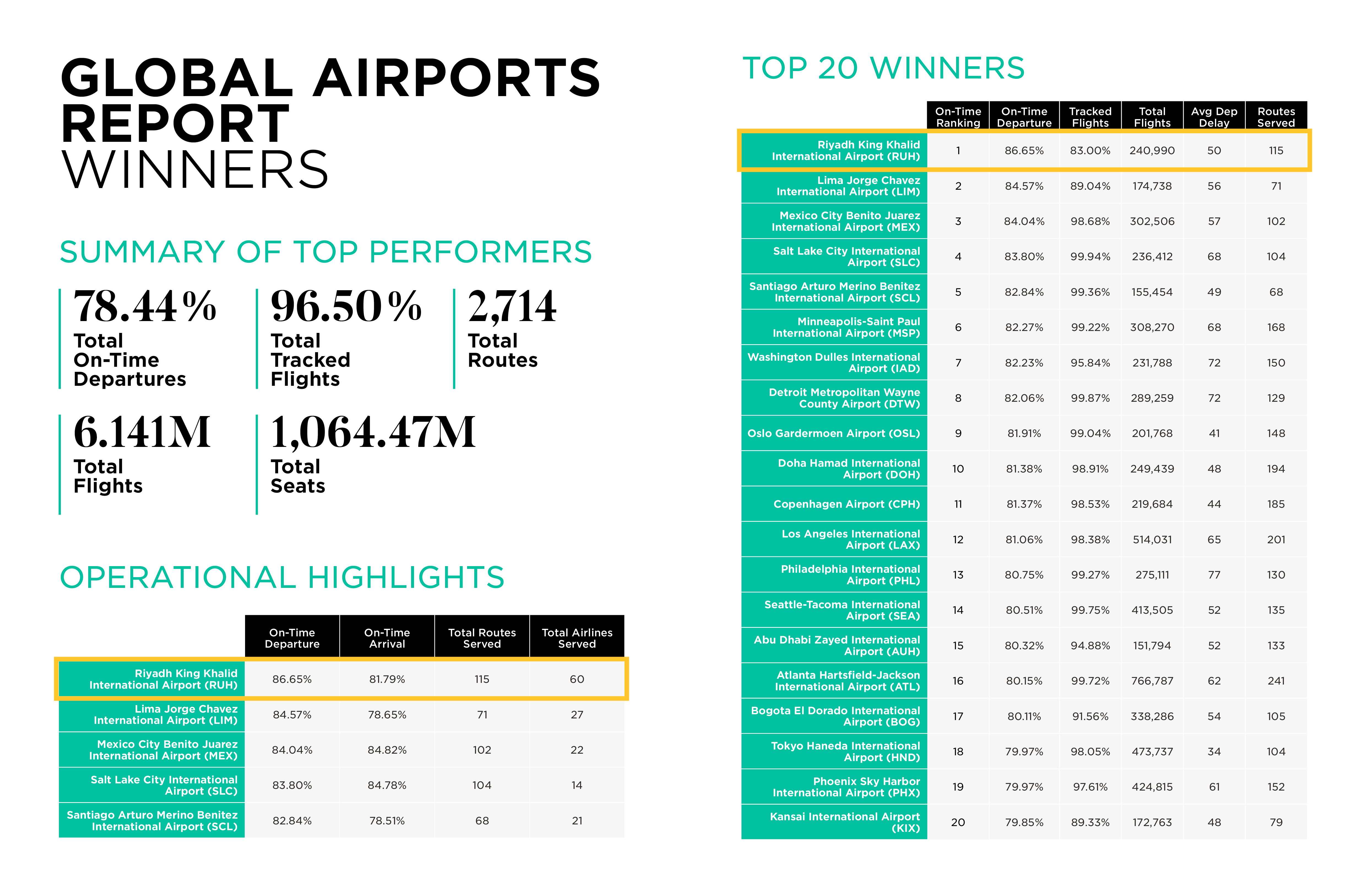
    King Khalid International Airport (RUH), positioned 35 kilometers north of Riyadh, Saudi Arabia has established itself as a global benchmark for airport operational excellence. In Cirium’s 2024 On-Time Performance Awards, RUH was recognized as the Most On-Time Global Airport, achieving an industry-leading departure OTP rate of 86.65%—a distinction that places the airport at the forefront of global aviation performance standards.

    In 2024, the airport handled a record-breaking 37 million passengers with double-digit year-on-year growth, added 15 new airlines to its roster and recognized as the second busiest airport in the Kingdom. These results demonstrate effective integration of infrastructure, planning, and process optimization across increasing passenger volumes.

    Leadership Driving Transformation

    Under the stewardship of CEO Ayman Abdulaziz AboAbah, who was appointed in February 2024, Riyadh Airports Company has accelerated its operational excellence initiatives. Mr. AboAbah brings extensive aviation sector experience, having previously served as CEO of Jeddah Airports where he enhanced planning and operations at King Abdulaziz International Airport. His tenure has coincided with RUH’s ascent to global recognition, reflecting strategic focus on operational discipline and systematic performance improvement.

    The leadership team’s commitment to excellence has resulted in exceeding revenue targets by over 15%, with enhanced offerings, stronger partnerships, and significant increases in passenger movements, according to industry reports. This performance underscores the airport’s evolution from regional gateway to emerging global hub.

    Operational Resilience Through Strategic Infrastructure

    Ayman Abdulaziz AboAbah, CEO, Riyadh Airports Company

    RUH’s performance reflects purposeful modernization strategies implemented over several years. The expansion of Terminals 1 and 2 increased the airport’s passenger handling capacity by 40% — from 10 million to 14 million annually. By upgrading baggage handling, adding security lanes, and introducing automation like self-service kiosks and automated boarding gates, the airport has cut processing times per passenger and unlocked higher throughput.

    The 2022 commissioning of Terminals 3 and 4 marked a decisive step in RUH’s evolution. Terminal 3’s reconfiguration from domestic to international operations represents an important strategic shift to accommodate long-haul growth. A centralized check-in system now serves both terminals, allowing flexible resource utilization and enhanced operational fluidity. These terminal linkages, combined with renewed airside control infrastructure, have streamlined aircraft movements and reduced turnaround times—key enablers of on-time departures.

    The airport’s connectivity received another boost with the opening of Riyadh Metro Line 4 on December 1, 2024, providing passengers with efficient access to the city center through stations serving all terminal complexes.

    Strategic Alignment with National Objectives

    RUH’s growth is tightly linked to Saudi Arabia’s Vision 2030, supporting Riyadh’s emergence as a global hub for business and tourism. Backed by GACA and managed by Riyadh Airports Company, its development roadmap ensures infrastructure expansion matches the pace of rising traffic and future demand—positioning RUH as a cornerstone of national connectivity.

    The on-time performance gains reflect systematic operational improvements rather than statistical outliers. Enhancements to landside and airside coordination, expansion of aircraft parking bays, and deployment of real-time operational control technologies are part of a disciplined approach to minimize delays and improve predictability across the passenger journey.

    Data Standards and Industry Recognition

    Cirium’s On-Time Performance program serves as the gold standard for measuring airline and airport operational performance, using rigorous methodology that combines global flight tracking with airport-level operational data. On-time flights at airports are defined as those departing within 15 minutes of scheduled departure times. RUH’s recognition within this program reflects not only punctuality but consistency—demonstrating reliable performance across a complex operational environment.

    The achievement underscores a broader transformation taking place across the Kingdom’s aviation sector—one that extends well beyond operational metrics to fundamental shifts in how airports can function as economic catalysts.

    From Regional Gateway to Global Hub

    Since opening in 1983, King Khalid International Airport (RUH) has evolved from a regional gateway to a critical global node. The transformation required infrastructure investment, operational discipline, and leadership vision working in concert.

    Today, King Khalid International Airport (RUH) stands as one of the world’s most efficient large airports—a working model for how airports can excel amid rising expectations and traffic complexity. In an industry where timing defines competitive advantage, RUH’s four decades of strategic evolution positions it as an essential component of Saudi Arabia’s aviation future, proving that systematic operational excellence achieves results that resonate across global performance benchmarks.

  • For the aircraft engine market, newer may not be better – yet

    Vanessa Gu, Asia Finance Editor, Cirium

    Power to perform: The aircraft engine market was broadcast live Thursday 25th September.

    The cost of maintaining new-generation engines is expected to be higher than current-generation engines even with improvements in hardware, supply and the easing of MRO constraints.

    That is as the latest engines are requiring more shop visits than those of 10 years ago as more efficient fuel burn has inadvertently resulted in quicker wear and tear, and shorter time on wing.

    While ongoing improvements such as Pratt & Whitney’s GTF Advantage programme and more durable blades on the CFM International Leap engines are expected to allay some of those issues, “it still is an altogether different level of cost on engines now compared with the previous generation,” says Giles Thomas, Managing Director at Charlotte Parker Associates.

    “So it will get better. I don’t think, unfortunately, we’re going to get back to the levels of time on wing and product robustness, or reliability … that we, for example, saw relatively now on the CFM56, V2500, widebody, GE CF6, Trent 700 which were pretty predictable,” he adds, while speaking on a panel Cirium’s ‘Power to perform: the aircraft engine market’ webinar.

    At the same time, the unreliability of new-generation engines has made an increasing number of airlines “a bit reluctant to look into the new technology aircraft also because there’s a lot of risk which they got to take on that,” says Mahesh Kumar, chief executive of Capital A subsidiary Asia Digital Engineering, who was also on the panel.

    That reluctance has been exacerbated by engine manufacturers moving away from power-by-the-hour agreements as OEMs have underestimated the amount of maintenance and repair their engines need, says Kumar.

    Coupled with the ongoing supply chain crunch and MRO slot constraints, the values and lease rates of old and new generation engines have rocketed in the past six years, leaving airlines to bear the brunt of added costs.

    “That’s the interesting part of it – your product [new generation engines] is not reliable, the value of your engine went up because the demands spiked up, so on that I would say the airlines are on the suffering part of it,” Kumar states.

    Engine values and lease rates

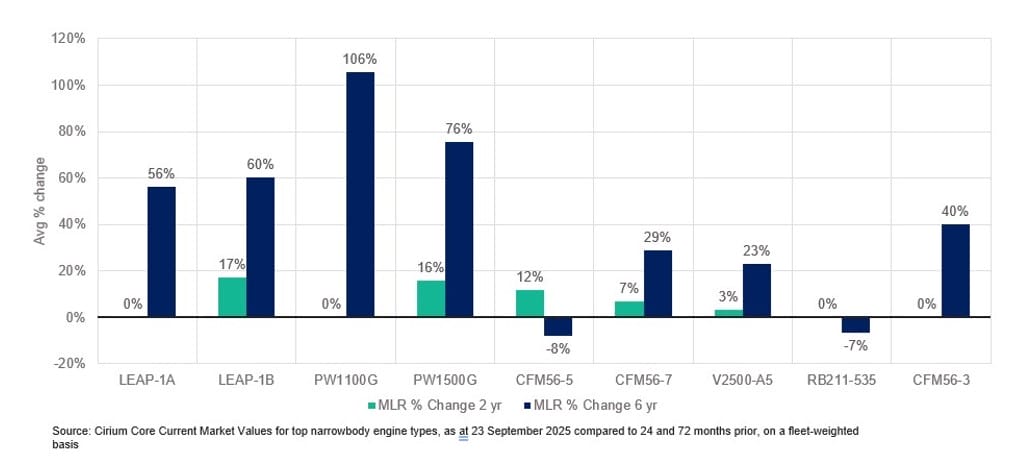
    The market lease rates of narrowbody and widebody engines have gone up by 34% and 23%, respectively, while market values are up 14% and 5%, respectively, compared to September 2019, details Cirium’s Senior Valuations Analyst Lionel Olonga on the webinar.

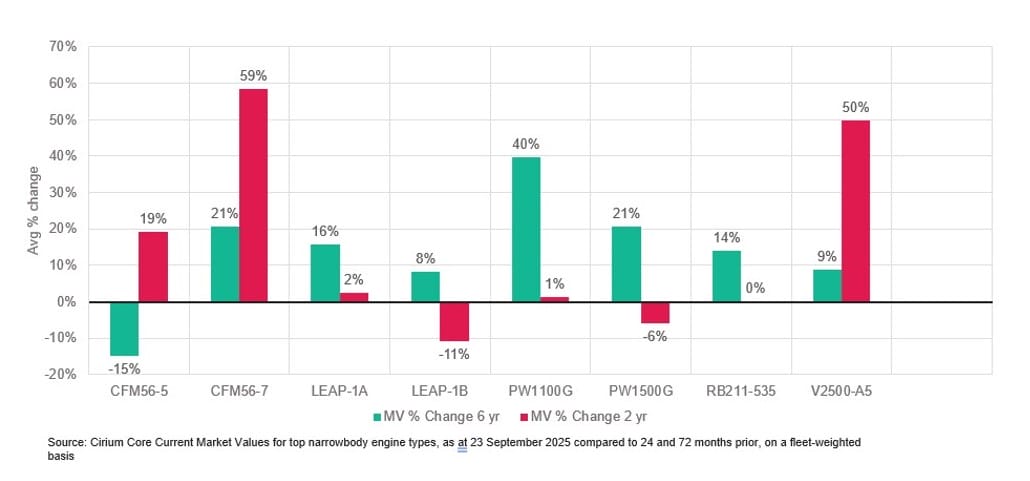
    Breaking it down further for narrowbody engines, the increase in value is most pronounced over the last two years for CFM56-7B engines that power Boeing 737-800s and International Aero Engines V2500 powering Airbus A320ceos.

    The increase in values for -7Bs are mainly driven by the NGs operating for longer due to delivery delays, while the increase for V2500s are due to operators which have A320neos powered by Pratt & Whitney’s PW1100G engines in their fleet renewal plans increasing the use of their existing -ceos, explains Olonga.

    On market lease rates, PW1100G has seen a more than two-fold increase on lease rates compared with 2019, while the Leap-1A and -1B engines have seen a more than 50% increase.

    These increases come on the back of an uptick in maintenance costs and green time value for new generation narrowbody engines – such as the Leap and GTF – which have increased by over 50% in the last six years, while those for CFM56s and V2500s are 10-30% higher, says Olonga.

    Widebody engines also tell a similar story, with maintenance costs and green time values up 60% for new generation engines and a 10-30% uptick for older generation engines.

    Gradual decline to sane pricing

    The current issues facing the industry have been described as a perfect storm that is expected to bare its teeth until the end of the decade.

    However, as the supply of new aircraft increases and as MRO constraints ease, there will be a “readjustment”, says Thomas, though he cautions it will be gradual and measured.

    As older aircraft retire with the incoming new generation jets, Thomas is of the view that values of CFM56s or the V2500s “will certainly decline”.

    “A decline, I should clarify, doesn’t mean … necessarily, very quickly. And what I mean is decline from the current very high levels today” to “historic levels pre-Covid” before the aircraft types start retiring in volume, he says.

    An example of “high levels”, he details, is how he heard anecdotally that “completely run out” CFM56 engines with no performance left and “virtually done” life limited parts trading for above $3 million.

    “Therefore, that sort of elevated level of value, which is purely a factor of lack of MRO capacity and lack of power supply, that will disappear, so therefore the engine values would, for that sort of engines, go back to a million or less,” he goes on to say.

    In the meantime, however, values for engines are expected to stay high as airlines continue to grapple with a litany of issues ranging from MRO slot constraints and unreliability of new generation engines.

    Kumar says the need for spares is not merely about manufacturers producing the required engines but also related to increased shop visits due to engine reliability issues.

    And shop visits now have longer turnaround times and increased costs, and from an airline’s perspective, “it might make sense to get another engine in, rather than putting the older engine for a shop visit,” states Kumar. This in turn further drives up values.

    Regardless of when the gradual fall of values might happen, Thomas cautions: “If one is investing in engines today, one needs to be very aware of what engine build standard one is investing in, so that you have some knowledge and competence in the longevity of that particular engine variant of any new engine technology engine.”

    Premature aircraft partout will continue (for now)

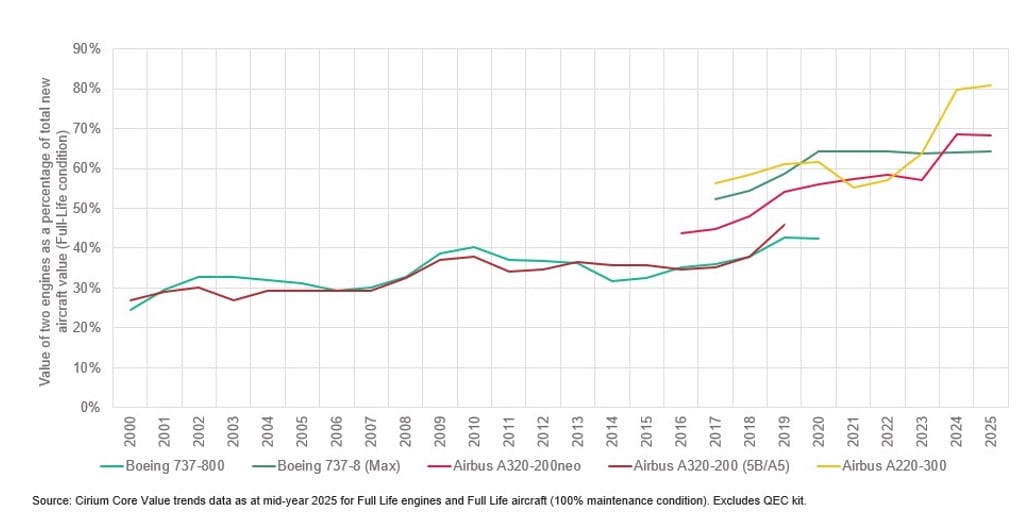
    There are at least 15 A320neo family aircraft that have been retired for part-out as the value of a pair of engines is hovering close to 70% of total aircraft value for the type, says Olonga.

    With the value of engines taking up such a big portion of aircraft value, the interest in purchasing aircraft for the engine or for parting them out is expected to continue.

    Thomas recalls how one airline said it was doing four engine changes in the next 10 days “purely to keep its fleet flying”, highlighting a “horrendously complex situation which is not going to be cured quickly”, meaning demand for part-out engines will remain high.

    At the same time, for lessors, leasing an aircraft at a price they need while taking into consideration the high engine values may be hard for airlines to swallow.

    “Therefore the solution for engines is actually pretty neat, and the byproduct of that also is all the serviceable used material from the rest of the aircraft and airframe,” says Thomas.

    Kumar likewise concurs that interest in parting out new generation aircraft will continue, recounting that an airline was willing to lease a widebody just to drop both the engines and put it back to operations.

    “It makes complete sense for the lessors to just drop the engines from the aircraft and then lease it where they can make a better margin out of it, rather than leasing the whole plane,” he says, adding that it also reduces transition and redelivery costs.

    Despite the continued interest, it is widely acknowledged that the parting out of six-year-old aircraft with years of service left due to part shortages and limited MRO slots is highly unsustainable.

    While Thomas expects the situation to continue in the shorter to medium term, he hopes to see “common sense and normal rules of the aviation industry returning in a couple of years’ time”.

    Power to perform: The aircraft engine market is now available to watch on demand.

  • How will airlines maximise value from the A321XLR?

    Cirium Ascend Consultancy is trusted by clients across the aviation industry to provide accurate, timely, and insightful aircraft appraisals. The team provides the valuations and analysis the industry relies on to understand the market outlook, evaluate risks and identify opportunities.

    Discover the team’s industry reports & market commentaries. Read their latest expert analysis, viewpoints and updates on Thought Cloud.

    Richard Evans airline consultant
    Richard Evans airline consultant

    Richard Evans, Senior Valuations Consultant, Cirium Ascend Consultancy

    With the first examples of the Airbus A321XLR variant now in service, the network plans for this sub-type of the extremely successful A321neo are starting to become clearer.

    There are now four airlines with aircraft in regular service, with at least two more to come by the end of 2025. It has not all been plain sailing for the new variant, however, with delays due to certification and seat supply issues. There has also been the news that Wizz Air is exiting the Abu Dhabi market, which calls into question its commitment to the XLR.

    Airbus does not formally split out variants within its A321neo order book. Cirium’s Fleets Analyzer currently shows a total of 15 aircraft delivered (11 in service and 4 currently stored), plus a firm order backlog of 461 units for commercial customers. This represents around 9% of the total A321neo backlog, but there could be additional commitments that have not been made public.

    To what extent the XLR is a niche version of the type, or not, is a relevant question for financiers and lessors, especially given the XLR commands a price premium for its capability. To illustrate this, Cirium’s Values Analyzer shows a Full-Life Market Value (FLMV) of $62.4m for a brand-new baseline A321neo (no ACTs, 93.5t Max Take-off Weight). This increases to $66.8m for an A321neo, with 3 tanks fitted and 97t MTOW. Although not an official nomenclature, this configuration is often referred to as an A321neo LR. For the XLR, FLMV increases to $71.9 million. For comparison, the smallest twin-aisle type currently in production, the 787-8, commands a FLMV of $127.9 million.

    A321XLR order book, as at 17 September 2025

    Operator regionOperatorDeliveredOn orderInitial deliverySeating layout (where known)
    Asia PacificAirAsia Group702027 
     Cebu Pacific92026236
     Drukair22030 
     IndiGo292025195
     Jetstar362027 
     Peach32030218
     Qanot Sharq32027 
     Qantas2172025200
     VietJet Air152026 
    EuropeAer Lingus422024184
     Azores Airlines12027 
     Iberia442024182
     Icelandair122027187
     Wizz Air Group3442025239
    Latin AmericaJetSmart Chile142030 
     LATAM Group52027 
     Sky Airline102026 
    Middle EastAir Arabia202028 
     Flynas102026 
     MEA42027160
     Saudia15  
    North AmericaAir Canada302026182
     Air Transat32027199
     American Airlines2482025155
     JetBlue (Aegean)132025138
     United Airlines502026150
    LessorsAerCap9  
     Air Lease Corporation18  
     Aviation Capital Group5  
     BOC Aviation10  
    Operator regionOperatorDeliveredOn orderInitial deliverySeating layout (where known)
    Asia PacificAirAsia Group702027 
     Cebu Pacific92026236
     Drukair22030 
     IndiGo292025195
     Jetstar362027 
     Peach32030218
     Qanot Sharq32027 
     Qantas2172025200
     VietJet Air152026 
    EuropeAer Lingus422024184
     Azores Airlines12027 
     Iberia442024182
     Icelandair122027187
     Wizz Air Group3442025239
    Latin AmericaJetSmart Chile142030 
     LATAM Group52027 
     Sky Airline102026 
    Middle EastAir Arabia202028 
     Flynas102026 
     MEA42027160
     Saudia15  
    North AmericaAir Canada302026182
     Air Transat32027199
     American Airlines2482025155
     JetBlue (Aegean)132025138
     United Airlines502026150
    LessorsAerCap9  
     Air Lease Corporation18  
     Aviation Capital Group5  
     BOC Aviation10  

    Source: Cirium Fleets Analyzer

    The status of JetBlue’s order is unclear, with its first two aircraft destined for sale to Altavair on delivery, for onward lease to Aegean Airways. It also appears likely that the Wizz Air Group will convert some of its backlog to other versions of the A321neo.

    By the end of 2026, there are set to be at least 13 airlines flying the XLR, operating in a wide variety of seating layouts. Many, such as Aer Lingus, Air Canada, Aegean, American and United, will fly with lie-flat business class seats, in contrast to Wizz Air and other Low Cost Carriers (LCCs) flying with high-density seating layouts of 230-240 seats. Qantas plans two different layouts, with initial deliveries having a 37 inch pitch business product, but then others with full lie-flat business class for longer routes.

    The selling point of the XLR is additional range. Airbus markets the type as having a range of up to 4,700 nautical miles (nm), but this is subject to caveats. Firstly, this is the range with a standard dual-class seating configuration. Fitting more seats will mean less range. Secondly, real-world routings and headwinds generally cut the true capability, for great circle distances, by around 15%. Thus, the longest route that could be reliably flown year-round may be more like 4,000 nautical miles great circle. This is similar to London to Denver, or Sydney to Bangkok.

    For airlines configuring just 138-155 seats, the range capability may, conversely, be more than 4,000 nautical miles. These type of configurations, including business class and premium economy seats, are clearly aimed at high-yield premium markets.

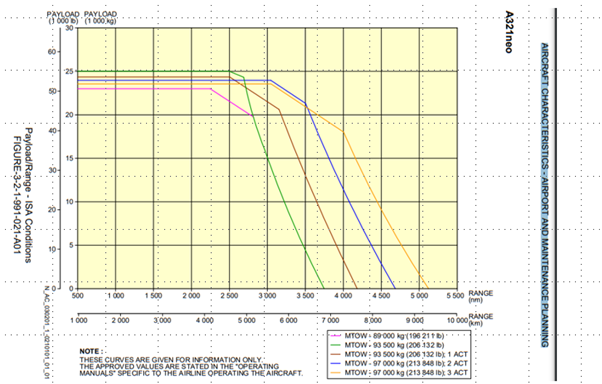
    Airbus has not yet published a payload-range chart on its Airport Operations and Aircraft Characteristics website, but the below chart including the A321neo LR (97,000kg MTOW with 3 ACTs) highlights the issue of payload capability. It shows that for an LCC, such as Wizz Air with 239 seats, the aircraft is operating very close to its maximum payload of around 23 tonnes.

    A321neo payload-range capability

    Source: Airbus

    We believe the XLR will have a marginally higher empty weight than the LR, but that Airbus is looking to increase the MTOW from 101t to 101.5t to restore payload and/or range capability. It is thus likely that the XLR will have a similar maximum payload to the A321LR. This means that fitting 230 seats or more results in hitting maximum payload on routes with high luggage needs – typical of many routes to/from the Middle East, Africa, and Latin America. This is not an issue for network airlines, where they are fitting low-density dual-class or three-class layouts.

    The big question, therefore, is where do the XLR operators plan to fly their aircraft, and how far can they extend operations into markets previously only available to longer-range twin-aisle types?

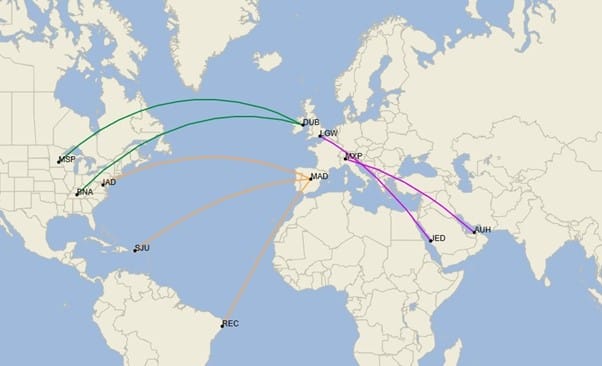
    The longest routes currently flown by the initial operators are shown on the map below. Iberia’s Madrid-San Juan route is 3,448 nm great circle distance and Aer Lingus’s Dublin-Nashville flight is 3,394 nm. Wizz Air’s Gatwick-Jeddah and Milan-Abu Dhabi services are both around 2,550 nm. This highlights that the XLR is not really required for most Middle East to Europe operations, but also that the initial operators are not pushing the range out to anywhere near Airbus’s marketing figure. As an example, Etihad Airways recently stated it saw the A321LR as sufficient for its needs.

    Longest current A321XLR routes, November 2025

    Source: Cirium schedules data

    For reference, the longest A321LR route today is Sharjah to Kuala Lumpur by Air Arabia, with 215 seats, at 2,990 nm. This matches very well with the A321LR range in Airbus’s payload-range diagram of  around 3,500 nm, before track and headwinds are accounted for, at 21t of payload.

    Several other airlines have announced their initial A321XLR routes. Aegean has said it will fly to Mumbai (2,783 nm) and Delhi (2,697 nm) initially, potentially followed by Bangalore (3,216 nm). It will have a code-share partnership with IndiGo, who will also use its first XLRs on these two markets. Lastly, Air Canada will operate the type on Montreal to Edinburgh (3,031 nm), Toulouse (3,569 nm) and Palma de Mallorca. The latter is the longest route announced yet, at 3,777 nm, and will be a summer-only service.

    Analysis of existing and planned XLR routes indicates the real-world range network capability of the XLR (taking into account headwinds and track deviation) comes out more like 3,500-4,000 nm with low-density seat layouts, or considerably less for a 239-seat Wizz configured aircraft.

    To conclude, the A321XLR looks set to be a very important aircraft for many airlines, especially those seeking to maximise premium revenues on thinner business or leisure-focussed routes.

    For LCCs, it may be less attractive. For them, ancillary revenue is very important and flying longer missions does not necessarily maximise this. There may be more hold-bag fees and more opportunity to sell meals on longer flights, but there are fewer flights per day to do so. Having a sub-fleet of XLRs may also limit the ability to maximise asset utilisation across both short and long sectors.

    It is still too early to accurately forecast what proportion of the A321neo fleet the XLR will represent long-term. It may well be a relatively niche product, but has already been ordered by several influential major carriers. Liquidity could be an issue, but major network airlines tend to retain their aircraft longer, so this could be mitigated, such that the premium pricing for the type is justified.

  • Air travel demand: Is it faltering?

    Thomas Sweeney - Cirium Ascend Consultancy
    Thomas Sweeney - Cirium Ascend Consultancy

    Thomas Sweeney, Valuations Associate, Cirium Ascend Consultancy

    As the summer winds down and we look ahead to a busy couple of months of conferences and events, I wanted to examine how risks to travel demand – which seemed unknowable six months ago – have been shaping up. In April when President Trump announced sweeping tariffs, the ensuing economic uncertainty was as large a risk to the aviation sector as the direct impacts of tariffs on aircraft trading. The latter continue to be defined and negotiated but the former have gained some clarity. The US market is naturally the most directly affected by recent events, though instability and contraction in the US economy will always have global ramifications. As the issuer of the world’s reserve currency and a major source of sovereign debt held globally, US economic instability quickly impacts global markets through shifts in dollar value, Treasury yields, and the productivity trends that underpin global growth expectations.

    Economists have been asking if the US is in a recession. Shortly after the tariffs were announced many were predicting one, albeit mild. Government data suggests that the economy is growing, and recession has been avoided so far [1]. However, a common view among economists is that growth in the country is highly unevenly distributed between both sectors of the economy, socioeconomic groups and geographical regions[2]. Large investments into AI have resulted in strong growth for companies developing and utilising the technology. A second major driver of growth has been by the wealthiest segment of Americans. The top 10% of earners account for nearly 50% of consumption[3]. Has the demand for air travel been buoyed by wealthy spenders and AI investment or is there weakness indicative of a weaker economy outside these areas?

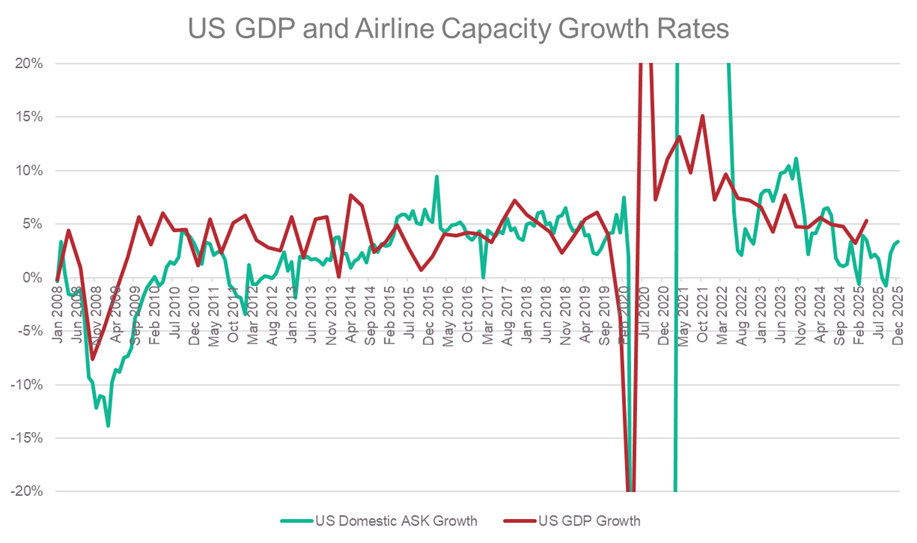
    Growth in US capacity (ASKs) is correlated to overall GDP growth, amongst other factors. The correlation is not direct – there are specificities in the airline market distinct from the general economy – but the link is clear:

    Source: Cirium Core and Federal Reserve Economic Data (FRED)

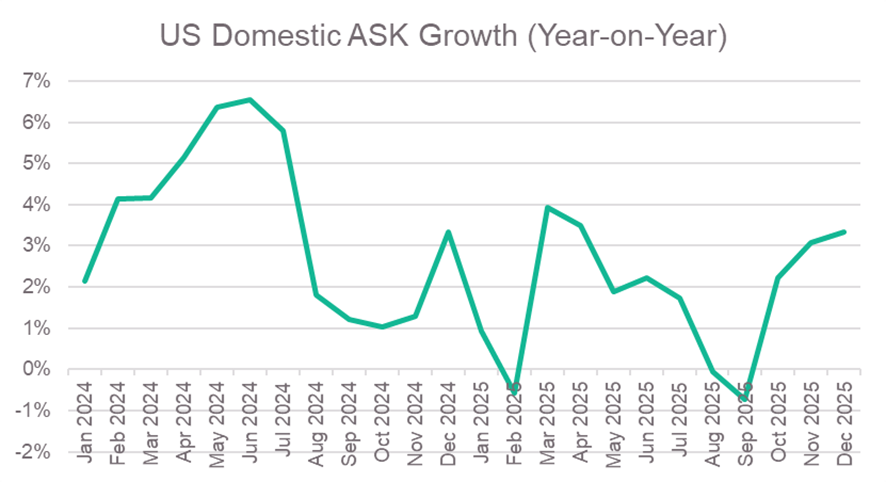
    Zooming in to the most recent months, domestic capacity has been growing slower in 2025 than 2024 and, in some months, capacity has contracted.

    Source: Cirium Core

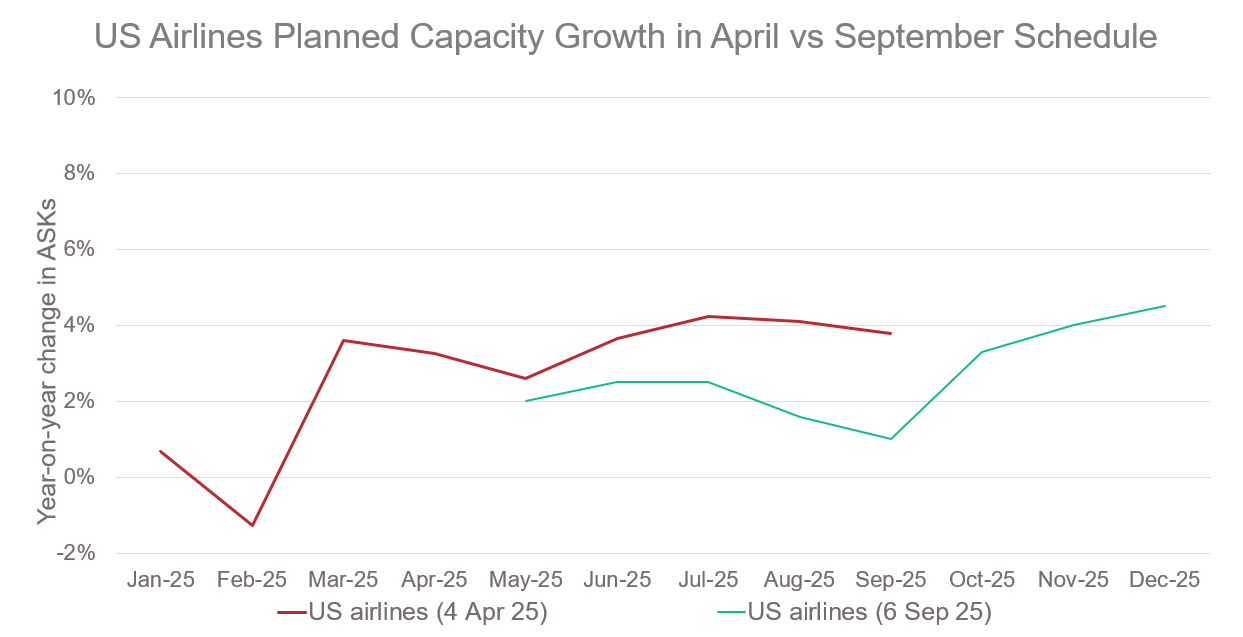
    Several US airlines cut capacity from Q2 onwards in response to the economic uncertainty caused by tariffs. Planned domestic and international capacity has been cut by up to three percent by US airlines.

    Source: Cirium Core

    Capacity growth is recovering in the later part of the year, potentially as the uncertainty has waned in recent months. Nonetheless, apart from 2020 heavily influenced by the Covid-19 pandemic, 2025 appears to be the weakest year for capacity growth in a decade.

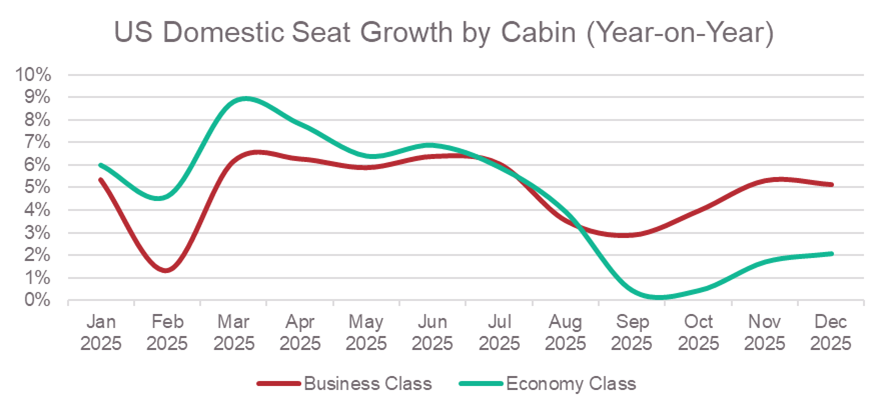
    The picture is consistent with a growing economy for which there remains significant risk. Travel demand (and resulting capacity) within the US is exposed to the high-growth sectors of the economy, especially wealthy consumers who travel more frequently and in higher yielding cabins. Cutting capacity growth and focusing on premium travel can be a positive for airlines, allowing them to keep yields high. In the second half of 2025, capacity growth has been much slower in economy class seats, with business class seats remaining more robust.

    Source: Cirium Core

    Average US personal consumption expenditures have grown at their slowest level since 2020[4], which has been translating into the softening demand and capacity growth, even if it’s in lower-yielding cabins and sectors. Travel demand, like the US economy more generally, is likely to be highly sensitive to the consumption of the wealthiest segment of Americans. Any downturn which affects the spending habits of this group, such as a slump in AI confidence and investment, could impact air travel demand quickly. With risk concentrated in this way, close attention must be paid to economic signals for this group.

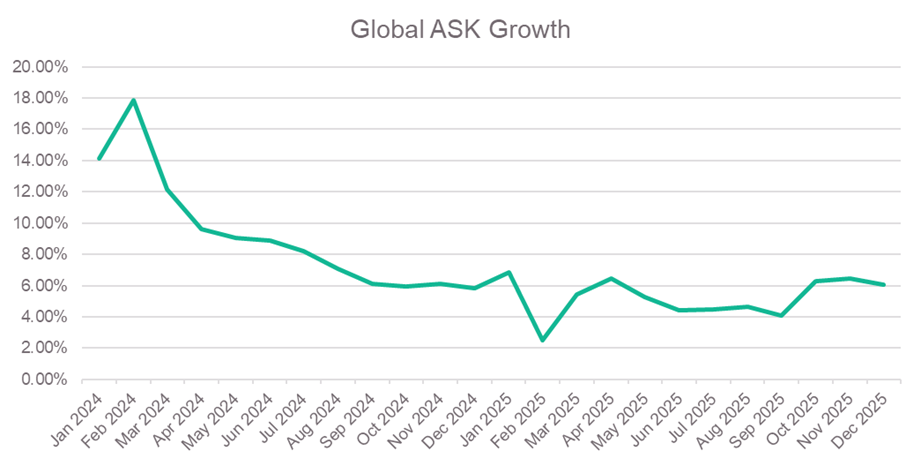
    The US domestic market is markedly weaker than other regions. Despite the impact of tariffs on other countries, most do not show significantly weakened economies as compared to the beginning of the year. Global scheduled ASK growth is healthy, sitting between 4% and 6% for most of this year.

    Source: Cirium Core

    Global demand is remaining strong. However, the nature of the global economy and financial system is such that issues in the US have an outsized influence globally. US growth is currently resting on a few small groups. Softening there could have downstream effects on not just the US domestic airline market but passenger demand globally. Therefore, it is critical that we continue to monitor the health of this market for warning signs and proactively consider how we will navigate those challenges.

    Meet the Cirium team at Airline Economics Growth Frontiers London 2025.

    Hear from Thomas on the SAF Panel, Thursday 18th September 2025 at 14:00. Eleni Maragkou will join the Lease Rates & Valuations Panel, Wednesday 17th September 2025 at 11:40.

    [1] fred.stlouisfed.org/series/GDPC1
    [2] www.ft.com/content/e9be3e3f-2efe-42f7-b2d2-8ab3efea27a8
    [3] https://www.wsj.com/economy/consumers/us-economy-strength-rich-spending-2c34a571
    [4] fred.stlouisfed.org/series/PCECC96

  • A Marathon Mindset: The 2025-2034 Cirium Helicopter Forecast

    Sara Dhariwal, Senior Aviation Analyst, Lead Appraiser – Helicopters & AAM, Cirium Ascend Consultancy

    The past decade has for the helicopter industry been largely lived through a downturn. A prolonged period of significantly reduced oil prices affected production and exploration, which impacted the offshore support market. This turned relative undersupply to oversupply at a rapid speed leaving a substantial pool of excess helicopters, resulting in notable pressure on values. Growth slowed from a CAGR of around 2.5% prior to 2015, to 1.2% in the most recent decade. 

    In 2024 there was a fleet growth of 1.9% which is the strongest since 2015 signalling ongoing recovery.

    The growth has been supported by stable deliveries, and lower attrition – with fewer retirements and total losses. In 2024, there were almost 100 fewer retirement/total loss events than in 2023. This means that existing fleet is being used longer supporting the long useful lives of helicopters, which helps strengthening investment cases. It also marks a welcome and long-term improvement in terms of safety.

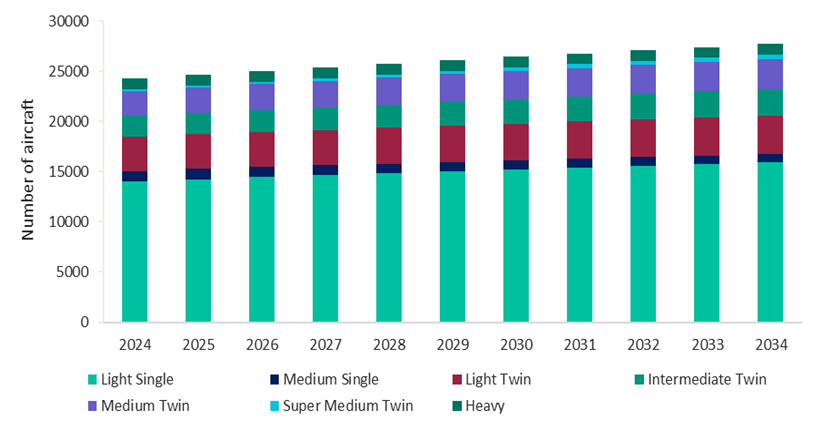
    Over the next 10-year period, the 2025 Cirium Helicopter Forecast anticipates a continued steady rebound at a pace of 1.3% year-on-year. The market is expected to welcome 7,500 new civil turbine helicopters, reaching a fleet of 27,700 by 2034. Key drivers will be the need for replacements and rising demand in emerging markets.

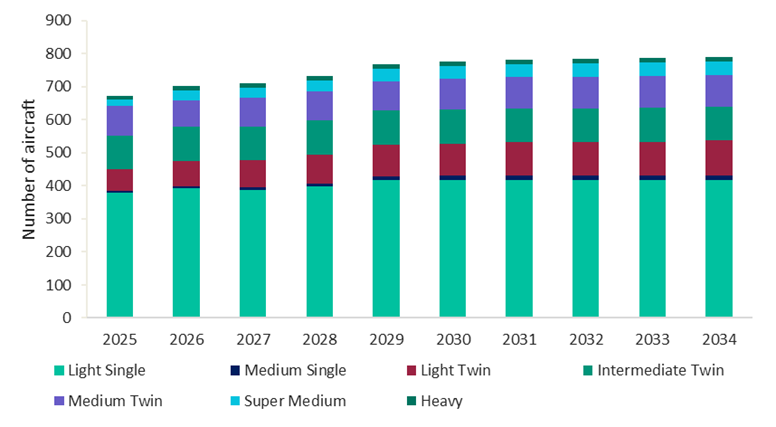
    Helicopter delivery forecast (2025-2034)

    Despite recovery from the oil and gas downturn and the Covid-19 pandemic, the 2025 forecast is 3% lower than 2024 due to ongoing supply chain constraints making lead times for new aircraft extensive. Annual deliveries dropped to 512 in 2020 but rebounded to nearly 700 in 2023, with no growth in 2024. A 5% decline is expected in 2025 compared to 2024, with gradual recovery projected and reaching 2014 levels (~790 units) by the early 2030s.

    Overall, the forecast anticipates –

    • 7,500 new civil turbine helicopters valued at $50 billion in 2025$ (based on a Base Full-Life Value for a typical utility machine) to be delivered over the next decade.
    • 54% of demand is expected to be driven by replacement, and 46% by fleet growth.

    Forecast annual civil helicopter deliveries 2025-2034

    Source: 2025 Cirium Helicopter Forecast

    Key factors stimulating future helicopter demand include:

    • Aging fleets, especially in North America and Europe.
    • Recovery in offshore oil support and growth in Asia-Pacific.
    • Introduction of new models (e.g., H140, R88, Bell 525).

    In 2024, there were 225 helicopters recorded as retired which was 100 fewer than 2023 and likely a result of a combination of high demand and constrained supply, as OEMs find challenges in despatching new helicopters due to ongoing supply chain issues. Subsequently and whilst deliveries are not predicted to increase significantly in the near term due to the challenges, it leads to longer use of the existing fleet.

    Longer use underpins the asset class having strong residual values, supporting investment.

    Helicopter replacement demand

    Over the last 10 years, Cirium recorded approximately 2,200 permanent retirements, averaging around 1% of the fleet annually. This retirement rate is relatively low compared to commercial fixed-wing aircraft standards.

    The average age of retirement in the past 10 years has been at 37.5 years.

    Besides the physical retirements, there is also attrition from the fleet through accidents (total losses), which has to be factored into replacement demand and can be added to retirements.

    Cirium Ascend monitors the total losses for helicopters and some 1,200 were recorded in the past 10 years. As helicopters operate in many different roles and environments, their loss rate can be comparatively high versus other commercial aviation sectors.

    On a per year basis, some 1% of the fleet was being lost 20 years ago, but the trend has been declining and has been at just 0.5% in the most recent ten-year period. In 2024, the recorded rate was a record low of only 0.4%. This effectively means there is replacement demand for an average of 1.4% of the fleet annually, or 4,050 civil turbine helicopters in the next 10 years, which is 17% of the current total fleet.

    Helicopter fleet growth outlook

    Forecast civil helicopter fleet to 2034

    Source: 2025 Cirium Helicopter Forecast

    By 2034, the global fleet is projected to reach 27,700 helicopters, growing at a slow but steady 1.3% annually, slightly higher than the previous decade’s rate.

    North America is projected to remain the largest market, followed by Europe. The projection for Asia-Pacific has been revised in the 2025 forecast due to growth slowing down in recent years following restriction on airspace usage in China, impacting demand for helicopters.

    Slow but steady seems a good pace for the helicopter market. The pre-2014 sprint approach to secure quick returns failed. Few held on to those returns as the oil and gas downturn led to financial hardship across the industry.

    Some would argue that slow and steady is “boring” and implies that there isn’t anything of interest going on in the market. The stronger argument is possibly that slow and steady provides companies the time required to make better, more considered long-term strategic decisions.

    The past decade suggests that discipline, and resilience alongside consistency, pacing, and the ability to learn from experience and adapt to unexpected situations is key. In other words, a Marathon Mindset, rather than that of a sprint.


    REQUEST THE FULL 2025-2034 CIRIUM HELICOPTER FORECAST HERE

  • Rob Morris: Reflecting on a 35-year career in aviation

    When Rob Morris checks out from Cirium Ascend Consultancy‘s London Heathrow headquarters at the end of August, he will be calling time on a 35-year career in which he has gone from British Aerospace market analyst to influential voice that resonates across the ever-changing global aviation industry.

    As will be familiar to many in the industry, the spark of that career began in childhood, says Morris, recalling that he received a pair of binoculars one year for Christmas and headed down with his brother to Heathrow to try them out.

    “We spent a day watching the planes, and my passion for aviation was born just looking at those planes.”

    That spark ignited something, but Morris admits he was “a fairly naive teenager, not knowing what I really wanted to do”, so settled on studying chemistry, which led to a job with the United Kingdom Atomic Energy Authority in the 1980s.

    The shift into aviation would not come until 1989 when he applied for a database analyst position at British Aerospace, but the role was already filled. However, as a market analyst had just left the company, Morris was invited back to interview for that role. This resulted in a career change at age 27, to start work at BAe in Hatfield.

    “And I still remember sitting there in May 1990, my first day in Hatfield thinking: ‘Am I getting paid to do this? That’s robbery!’”

    He primarily worked on BAe’s Worfleet database, with the task of running queries of fleet data and at times the ABC Schedules database – a grounding for his later role leading consultancy at Cirium.

    “Everything our team says now is based upon a reading of the data and interpretation of the data, the trend of the data, that kind of thing. So having been privileged enough to work with Cirium and being able to go and present that data to the world has been an end of my career that I could never have imagined.”

    Back in the early 1990s, as a 27-year-old new entrant to the business, Morris quickly immersed himself into the industry and its dynamics, largely through attending conferences.

    “I sat and listened to what people were saying, and I vividly remember my first finance conference in Geneva around 1991 where I sat there and thought: ‘What are they talking about? I need to go and learn about this,’” he recalls.

    As that was occurring, though, BAe itself was transitioning from OEM to supplier and later to defence contractor BAE Systems.

    For Morris, this meant that instead of having “a job for life”, within a few years he would have to make a career move as the manufacturer moved production away from its Hatfield site.

    That led to a role with the UK’s Department of Trade and Industry, which included a lot of time working with Airbus, which was just starting to overtake McDonnell Douglas as the second-largest airframer in the world.

    From there, he joined BAE Systems Asset Management – the forerunner to Falko – before joining Ascend in January 2012, not long after the business had been acquired by the parent of what is now Cirium.

    “I thought I’d just be a senior consultant, but then in 2014 came the chance to lead the business, and together with our Head of Valuations George Dimitroff, we became the leaders of Ascend.”

    Leading an award-winning team

    That ascendancy came as Cirium, under previous branding, was in its own transition from publisher to aviation data provider through several acquisitions, which expanded the consultancy team’s available toolbox considerably, and allowed Morris and the team to focus on delivering data-driven insights, which has continued to grow.

    “We had fleets data and we had values and lease rates. Then we got the schedules and then latterly we got tracking, [which] is just fabulous because tracking tells us what’s happening in real time or in near-real time.”

    Asked about his professional highlights, Morris points to Cirium Ascend Consultancy’s ten wins of the Airline Economics Appraiser of the Year award.

    “Appraiser of the Year is the only way the market can recognise us publicly other than giving us their business, so winning that, keeping the confidence of the team in the market has been really important for us,” he says.

    Another key achievement has been building up the skills of the consultancy team, including adding more ISTAT- and ASA-certified appraisers.

    “Developing the team has become probably the thing I’m proudest of at the end of my career, just being able to try and help to mentor more junior members of the team,” he says. “And that’s what I’m going to miss the most: working with those people day to day. But of course, with global connectivity, I’ll still be able to connect with those people most days. So I’ll be watching closely to see the industry continue.”

    Constants and change

    Over Morris’s 35-year career he has witnessed some major changes in the market, including tracking closely the rise of Airbus into its current duopoly with Boeing in the large-jet market.

    “I’ve never stopped learning,” he reflects. “Every day this industry teaches you something new, and that’s why it’s so fascinating and why it’s such an exciting industry. Because it’s only with 35 years’ hindsight can you see the big changes that have happened, but each day you don’t really see them.”

    Another big change Morris notes is the rise of operating leasing, which now finances just over half of new deliveries – a far cry from where it was when he started in the industry.

    “Back in 1990, leasing was hardly a thing, and I’m sure most of the financing was either sovereign debt or bank debt. Now you have these financial institutions that are more effective at raising capital than airlines which can manage the asset for financial gain.”

    He also bore witness to some key shocks, most notably 9/11 and the Covid pandemic.

    Of the post-9/11 crisis, Morris, who was then working at the Department of Trade and Industry, recalls: “It was the first time in my career that things were changing daily, and we were trying to understand how they were changing.”

    But the Covid pandemic and the rapid recovery of demand thereafter, which has led to major disruption of the supply chain across the industry, gave rise to a whole new scenario.

    “We’ve come out of it far more quickly than we expected to, and the OEMs and their suppliers have been caught on the hop. Supply is lagging demand, and we can hypothesise about how much, and where the equilibrium is, et cetera, but it is a fact that it is lagging, new aircraft supplies lagging demand, and that’s a big issue.”

    In the same breath, though, Morris notes that traffic demand is slowing this year, and that growth is forecast at around 5% instead of the 8% predicted at the start of the year.

    That leads him to another insight: “I’ve always said in the periods when we’ve got growth, my job is to say ‘Calm down’ and in the periods when we’ve got decline, my job is to say: ‘It’s fine, it’ll be OK. Cheer up, don’t get caught up in the moment because we’ve got a long-term growth industry.’

    “I’m probably a pragmatist, but I’m an optimist by nature of the industry because of those underlying fundamentals that are strong.”

    He also points out that for all that has changed, the fundamentals of aircraft design have not.

    “When I think about the aircraft that we were delivering in 1990, like the A320 which today has had new engines and a slightly different wing, the geometry is still a cigar tube with wings on it.

    “And the 787 looks very similar to the 767 that was being delivered in 1990 – OK, with different materials – but similar geometry. So the efficiencies have been more incremental than fundamental.”

    What next?

    Morris warns that this poses a problem for the industry as it may hold back the kind of progress on emissions that will make it a larger target for politicians to take action against to constrain its growth.

    “If we don’t do enough, then regulators will do more. They’ll say if the only way to decarbonise aviation is to make flying less attractive, and the way to make flying less attractive is to make flying more expensive.

    “If we, if the businesses don’t deal with it, then eventually the regulators will deal with it. Now it might be too late for the planet by then, but they’ll still deal with it.”

    More positively, as a long-time data watcher, Morris is curious about how artificial intelligence will play a greater role in decision making for the industry.

    “I’m kind of getting out at a strange time because I’m getting out at a time when all these things are changing, but actually the point is that as you get older, change becomes harder to manage and deal with.

    “You know, doing things in a certain way becomes not comfortable, but it becomes what you do and it’s harder to exit your comfort zone at 60-something than it is at 20-something.”

    More immediately, though, Morris says he has not given much thought to his next move after leaving Cirium.

    “I do know that my garden needs a lot of work. I do know that I need to spend more time with my family and I do know that I want to spend more time watching my football team, Reading.”

    He muses that he may write a book about the club; and travel is also high on the list of priorities, although more of that may be on the ground given how often work has taken him around the world over several years.

    “I don’t want to get on aeroplanes quite so much,” he admits.

  • How High-Speed Rail is Reshaping Chinese Regional Air Travel

    Cirium Ascend Consultancy is trusted by clients across the aviation industry to provide accurate, timely, and insightful aircraft appraisals. The team provides the valuations and analysis the industry relies on to understand the market outlook, evaluate risks and identify opportunities.

    Discover the team’s industry reports & market commentaries. Read their latest expert analysis, viewpoints and updates on Thought Cloud.

    Scott Zhao
    Scott Zhao

    Scott Zhao, Principal Aviation Analyst, Cirium Ascend Consultancy

    China’s transportation landscape has undergone a quiet but profound transformation, one that is redefining how people move across the country and recalibrating the roles of air and rail in the national mobility ecosystem. At the heart of this shift is the rapid rise of high-speed rail (HSR), which has not only captured market share from short-haul aviation but has fundamentally altered traveller behaviour, airline network strategies, and urban connectivity.

    With a series of strategic milestones, from the 2007 railway speed-up, when several existing lines were upgraded to support operations at speeds of up to 250 km/h, to the 2017 launch of the 350 km/h “Fuxing” trains, China has built one of the world’s most advanced HSR network, one that now outperforms air travel on many regional routes.

    For urban travellers in China, the total time from home departure to passing security at the terminal is a critical factor in mode choice. Despite the speed of air travel, the full door-to-security journey often favours high-speed rail, especially for trips under 800 km. This analysis compares average total travel times from a typical urban centre residence to completing security at major airports versus high-speed rail stations across China’s first-, second-, and third-tier cities. This advantage is evident across city tiers.

    Average total time – home door to security clearance:

    City tierAirport (door to security)HSR station (door to security)Time saved by HSR
    First-tier (e.g., Beijing, Shanghai)120 min75 min45 min
    Second-tier (e.g., Chengdu, Hangzhou)105 min65 min40 min
    Third-tier (e.g., Nanchang, Luoyang)85 min50 min35 min

    Note: averages based on typical urban residential areas, non-peak traffic, and standard security wait times

    The time savings stem from three key factors: HSR stations are typically 10–15 km from city centres, compared to 25–40 km for airports; access is faster and less prone to congestion; and security screening is more efficient, with shorter queues and less stringent protocols.

    Time breakdown by component (typical first-tier city):

    StepAirportHSR station
    Home preparation & departure15 min10 min
    Distance to terminal25–30 km10–15 km
    Travel time (car/taxi)55 min30 min
    Parking / entry / walk-in15 min10 min
    Security screening & queue35 min18 min
    Total~120 min~75 min

    Data source: urban mobility surveys, traffic analytics (2023–2024), and operational benchmarks from major Chinese transport hubs

    These advantages explain HSR’s dominance for trips under 800 km, where it offers faster, more reliable, and more convenient service than air, even when flight time is shorter.

    The impact on aviation is clear. As HSR expanded, short-haul flights began to decline in relative importance. The data from Cirium SRS Analyser illustrates a structural shift in domestic air travel patterns:

       Count of total flightsAvg. distance kmFlight count (≤800 km)Flights ≤800 km (as a % of total)Avg. distance (≤800 km flights)
    2011 Q1395681147710454926.4%550
    2013 Q1469721153911836325.2%561
    2015 Q1562112156313035923.2%556
    2017 Q1689640153715202222.0%549
    2019 Q1828744151417544221.2%557
    2024 Q1967186160515781916.3%583
    2025 Q1960944161015267515.9%581

    Data source: Cirium SRS Analyser, all figures refer to scheduled flights only

    While total flight volume has more than doubled since 2011, growth has plateaued in recent years, with a slight dip observed in Q1 2025 suggesting market saturation. More significantly, the average flight distance has increased from 1,477 km to 1,610 km, while the share of short-haul flights (≤800 km) has declined sharply from 26.4% to 15.9%. This shift is not incidental; it reflects the growing impact of HSR on route-level demand. As high-speed rail has expanded and gained preference for sub-800 km journeys, airlines have responded by reallocating capacity toward medium- and long-haul segments, where air travel retains a competitive edge.

    Rather than eliminating demand for air travel, HSR appears to be reshaping it. The above data suggests that airlines may be gradually shifting their focus away from saturated short-haul routes – particularly in regions where HSR provides strong competition – and toward longer domestic flights, international services, and markets where high-speed rail coverage remains limited. These may include parts of western China, smaller cities, or corridors requiring multi-stop connectivity. While further analysis is needed to confirm the extent of this realignment, the observed trends point to a broader strategic adaptation by airlines in response to evolving competitive dynamics.

    The implications for fleet demand are therefore complex. While HSR appears to have suppressed growth in the short-haul segment, this does not necessarily equate to an overall reduction in aircraft needs. Instead, demand may be shifting toward aircraft better suited for longer distances. Cirium’s forecast of over 6,600 new single-aisle aircraft in the next 20 years is driven not just by fleet renewal, but by structural changes in route design and demand profiles, especially as more airlines prioritize efficiency and range in their future operations.

    China’s evolving air network illustrates how modal competition can catalyse innovation and resilience. The rise of HSR has challenged airlines to redefine their role, moving from head-to-head competition to strategic differentiation. The future of mobility in China may not be rail versus air, but rail and air functioning in a more integrated ecosystem. HSR delivers strong regional and intercity access, while aviation continues to lead in long-haul and international connectivity. Together, these modes have the potential to support a more balanced, sustainable, and passenger-oriented transportation system.

    For policymakers and industry leaders, a key takeaway is that high-speed rail need not be viewed solely as a competitor to aviation, but as a potential enabler of broader transport efficiency. By exploring multimodal integration through coordinated scheduling, ticketing, and infrastructure planning, China may be developing a model that reduces redundancy, enhances connectivity, and improves system resilience. Its evolving experience offers valuable insights for other countries planning or expanding high-speed rail networks.

    It is important to note, however, that this analysis has limitations. The time comparisons in Tables 1 and 2 are based on generalized assumptions for typical urban travellers under non-peak conditions. Moreover, the 800-km threshold, though widely used in industry and media, should be interpreted as a flexible benchmark rather than a fixed cutoff. Future research could extend this analysis to routes in the 800–1,000 km range to better understand the full extent of modal overlap and passenger preference shifts as HSR networks continue to evolve.

  • South Side Story – Southeast Asian Airlines’ Stalled Growth

    Cirium Ascend Consultancy is trusted by clients across the aviation industry to provide accurate, timely, and insightful aircraft appraisals. The team provides the valuations and analysis the industry relies on to understand the market outlook, evaluate risks and identify opportunities.

    Discover the team’s industry reports & market commentaries. Read their latest expert analysis, viewpoints and updates on Thought Cloud.

    Thomas Kaplan Senior Valuations Analyst, ISTAT Appraiser
    Thomas Kaplan Senior Valuations Analyst, ISTAT Appraiser

    Thomas Kaplan, Senior Valuations Consultant, Cirium Ascend Consultancy

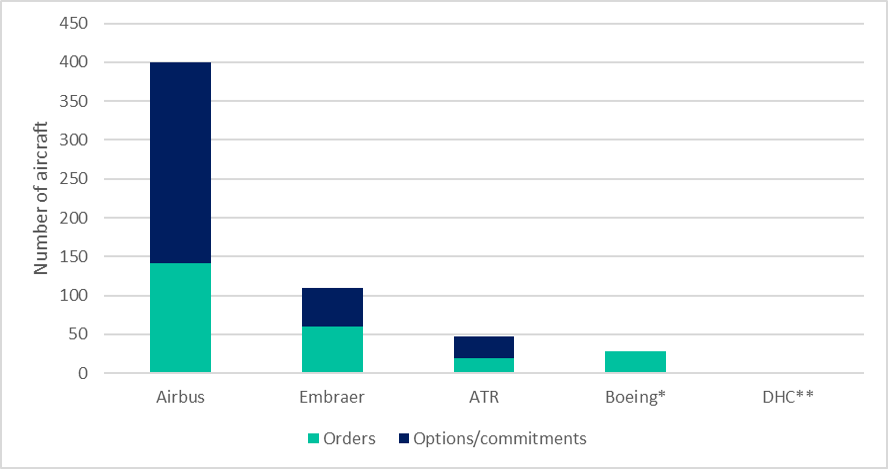
    News that AirAsia had signed for up to 70 A321XLRs earlier this month certainly raised eyebrows. An airline that already has such a large backlog, and which is still emerging from restructuring, should not, on the face of it, be adding more orders. Reading beyond the headlines, however, the 70 A321XLRs are only commitments, not firm orders. AirAsia Group’s firm orderbook stands at 402 aircraft, all A321neos (including 20 XLRs) save for 15 A330neos. Its in-service passenger fleet comprises only 219 aircraft (mostly A320-family jets, plus 24 A330neos), which is still fewer than the 240+ it was operating in 2019.

    In 2015, we prepared a slide deck showing the airlines in Asia-Pacific that had orderbooks far larger than their in-service fleets. Two airlines were outliers: Lion Air and AirAsia. Our message at the time was these airlines had managed double-digit growth rates in the past and it was theoretically possible for them to absorb their orderbooks if they managed to continue the same growth trend.
    There were reasons to be optimistic about Southeast Asia’s air travel market. The 640 million people spread across islands and narrow peninsulas were getting richer and they’d sooner or later take a flight. Tourism was booming, and it seemed Chinese tourists would provide an endless source of demand. The ultra low-cost carrier (ULCC) model applied by AirAsia and Lion Air was seen as the best way to capture and drive that growth.

    Ultimately, the story of fast-paced growth was not to last. Economic and geopolitical factors along with the competitive dynamics of a ULCC turf war all contributed to a decade of slowed growth.

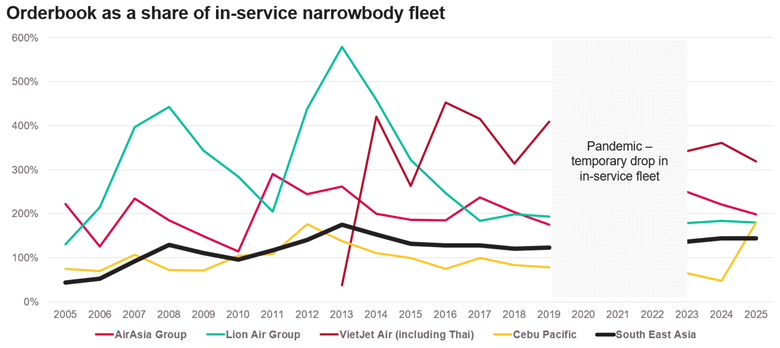
    The chart below shows the compound annual growth rate of the in-service narrowbody passenger jet fleet of Southeast Asian airlines with the largest orderbooks, compared with the region’s overall fleet growth. Looking at five-year periods (but shifting 2020 to 2019 in order to isolate pre-pandemic figures), we can see 2005-2015 was a time of very rapid growth for AirAsia and Lion Air with sustained periods of over 20% annual growth. The Southeast Asian fleet also grew at around 10% per year throughout that decade.

    The period of 2015-2019 brought a marked reduction, to single-digit levels, with AirAsia’s narrowbody fleet growing at the same pace as the rest of the region’s fleets. VietJet, which was Vietnam’s ULCC, tripled in size from 24 to 76 aircraft, but added fewer aircraft than Lion Air did and only slightly more than AirAsia.

    Since 2019, growth has been a struggle for all these players. Over the past six years, the Southeast Asian narrowbody jet fleet actually shrunk at a rate of 1% per year, and the highest ULCC compound annual growth rate was VietJet’s 3%, a far cry from the >20% the region’s high-flyers had achieved in the past.  

    Filters: Narrowbody jets, passenger usage, years calculated as 1 July, company category Airlines. Southeast Asia is defined as: Brunei, Cambodia, East Timor, Indonesia, Laos, Malaysia, Myanmar, Philippines, Singapore, Thailand, Vietnam.
    Source: Cirium Fleets Analyzer

    The stalled growth raises questions about the remaining substantial orderbook. Southeast Asian Airlines have 1,366 narrowbody passenger jets on order, representing 144% of the current in-service fleet. By comparison, the world’s backlog share of in-service narrowbody fleet is only 66%.  Large Southeast Asian ULCCs’ backlog can be 180% to over 300% of their in-service fleets, which are about the same level as they were 10 years ago. The chart below shows this, while omitting the pandemic years in which the temporary parking of aircraft led to a small in-service fleet, artificially inflating orderbook share.

    Filters: Narrowbody jets, passenger usage, years calculated as 1 July, company category Airlines. Southeast Asia is defined as: Brunei, Cambodia, East Timor, Indonesia, Laos, Malaysia, Myanmar, Philippines, Singapore, Thailand, Vietnam.
    Source: Cirium Fleets Analyzer

    Southeast Asian airlines are not taking deliveries fast enough to make a dent in their orderbooks and bring them back to stable levels. Supply chain issues that have been plaguing the industry are partially to blame, but the slowing fleet growth began before the pandemic and the Max grounding. Southeast Asia’s peak for passenger narrowbody jet deliveries was back in 2014 at 126. That is more than has been delivered since the start of 2020.

    A replacement cycle rather than a growth cycle may finally drive deliveries, but there are problems with orders placed so far in the past. AirAsia placed a massive order for 200 A320neos back in 2011. To date, only 55 A320neo family aircraft have been delivered to the group. It may have received a good deal from Airbus at the time, but what does 14+ years of escalation do to delivery pricing? Orders were likely renegotiated during the pandemic as the group also went through general restructuring, but escalation continues to increase the eventual delivery pricing.

    Southeast Asia is not the only place with a very large narrowbody jet orderbook as a share of in-service fleets. India, Saudi Arabia and Hungary (home to Wizz Air) stand out with orderbook shares at over 200%. It can be argued these have growth potential in different ways, but the ULCCs of Southeast Asia appear to have over-ordered given the trend of the last decade.

    This does not risk causing global oversupply, as OEMs cannot deliver fast enough to meet the global demand in any case. However, the backlog increases the risk for those airlines with growing liabilities in terms of escalating delivery pricing in an ultra-competitive market which appears not to be growing as fast as their ambitions.

  • Is Commercial Aviation Cruising or Climbing?

    Commercial aviation faces a complex landscape in 2025, showing clear momentum while facing new challenges that hold the potential to reshape the sector’s trajectory.

    In Commercial aviation in 2025: cruising or climbing?, MUFG’s Head of Aviation Research joined Cirium Ascend Consultancy’s Max Kingsley-Jones and Sofia Zoidou to explore the key factors shaping the industry’s path forward. In a lively and wide-ranging discussion, they shared data, insights and perspectives on commercial aviation’s outlook in the near-term and beyond.

    Tariffs Create Industry-Wide Uncertainty

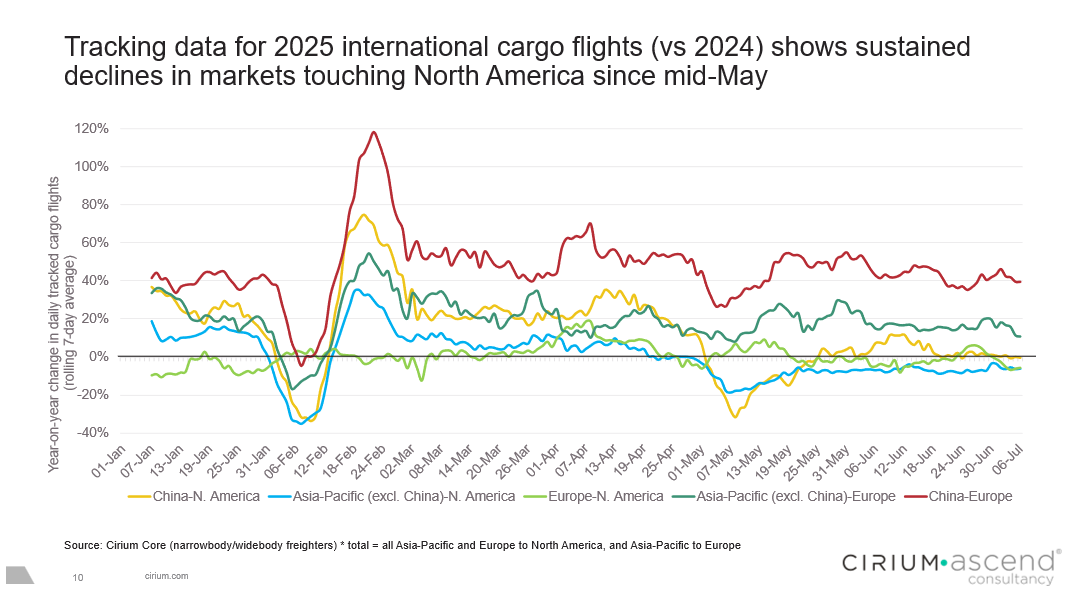
    Trade tensions dominated much of the discussion, with tariffs emerging as a significant and wide-ranging risk factor. Max Kingsley-Jones emphasized that “tariffs pose a risk to all the parameters, be it demand, supply, and also to aircraft values.” He pointed to slowing demand for cargo already showing in tracking data, with international cargo flights demonstrating a sustained year-on-year decline since mid-May in markets touching North America.

    On the risk to aircraft values, Max explained that new aircraft values are unlikely to increase due to the tariff themselves, as this ‘tax’ is not an intrinsic part of the asset’s value. However, if tariffs cause a reduction in new aircraft deliveries, that will further tighten supply and increase positive pressure on secondary market values and lease rates.

    The ripple effects of tariffs will extend beyond manufacturers. Simon Finn highlighted aviation’s unique vulnerability, noting “it’s difficult to think of another industry that’s more globalised than aviation.” He pointed to how the industry’s interconnectedness leads tariff impacts to cascade throughout the supply chain, forcing manufacturers to determine what is passed onto the customer, and if they can’t, how to absorb the costs themselves.

    Production Recovery Faces Continued Delays

    Despite ongoing efforts to scale production, original equipment manufacturers (OEMs) remain behind their pre-pandemic output levels. The industry continues to grapple with supply chain constraints that have pushed full recovery timelines from 2025 to 2026.

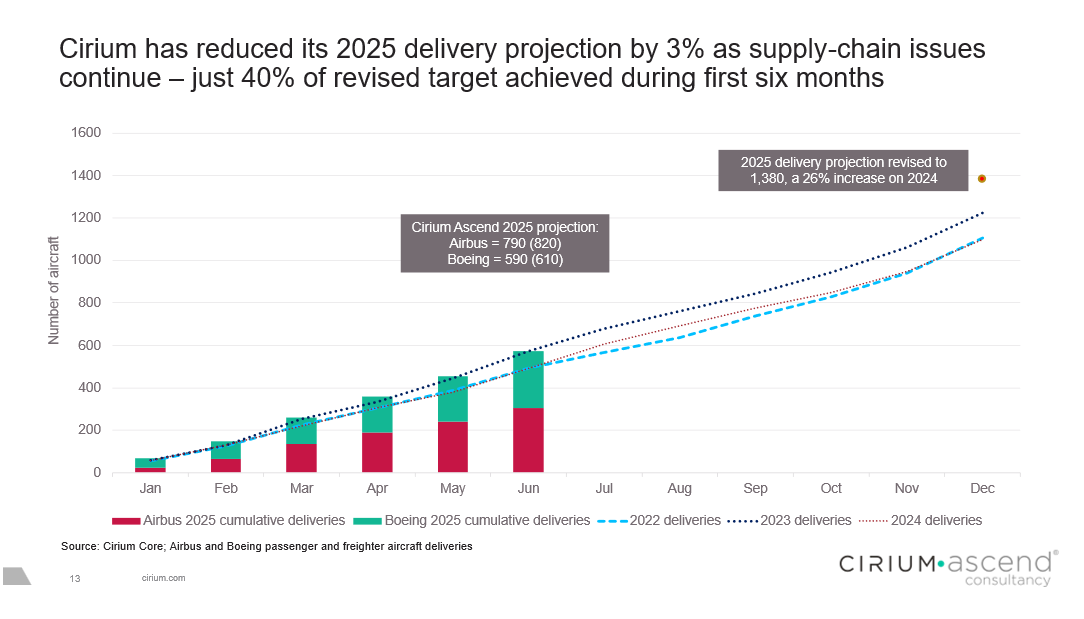
    Current projections show the challenge ahead. Max noted that manufacturers “are still going to be behind in 2025,” compared to their stated targets, with much depending on supply chain. Cirium recently reduced its 2025 delivery projection by 3% as these issues persist, with only 40% of the revised target achieved during the first six months.

    Airbus faces particular scrutiny in meeting delivery targets. The company delivered 232 A320neo family aircraft in the first half of 2025, representing about 38% of the full-year forecast. Engine availability remains a bottleneck, with approximately 40 additional aircraft ready for delivery once their CFM LEAP engines arrive.

    Boeing’s recovery trajectory appears more promising, though both manufacturers must navigate ongoing supply chain complexities that continue to constrain industry-wide production capacity.

    Engine Supply Chain Bottlenecks Persist

    Engine availability has emerged as a critical constraint on aircraft deliveries. CFM’s LEAP engines power a significant portion of new aircraft, but supply limitations have created delivery delays across the industry.

    The data reveals the scope of this challenge: about 40 aircraft remain as “gliders” awaiting their LEAP engines before delivery completion. CFM accounted for 54% of total A320neo family deliveries in the first half of 2025, highlighting both the engine’s market dominance and the bottleneck’s industry-wide impact.

    These engine-related delays contribute to the broader production constraints facing manufacturers as they work to meet airline demand and fulfil existing order backlogs.

    Future Aircraft Development Accelerates Despite Current Challenges

    Looking ahead, the industry shows signs of preparation for the next generation of commercial aircraft. Both manufacturers and suppliers are advancing technologies that will define aviation’s future, even as current production faces constraints.

    Airbus continues developing its next-generation single-aisle aircraft, targeting a launch by 2030 for delivery around 2038. The CFM RISE open-fan engine technology, showcased as a potential powerplant for this program, represents significant advancement in propulsion efficiency.

    Simon expressed optimism about engine technology readiness, stating it’s “fair and reasonable to expect the engine manufacturers to push their technologies and have something ready for the early 2030s.”

    Market dynamics also support future growth. Airbus and Boeing combined net orders in the first half of 2025 exceeded 1,000, approaching the full-year 2024 total of 1,171. This strong order momentum, boosted by 300 orders added in June alone, indicates sustained airline confidence in long-term demand recovery.

    The emergence of new competitors adds another dimension to future market dynamics. Simon suggested China’s political will to produce an indigenous commercial aircraft may see Comac emerge as a major manufacturer in the long term. He pointed to favourable historic parallels with Airbus’s emergence, but cautioned this may take a decade or more to materialize. “Comac is in a powerful position, but there’s a lot of work to do”.

    Watch the Webinar on Demand

    To access the full presentation, including analysis of the capacity and emission trends, the Paris Air Show and more, register to watch the webinar.

  • Middle East Aviation: Key Market Insights From Latest Outlook

    The Middle East aviation sector continues to outpace global growth trajectories, with compelling data revealing the region’s expanding influence on international aviation markets. Recent analysis of regional performance metrics demonstrates sustained momentum across multiple indicators, positioning Middle Eastern carriers as significant drivers of global aviation recovery and future expansion.

    Watch the Middle East Market Outlook

    Market Share and Growth Trajectory

    The Middle East represents approximately 6% of the global aviation market by multiple measures. According to Cirium’s global Schedules data, the region accounts for 6.1% of total global scheduled capacity, while the passenger fleet in service represents 6.2% of the worldwide total.

    However, the region’s growth rate significantly outpaces global averages. Since 2010, Middle Eastern capacity has grown at 5.7% compound annually, compared to the global rate of 4%. This growth momentum continues into 2025, with Middle East international traffic expanding at 6% for the first five months of the year, ahead of the total market’s 5.8% growth.

    Fleet Development and Investment Pipeline

    The region’s fleet expansion tells a particularly compelling story. Middle Eastern single-aisle fleet development has surged more than 35% since July 2019, dramatically outperforming the global development rate of approximately 15%. Twin-aisle passenger fleets have similarly outperformed, growing nearly 3% above 2019 levels while global twin-aisle fleets remain around 2% lower.

    Three major markets – UAE, Saudi Arabia, and Qatar – each maintain aircraft backlogs exceeding 100% of their current installed fleets. The total regional backlog encompasses approximately 1,615 aircraft scheduled for delivery through 2035, representing roughly $200 billion in 2025 economic conditions.

    Financial Performance Strength

    Middle Eastern airlines have demonstrated exceptional profitability recovery. While representing 6% of global fleet capacity, the region contributes more than 12% of total global airline profits. IATA projects the region will generate $5-6 billion of the estimated $36 billion in global airline net profits for 2025.

    This financial strength has enhanced the region’s creditworthiness with lessors. Operating lessors manage approximately 50% of single-aisle aircraft and 40% of twin-aisle aircraft in the region, with the higher twin-aisle leasing percentage indicating lessor confidence in Middle Eastern airline credit quality.

    Environmental Considerations

    The region faces sustainability challenges that require attention. Despite representing 6% of the global fleet, Middle Eastern airlines generate approximately 10% of global aviation emissions, primarily from twin-aisle operations. This intensity reflects the region’s role as a major connecting hub for long-haul international travel.

    As the industry moves toward net-zero commitments, replacing current-generation aircraft with more fuel-efficient models like the 777-9, 787, A350, and A320neo family will be crucial for reducing the region’s emissions intensity.

    Looking Ahead

    Cirium’s Schedules data projects Middle Eastern regional capacity growth between 5-10% on a year-over-year basis through the remainder of 2025, maintaining the region’s position above global growth trends. This projection aligns with the substantial aircraft delivery pipeline required to absorb the significant backlog.

    The region has also established itself as a growing center for aircraft leasing, with two companies now ranking among the world’s 25 largest lessors by fleet value. This development reflects recognition of operating leasing as an efficient aircraft financing method and suggests continued growth in this sector.

    These insights underscore the region’s continuing evolution as a critical global aviation hub, supported by strong financial performance, significant investment commitments, and strategic positioning in international connectivity markets.

    Watch the Middle East Market Outlook in full.

  • Emerging Freighter Market Dynamics in H1 2025

    Cirium Ascend Consultancy is trusted by clients across the aviation industry to provide accurate, timely, and insightful aircraft appraisals. The team provides the valuations and analysis the industry relies on to understand the market outlook, evaluate risks and identify opportunities.

    Discover the team’s industry reports & market commentaries. Read their latest expert analysis, viewpoints and updates on Thought Cloud.

    Yinan-Qin

    Yinan Qin, Senior Aviation Analyst, Cirium Ascend Consultancy

    Traffic and Yields

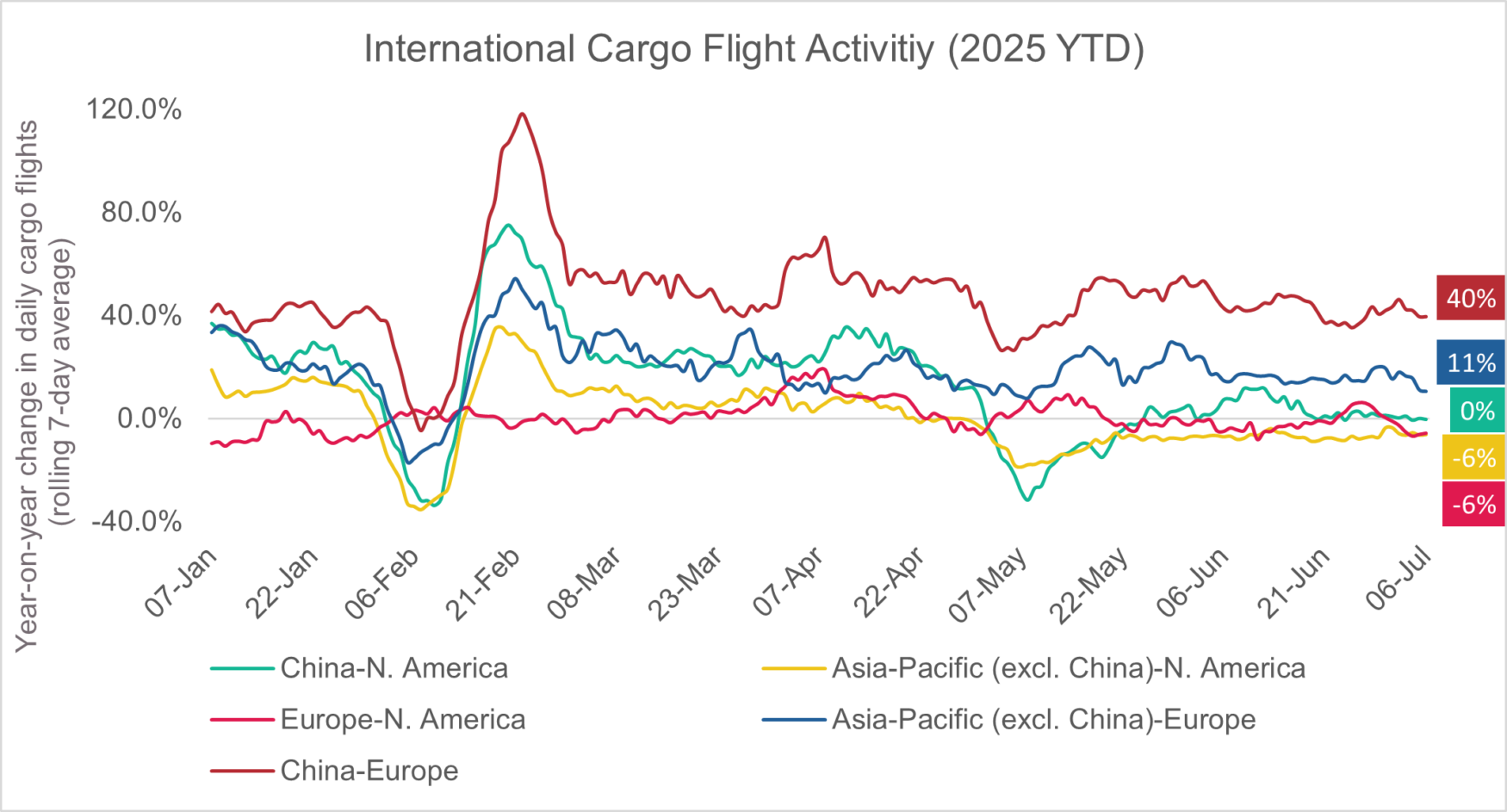
    Based on Cirium’s year-to-date cargo flight data for 2025 across the major cargo traffic lanes, we observed a sharp decline in flight activity around February, coinciding with the announcement of new US tariffs. However, flights rebounded quickly as carriers employed front-loading strategies to mitigate tariff impacts before the initially announced effective date in May 2025. The latest data indicates that routes connecting to North America have been the most significantly affected. Unlike passenger flights, cargo operations are more flexible and responsive to market changes. As such, we anticipate continued in-time adjustments in cargo flight schedules in response to tariff developments. However, when and how future tariff issues will be resolved is still unclear at present.

    Note: (narrowbody/widebody freighters) * total = all Asia-Pacific and Europe to North America, and Asia-Pacific to Europe
    Source: Cirium Core

    Global air cargo yields, which are also highly sensitive to market dynamics, were volatile from 2020 to 2022 but have stabilised since late 2023, staying about 33% above pre-Covid levels. On major long-haul routes like Europe-North America, rates are back to pre-pandemic levels, while Asia-Europe and Asia-North America rates remain elevated due to capacity constraints and geopolitical tensions. While the full impact of US tariffs on yields remains to be seen, a return to pre-Covid pricing levels appears unlikely in the near term.

    Freighter Fleet Overview

    The global freighter fleet has grown steadily over the past two decades. As of mid-2025, there were over 1,400 widebody and more than 800 narrowbody freighters in service. Growth in widebody freighters has been driven by new factory-built freighters, Passenger-to-Freighter (P2F) conversions, and reactivations of aging widebody freighters during the pandemic. Narrowbody freighters also surged in popularity but now face an oversupply issue, with roughly 26% in storage compared to 13% for widebodies — both figures remain above pre-pandemic levels.

    A closer examination of the stored fleet reveals that a higher proportion of inactive narrowbody freighters, particularly the Boeing 737-800 and Airbus A321, are owned by lessors compared with widebody freighters. Many of the parked narrowbody freighters are awaiting conversion or struggling to secure lessees that would be willing to pay a rent premium for the high feedstock and conversion costs. Additionally, the overheating engine leasing market may also encourage lessors to lease engines out separately to obtain better premiums than leasing the entire freighter.

    Note: Widebody and Narrowbody Freighters only
    Source: Cirium Fleets Analyzer

    P2F conversion activity slowed significantly this year, especially for the Boeing 737-800, with only 15 conversions completed. About 48 aircraft, mostly widebody freighters, are scheduled for conversion in 2025. The conversion backlog has dropped to around 320 units, mainly comprising the Boeing 737-800, Airbus A321, Airbus A330 and Boeing 777-300ER. However, some backlog aircraft may return to passenger service due to rising conversion costs, weakening freighter demand, and supplemental type certificate (STC) approval delays.

    Note: Widebody and Narrowbody Freighters only
    Source: Cirium Fleets Analyzer

    On the factory-built freighter side, about 25 new freighter orders have been placed so far in 2025, mostly for the Airbus A350F and Boeing 777-200LRF. Qatar Airways has placed the largest order for the upcoming 777-8F, while the Airbus A350F has attracted a broader customer base, including lessors. With production of the Boeing 767 and 777 set to end in 2027 and current order slots likely sold out, the market may face a potential supply shortage. Ongoing OEM delivery delays and uncertainty surrounding Boeing 777X certification could further contribute to the anticipated production gap in the short to medium term.

    Source: Cirium Core; Press Release

    An analysis of Cirium Market Values of selected key 20-year-old freighters indicates that Market Values have remained resilient over time, particularly for widebody freighters. The only exception has been the Boeing 747-400F, whose decline in value is largely due to its Market Value now being primarily driven by engine. A similar trend is observed in the leasing market. Lease Rates have remained generally robust following the volatility experienced during the pandemic.

    The sustained demand for widebody freighters, combined with continued delays in the delivery of new factory-built freighter, slow progress in the certification of the Boeing 777 P2F conversion programme, rising maintenance costs, and limited MRO slots are all contributing to the resilience of current Market Values. These factors are expected to continue placing upward pressure on freighter valuations until supply-side constraints ease. As such, we anticipate that Market Values will likely remain robust in the near term.

    Note: Value as of June 2025
    Source: Cirium Valuation Analyzer

    In conclusion, the global air cargo market is expected to remain supply-constrained in the near future, especially for widebody capacity. Despite North America’s status as a key air cargo market segment, routes to North America face the most immediate uncertainty due to tariffs, broader structural factors – including limited production capacity, slowing P2F conversions and elevated yield levels – suggesting a prolonged period of moderate demand and a mix of continued tight supply (widebodies) and gradually decreasing oversupply in the short-to-medium term.

  • Five Things We Learnt From the 2025 Paris Air Show

    Cirium Ascend Consultancy is trusted by clients across the aviation industry to provide accurate, timely, and insightful aircraft appraisals. The team provides the valuations and analysis the industry relies on to understand the market outlook, evaluate risks and identify opportunities.

    Discover the team’s industry reports & market commentaries. Read their latest expert analysis, viewpoints and updates on Thought Cloud.

    Max Kingsley-Jones Valuations Manager, Cirium Ascend Consultancy


    As ever, there was a lot going on around the Le Bourget chalets and halls, but here are some key takeaways:

    Airbus’s home run: The “home” OEM made the most noise as is usually the case, announcing some 400 orders and commitments during the show. Boeing, which has traditionally played down its participation in the so-called air-show “order race”, was intentionally quiet this time amid the Air India 787 tragedy which occurred just prior to Le Bourget. Despite Boeing’s low-key approach, total announcements at the show for commercial aircraft amounted to almost 600 orders and commitments.  The show sales tally might have been even higher had anticipated announcements materialised from AirAsia (for “100” small single-aisles – A220s or perhaps E-Jet E2s) and Turkish Airlines (long-expected large order for 737s and Boeing twin-aisles).

    Paris 2025 Commercial Aircraft Orders and Commitments

    Source: Cirium Fleets Analyzer/OEMs (*ANA order, not announced by Boeing; ** two DHC orders)

    Power play: The CFM RISE open-fan powerplant mock-up was a crowd pleaser on Safran’s stand in Le Bourget’s main exhibition hall. The concept is in the news as a potential front-runner to propel Airbus’s proposed next-generation single-aisle. With Airbus saying it aims to launch the new aircraft by the end of this decade, the open-fan architecture of RISE alongside is under evaluation alongside advanced shrouded-fan design concepts from rival engine OEMs. To that point, Pratt & Whitney outlined the progress of its work with fellow RTX company Collins to ground-test and then fly a hybrid-electric version of the A320neo’s PW1100G. Meanwhile the P&W Canada division disclosed that it is working closely with Airbus’s regional arm ATR to study a hybrid-electric powered turboprop derivative, in what is effectively a reboot of the regional aircraft OEM’s Evo project. This reduced-emissions design had previously been slated for a 2030 debut, but the target now is around 2035.

    Big twin: The A350-1000 had a particularly strong show, securing a total of 35 orders and 25 commitments from two clients – Riyadh Air and Starlux Airlines. Sales of the largest A350 variant have been solid this year to date, with the 62 announced so far accounting for two-thirds of the type’s 2025 tally. The variant now holds for almost 40% of the firm backlog for A350 passenger models, which totals around 700 orders. Talk of an A350 stretch has restarted, after previously being mooted a decade ago as the “A350-2000”. A larger derivative of the R-R Trent XWB-powered twinjet, which would pitch Airbus’s biggest aircraft directly at the 777-9, could open the door to an alternative engine option. This could perhaps be an advanced derivative of the Trent, or even a solution from Cincinnati. But would GE have the appetite to support a rival to the GE9X-powered Boeing?

    Regional resurgence: ATR and Embraer announced almost 160 orders and commitments between them. US-based public charter operator JSX placed commitments with ATR for 15 firm and 10 options in a deal touted as a potential signal of a turboprop revival in the USA. But there have already been several false dawns in that regard. Meanwhile Embraer’s ongoing success with its E175 was underlined by a deal from SkyWest Airlines for up to 110 aircraft. The OEM has secured 150 orders since the start of last year for the GE CF34-powered variant and said it expected this market would “continue for many years”. But Embraer was extremely disappointed to lose out to Airbus in a crucial campaign at LOT for small single-aisles, which signed for up to 84 A220s to replace its E-Jet E1s. The Brazilian OEM hinted that “geopolitics” may have helped sway the decision away from the E-Jet E2 in Toulouse’s favour.

    Supply snags: Despite deliveries being 5% down year-on-year in the first five months of 2025 (243 vs 258), Airbus restated its intention to raise shipments this year by around 50 aircraft to at least 820 units. Commercial chief Christian Scherer pointed to “almost 40 gliders” among the A320neo family production system where aircraft have been rolled out but are awaiting powerplants – specifically CFM Leap-1As. “Were it not for those engineless aircraft our delivery performance would be slightly above plan right now,” he said. In the widebody production system, cabin-equipment supply “remains a little bit of a bottleneck”, added Scherer. Meanwhile, the OEM is gearing up to implement the take-over of former Spirit AeroSystems production sites as part of the US primary supplier’s restructuring and merger with Boeing.