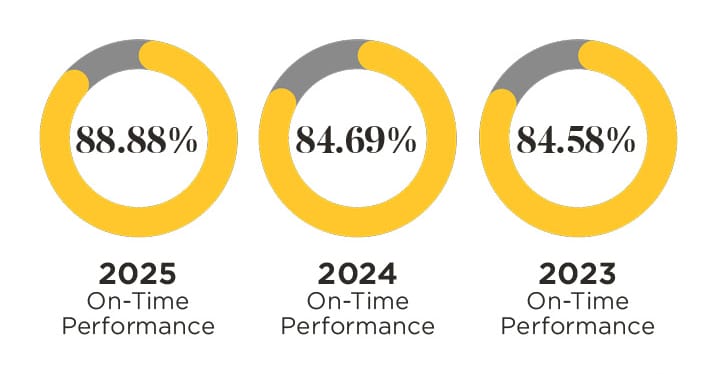
In 2025, Iberia Express achieved an outstanding arrival OTP of 88.94 % across 37,119 total flights operated, a testament to its unwavering commitment to operational excellence and customer trust.
This year’s recognition is particularly significant given the challenging landscape for European aviation. Iberia Express’s performance stands out against a backdrop of notable disruptions, including a major power outage that affected air travel across the Iberian Peninsula and a global software issue impacting the Airbus A320 family—aircraft that comprise the entirety of the airline’s fleet. These events led to widespread delays and operational constraints for carriers throughout the region.
Despite these headwinds, Iberia Express maintained its hallmark punctuality. The airline’s ability to deliver reliable operations in the face of disruption reflects a strong foundation of effective planning, robust processes, and a commitment to high standards throughout its organization. Madrid-Barajas Adolfo Suárez Airport, serving as the airline’s strategic hub, plays a central role in supporting operational continuity, while close collaboration within the Iberia Group and IAG provided additional resilience and flexibility during challenging periods.
The commitment and expertise of Iberia Express’s operational teams have been instrumental in sustaining exceptional performance. From flight crews to ground staff, there can be no doubt that the dedication and professionalism of their employees have contributed to the airline’s ability to sustain high performance standards over multiple years, helping ensure passengers can rely on timely arrivals and departures even during periods of disruption.
So, as Iberia Express celebrates its third consecutive European OTP crown, it stands as a symbol of Spanish reliability and innovation. The airline’s achievements not only reflect its own strengths but also raise the bar for the entire industry. Congratulations to the Iberia Express team for their continued leadership in punctuality and for delivering exceptional value to travellers year after year.
Lydia Webb, Marketing Director – Americas & Strategic Programs, Cirium
It is a foundational element that directly influences an airline’s brand reputation, operational stability, and financial health. As the industry becomes increasingly competitive, the strategic value of maintaining high OTP has never been more significant.
For airlines, excelling in on-time performance creates a ripple effect of positive outcomes. It strengthens passenger loyalty, streamlines complex operations, provides a distinct competitive edge, and generates substantial cost savings.
Improved Passenger Loyalty and Satisfaction
The modern traveler expects reliability, and a consistent record of on-time arrivals and departures allows airlines to meet this expectation effectively. This foundation of trust directly contributes to increased customer loyalty. When passengers can rely on an airline to deliver them to their destinations as scheduled, their overall travel experience is enhanced. Each timely flight reinforces the airline’s commitment to dependable service, which is essential for establishing and retaining passenger trust. Punctuality holds particular significance for business travelers, enabling them to plan meetings and commitments with assurance. Leisure travelers also benefit from reduced stress and uncertainty associated with reliable service. Over time, such operational consistency cultivates a loyal customer base that is more likely to choose the airline in the future and endorse it to others.
Enhanced Global Brand Recognition
A strong record of on-time performance serves as an effective marketing advantage for airlines. Consistently high OTP rankings attract favorable media coverage and help build a dependable reputation, influencing how both customers and industry partners view the airline worldwide. When a brand is recognized for its punctuality, it is often seen as professional, well-organized, and attentive to customer needs, making it stand out in a competitive market. Maintaining excellent OTP not only develops a positive brand image but also signals a commitment to high standards and respect for passengers’ time. This reputation may be the deciding factor for travelers choosing between flights with similar prices. An airline known for its timeliness also tends to be associated with high quality across other elements of service, such as safety and customer support, ultimately strengthening its brand and market position.
Driving Operational Efficiency
On-time performance isn’t just about how customers view an airline—it reflects the overall efficiency of its operations. When every part of the system, from ground staff to scheduling, runs smoothly together, high punctuality is achieved. Prioritizing on-time departures and arrivals pushes airlines to refine their processes, making everything work better. Because airline networks are so interconnected, even one delay can cause problems across many flights and connections.
Optimized Aircraft Utilization and Crew Scheduling
Aircraft are among an airline’s most valuable assets, and maximizing their use is essential for profitability. Punctuality ensures that planes adhere to their intended schedules, minimizing costly time on the ground and allowing for tighter turnarounds. This optimization allows carriers to fly more segments per day with the same number of aircraft.
Similarly, on-time operations lead to more stable and predictable crew schedules. Delays can cause a cascade of crewing issues, violating mandatory rest periods and requiring last-minute substitutions. By minimizing disruptions, airlines can improve crew quality of life, reduce sick leave, and avoid the operational complexities associated with re-assigning flight crews.
Gaining a Competitive Advantage
In an industry where ticket prices and in-flight amenities are often comparable, on-time performance has emerged as a key differentiator. Airlines that outperform their rivals in this metric can leverage it to attract and retain customers, ultimately increasing their market share. On-time performance data is publicly available and widely reported, allowing for direct comparison and benchmarking among competitors. Airlines use this data to gauge their own performance against the industry and identify areas for improvement. Consistently ranking at the top of these leaderboards provides tangible proof of operational excellence, which can be highlighted in marketing campaigns to attract discerning travelers.
Realizing Significant Cost Savings
High on-time performance brings significant financial advantages. Although it takes investment in both technology and process improvements to achieve punctuality, the savings from fewer delays often far exceed these upfront costs. Flight delays are costly—extra time spent taxiing or waiting in holding patterns consumes more fuel. Sticking to schedules helps airlines cut down on this unnecessary fuel use. Operating efficiently also lowers overtime costs for ground crews, gate agents, and other staff who must stay late when flights run behind. When flights are on time, resource management becomes smoother and more cost effective. Another major expense of delays is compensating passengers; airlines might have to offer meal vouchers, hotel stays, or even cash depending on how long people are kept waiting and what regulations apply. Delays can also mean extra work for agents rebooking travelers stranded by missed connections. By keeping flights running on time, airlines can substantially lower these expenses, safeguard their revenue, and reduce negative customer service incidents linked with disruptions.
The strategic importance of on-time performance in the aviation industry cannot be overstated.
It is a critical metric that influences nearly every aspect of an airline’s business, from the passenger experience to financial results. By delivering reliable, punctual service, airlines can foster deep-seated customer loyalty and enhance their global brand reputation.
In a landscape defined by tight margins and high customer expectations, on-time performance is not just a goal—it is a fundamental component of a successful and sustainable aviation strategy.
The Platinum recognition goes to one carrier annually based on a proprietary algorithm that weighs reliability, operational precision, disruption recovery, and performance at scale. The question is straightforward: which airline demonstrates the strongest operational control and consistency when you look at the complete picture.
The Performance Case
Qatar Airways delivered 84.42 percent on-time performance in 2025 under Cirium’s methodology, up from 82.83 percent in 2024 across roughly 198,303 flights.
That improvement matters because it came on top of an already strong base while maintaining completion factor close to 100 percent. Improving OTP when you’re already in the low 80s is harder than moving from the 70s—there’s less margin for gains, and the operational discipline required is tighter.
The scale context makes the numbers more meaningful. Qatar operates a tightly banked hub at Hamad International Airport serving over 170 destinations, running long haul and multistop journeys across multiple regions and time zones. Each connection bank multiplies operational risk because aircraft positioning, crew availability, passenger flows, and ground services all must align repeatedly throughout the day. Keeping delays and cancellations low in that environment requires precision that most network carriers struggle to maintain.
What Qatar Actually Did
The execution comes down to realistic planning and disciplined operations control. Qatar built turn times and connection windows that work in practice, not just on paper. When disruptions hit in 2025, including airspace constraints from geopolitical issues, weather volatility, and aircraft availability problems, the carrier protected key connection flows and used operational data to retime and reroute during irregular operations.
That approach kept cancellations low and gave passengers a higher probability of completing their journey as booked, even on difficult days. The completion factor numbers confirm this wasn’t theoretical; Qatar got passengers where they needed to go.
The A30 numbers tell the recovery story more clearly. Qatar Airways maintains one of the lowest A30 rates among global network carriers which means very few flights arrive more than 30 minutes late. That metric reveals operational discipline that goes beyond preventing delays; it’s about containing them when they occur. In a banked hub operation where one delay can cascade through multiple connections, keeping severe delays low requires tight control over recovery decisions such as aircraft swaps, crew repositioning, passenger reprotection, and ground coordination. Qatar’s A30 performance indicates they’re making those decisions well under pressure, consistently.
The operational focus appears to be a deliberate priority backed by investment in schedule planning, day of operations control, and analytics capabilities. You can see it in how Hamad International’s operations coordinate with the airline’s schedule, and the hub has grown over the past few years without the reliability of degradation that typically comes with expansion.
What This Signals
Looking at 2025’s operational data across global carriers, Qatar’s performance demonstrates that a large, complex network can still be run with discipline and predictability in a volatile environment. That’s not a given anymore. Many network carriers have accepted that operational variability is simply the cost of scale and complexity.
Qatar’s numbers suggest otherwise. The combination of high OTP, near-perfect completion, and performance improvement year over year at this scale indicates that operational control remains achievable when it’s treated as non-negotiable rather than a metric to track.
For the industry, that’s the real takeaway. Network complexity and operational volatility are facts, but they don’t have to determine outcomes. Qatar Airways proved that in 2025.
LONDON (Jan. 2, 2026) – Aeromexico maintained a 90.02% on-time performance to claim the world’s most on-time global airline title for the second consecutive year, according to Cirium’s 2025 On-Time Performance Review released today.
The Mexican carrier becomes only the second airline to achieve consecutive global wins since Cirium launched the program in 2009, operating 188,859 flights across 23 countries while maintaining industry-leading schedule reliability.
Aeromexico Holds Global Lead; Regional Champions Crowned
Aeromexico secured the global airline title with 90.02% on-time performance, holding off strong competition from Saudia in second place with 86.53% and SAS with 86.09% in third. The margin between first and third place was 3.93 percentage points, reflecting rising operational standards across the industry.
Regional winners included:
North America: Delta Air Lines won for the fifth consecutive year with 80.90% on-time performance
Europe: Iberia Express (International Airlines Group) defended its title for the third consecutive year with 88.94% performance
Asia-Pacific: Philippine Airlines claimed the regional title for the first time with 83.12% on-time performance
Latin America: Copa Airlines achieved its 11th win, the most of any airline since Cirium’s program launched in 2009 with 90.75% on-time performance
Middle East and Africa: Safair topped the regional rankings with 91.06% on-time performance
Qatar Airways Wins Airline Platinum Award
Qatar Airways captured Cirium’s Platinum Award, recognizing the Doha-based carrier’s operational excellence across its global hub network. The airline achieved 84.42% on-time performance across more than 198,303 flights spanning six continents.
Virgin Atlantic Claims Inaugural ‘Most Improved’ Award
Virgin Atlantic won Cirium’s new ‘Most Improved’ award, demonstrating the largest year-over-year operational performance gain among global carriers. The UK-based airline improved its on-time performance from 74.02% in 2024 to 83.45% in 2025—a 9.44 percentage point increase year-over-year.
The new award recognizes airlines that have achieved meaningful operational scale (minimum 70% baseline performance) while delivering substantial improvements, ensuring the honor reflects genuine operational excellence, rather than recovery from poor prior performance.
Istanbul Airport won Cirium’s Airport Platinum Award, which evaluates operational complexity, passenger impact during disruptions, and growth trajectory. Last year’s Airport Platinum winner was El Dorado International Airport in Bogotá, Colombia.
Industry Context and Analysis
Jeremy Bowen, Cirium CEO, said: “Maintaining consistent on-time performance requires sophisticated network planning, operational coordination, and the ability to recover quickly when irregularities occur. These results reflect the operational discipline that defines aviation’s top performers.”
“Qatar Airways’ Platinum win is particularly significant because it demonstrates how a network carrier can maintain on-time performance across six continents while operating one of the industry’s most complex hub structures. Their 84.42% on-time rate over 198,303 flights sets a new benchmark for network carriers. Similarly, Copa’s 11th win for the Latin American category and Delta’s fifth consecutive North American win reflects sustained operational focus that separates industry leaders from competitors.”
About the On-Time Performance Review
Now in its 17th year, the Cirium On-Time Performance Review analyzes flight data from over 600 real-time sources including airlines, airports, global distribution systems, and civil aviation authorities. An independent advisory board of aviation industry veterans provides oversight and guidance.
An on-time flight arrives within 14:59 minutes of scheduled gate arrival time. Airport punctuality measures flights departing within 14:59 minutes of scheduled departure time. The Platinum Awards for both airlines and airports consider operational complexity, network scale, passenger impact during disruptions, and consistency throughout the year.
The Most Improved award, introduced in 2025, requires carriers to demonstrate at least 70% baseline on-time performance in the prior year to ensure recognition reflects operational excellence rather than recovery from poor performance.
Complete 2025 Rankings
Top 10 Global Airlines
Ranking
Airline
On-Time Arrivals
Total Flights
1
(AM) Aeromexico
90.02%
188,859
2
(SV) Saudia
86.53%
202,864
3
(SK) SAS
86.09%
249,674
4
(AD) Azul
85.18%
304,625
5
(QR) Qatar Airways
84.42%
198,303
6
(IB) Iberia
83.52%
188,447
7
(LA) LATAM Airlines
82.40%
580,707
8
(AV) Avianca
81.73%
266,921
9
(TK) Turkish Airlines
81.41%
421,087
10
(DL) Delta Air Lines
80.90%
1,800,086
Top 10 North American Airlines
Ranking
Airline
On-Time Arrivals
Total Flights
1
(DL) Delta Air Lines
80.90%
1,800,086
2
(AS) Alaska Airlines
79.20%
453,031
3
(NK) Spirit Airlines
78.83%
218,265
4
(UA) United Airlines
78.77%
1,732,450
5
(WN) Southwest Airlines
77.04%
1,422,405
6
(AA) American Airlines
76.43%
2,259,576
7
(B6) JetBlue
74.66%
313,318
8
(WS) WestJet
73.58%
205,501
9
(AC) Air Canada
73.26%
383,819
10
(F9) Frontier Airlines
72.14%
208,987
Top 10 European Airlines
Ranking
Airline
On-Time Arrivals
Total Flights
1
(I2) Iberia Express
88.94%
37,119
2
(SK) SAS
86.09%
249,674
3
(OS) Austrian
83.74%
124,457
4
(IB) Iberia
83.52%
188,447
5
(VS) Virgin Atlantic
83.45%
26,359
6
(FI) Icelandair
83.23%
39,425
7
(VY) Vueling
82.20%
228,611
8
(TK) Turkish Airlines
81.41%
421,090
9
(D8, DY) Norwegian
80.96%
150,784
10
(AY) Finnair
79.67%
116,652
Top 9 Latin American Airlines
Ranking
Airline
On-Time Arrivals
Total Flights
1
(CM) Copa Airlines
90.75%
133,748
2
(AM) Aeromexico
90.02%
188,859
3
(G3) Gol
87.75%
238,182
4
(AD) Azul
85.18%
304,625
5
(LA) LATAM Airlines
82.40%
580,707
6
(H2) Sky Airline
82.39%
55,116
7
(AV) Avianca
81.73%
266,921
8
(JA) JetSmart Chile
76.91%
90,460
9
(AR) Aerolineas Argentinas
76.54%
107,490
Only 9 airlines qualified in the region
Top 10 Asia-Pacific Airlines
Ranking
Airline
On-Time Arrivals
Total Flights
1
(PR) Philippine Airlines
83.12%
116,268
2
(NZ) Air New Zealand
79.29%
171,216
3
(NH) ANA
78.88%
309,998
4
(SQ) Singapore Airlines
78.58%
121,293
5
(JL) JAL
78.25%
313,410
6
(6E) IndiGo
78.12%
802,418
7
(CX) Cathay Pacific
76.78%
119,193
8
(VA) Virgin Australia
76.54%
155,038
9
(QF) Qantas
76.51%
276,859
10
(KE) Korean Air
75.34%
133,252
Top 10 Middle East and Africa Airlines
Ranking
Airline
On-Time Arrivals
Total Flights
1
(FA) Safair
91.06%
62,805
2
(RJ) Royal Jordanian
90.73%
37,524
3
(F3) Flyadeal
86.54%
69,971
4
(SV) Saudia
86.53%
202,864
5
(4Z) Airlink
84.47%
84,361
6
(QR) Qatar Airways
84.42%
198,303
7
(WY) Oman Air
83.10%
38,828
8
(SA) South African Airways
81.26%
24,461
9
(EY) Etihad Airways
81.06%
100,620
10
(KU) Kuwait Airways
79.50%
29,977
Top 10 Large Airports
Ranking
Airport
On-Time Departures
Total Flights
1
(SCL) Santiago Arturo Merino Benitez Intl Airport
87.04%
153,326
2
(RUH) Riyadh King Khalid International Airport
86.81%
264,614
3
(MEX) Mexico City Benito Juarez International Airport
86.55%
295,737
4
(HNL) Honolulu International Airport
86.51%
156,139
5
(OSL) Oslo Gardermoen Airport
86.00%
204,882
6
(LIM) Lima Jorge Chavez International Airport
85.54%
183,137
7
(SLC) Salt Lake City International Airport
85.04%
243,848
8
(CPH) Copenhagen Airport
84.72%
236,903
9
(DOH) Doha Hamad International Airport
84.70%
251,864
10
(ARN) Stockholm Arlanda Airport
83.59%
181,238
Top 10 Medium Airports
Ranking
Airport
On-Time Departures
Total Flights
1
(PTY) Panama City Tocumen International Airport
93.34%
148,065
2
(BSB) Brasilia International Airport
88.36%
114,481
3
(JNB) Johannesburg O.R. Tambo International Airport
86.22%
189,542
4
(ITM) Osaka Itami International Airport
86.04%
136,489
5
(DMM) Dammam King Fahd International Airport
85.15%
94,768
6
(GIG) Rio de Janeiro Galeao International Airport
85.13%
115,384
7
(PDX) Portland International Airport
85.02%
159,964
8
(VCP) Viracopos-Campinas International Airport
84.55%
111,758
9
(SJC) San Jose Mineta International Airport
83.66%
99,182
10
(CNF) Belo Horizonte International Airport
83.57%
113,857
Top 10 Small Airports
Ranking
Airport
On Time Departures
Total Flights
1
(GYE) Guayaquil Jose Joaquin de Olmedo Intl Airport
91.47%
34,068
2
(SAL) El Salvador International Airport
90.28%
47,203
3
(SDU) Rio de Janeiro Santos Dumont Airport
89.67%
58,303
4
(SVG) Stavanger Airport
89.55%
38,894
5
(UIO) Quito Mariscal Sucre International Airport
89.45%
42,911
6
(CPT) Cape Town International Airport
88.72%
82,030
7
(KOA) Ellison Onizuka Kona Intl Airport at Keahole
Notes to editors *An on-time flight is defined as a flight that arrives within 15 minutes of the scheduled gate arrival. For an airport, it is defined as departing within 15 minutes of its scheduled departure.
About Cirium Cirium® is the world’s most trusted source of aviation analytics. The company delivers powerful data and cutting-edge analytics to empower a wide spectrum of industry players. It equips airlines, airports, travel enterprises, aircraft manufacturers, and financial entities with the clarity and intelligence they need to optimize their operations, make informed decisions, and accelerate revenue growth.
Cirium® is part of LexisNexis® Risk Solutions, a RELX business, which provides information-based analytics and decision tools for professional and business customers. The shares of RELX PLC are traded on the London, Amsterdam and New York Stock Exchanges using the following ticker symbols: London: REL; Amsterdam: REN; New York: RELX.
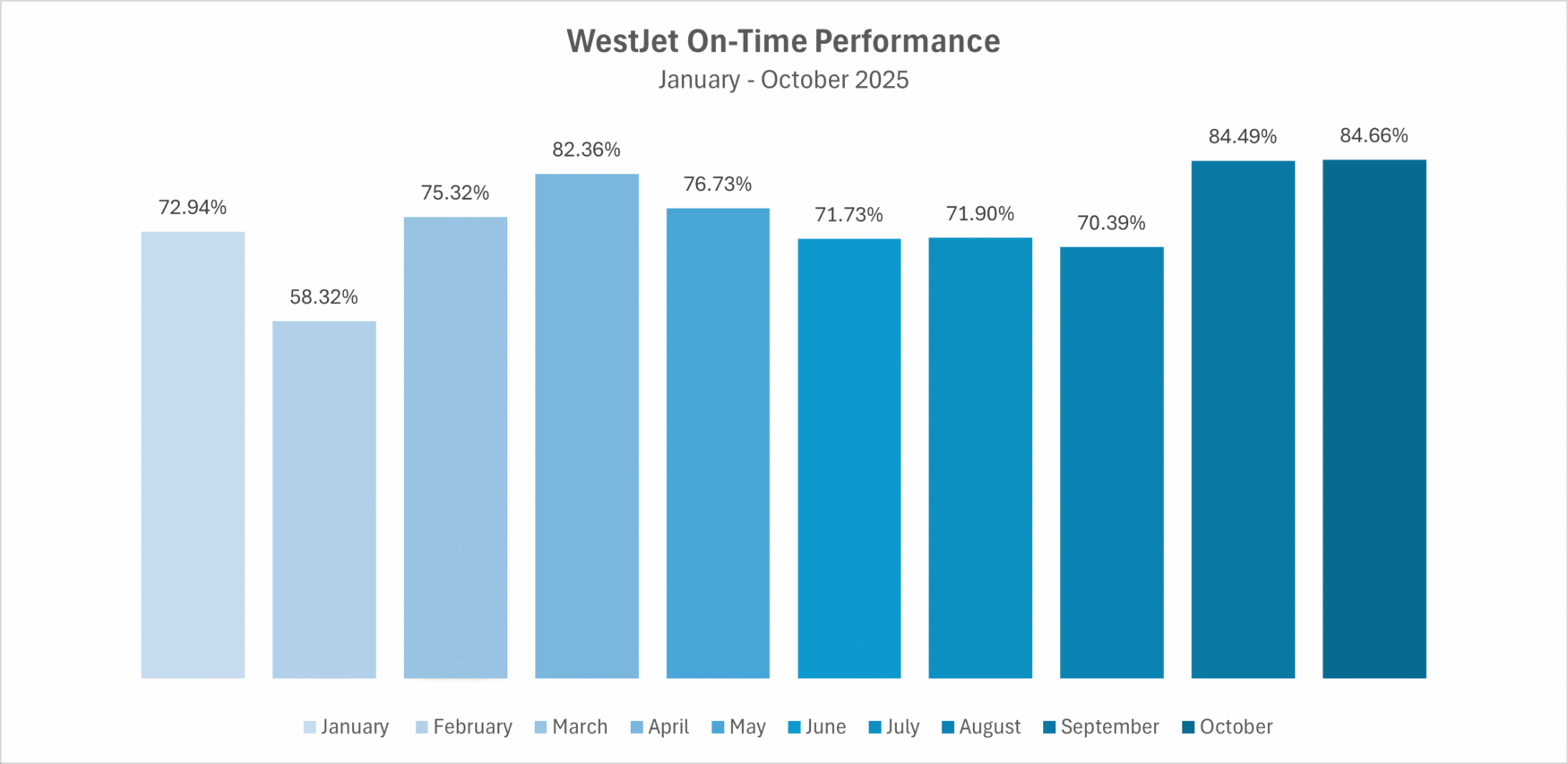
I’ll be honest—when I saw WestJet’s October numbers come across my desk, I had one thought: Good grief, this is fantastic. 84.66% on-time performance. Number one in North America. Not just good—the best.
Here’s what makes that achievement so impressive: just over a year ago, WestJet was posting around 71% on-time arrivals across nearly 192,000 flights. That put them near the bottom of major North American carriers—a tough place to be when your customers, your employees, and your investors are all watching the same scorecards.
Every month, I review on-time performance results with our committee and board. We see incremental improvements, seasonal dips, weather recoveries—the usual rhythm of airline operations. But October 2025 wasn’t usual. This was different. We all felt it was a big deal, and I don’t think most people truly understand what it takes to post these kinds of numbers.
What Most People Don’t See
When passengers see an 84% on-time rate, they might think: “Pretty good odds I won’t be delayed.” And they’re right—but they’re missing the real story.
What that number actually represents is thousands of people doing hundreds of things right, repeatedly, under pressure. It’s gate agents, dispatchers, maintenance crews, pilots, and operations centers all executing with precision. It’s schedules built with discipline. It’s recovery plans that actually work when things go sideways.
You don’t get to 84.66% OTP by hoping for good weather. You get there through relentless operational focus and a culture that treats reliability as non-negotiable.
Leadership That Gives Credit Where It’s Due
I’ve met a lot of airline CEOs over the years. Some are brilliant strategists. Others are financial experts. A few are operations specialists.
Alexis von Hoensbroech, who became WestJet’s CEO in February 2022, is something different—and refreshingly so. When I met him at a conference, what struck me wasn’t just his impressive background (a physics PhD from the Max Planck Institute, years at Boston Consulting Group, sixteen-plus years in senior roles at Lufthansa Group including CEO and CFO of Austrian Airlines). It was how genuinely warm and personable he was—surprisingly so for a CEO with those credentials.
More importantly, when he talks about WestJet’s operational progress, he consistently gives credit to the teams doing the work. That kind of humility from a leader with his accomplishments says a lot about how he’s building the airline’s culture.
His approach appears to focus on two principles: shared accountability across the operation, and schedule discipline as the foundation of everything else. Those aren’t just words at WestJet—they’re visible in the month-over-month data.
Alexis von Hoensbroech CEO, WestJet
Building the Foundation
WestJet’s network today spans major hubs in Calgary, Toronto Pearson, and Vancouver, with extensive transborder and leisure flying. That’s a complex operation—the kind that exposes any weakness in your processes.
The airline is also midway through significant fleet modernization. In 2025, WestJet announced an order for 67 Boeing aircraft—60 737-10 MAX jets and 7 787-9 Dreamliners, with deliveries through 2034. Modern fleets don’t guarantee operational excellence, but they certainly help create the conditions for it.
September’s numbers already showed momentum—roughly 84.5% OTP, putting WestJet among the month’s top performers. October confirmed it wasn’t a fluke.
Why This Matters
Airlines around the world take on-time performance seriously, and they should. It affects brand reputation, investor confidence, and employee morale. When I see results like WestJet’s, it makes me proud that Cirium’s data plays a role in helping airlines benchmark and improve.
But more than that, I genuinely want to see the industry succeed. Every carrier doing well lifts the entire sector. And when an airline posts numbers like this—especially after climbing from a challenging baseline—it proves something important:
You can fix an airline. It takes clear leadership, operational discipline, fleet investment, and teams committed to execution. It doesn’t happen quickly, and it doesn’t happen by chance. But it can be done.
What Comes Next
The coming months will tell us whether October represents WestJet’s new normal or an early chapter in a longer story. Either way, this moment matters.
It’s proof that when airlines focus on the fundamentals—schedule integrity, operational coordination, and accountability at every level—the results show up in the data. And when those results are sustained, everything changes: customer trust rebuilds, brand strength returns, and business resilience grows.
Congratulations to Alexis and the entire WestJet team. October 2025 will be remembered as the month you reached the top of North American on-time performance.
And from where I sit, that’s fantastic news for everyone.
While Gulf carriers built empires on long-haul wide-body operations, Royal Jordanian identified a different opportunity in the early 2000s. The airline positioned itself as the region’s connectivity specialist, deploying efficient regional jets to secondary cities that larger carriers couldn’t economically serve with 777s and A380s. Routes across the Middle East, North Africa, and the Gulf that seemed too small for the big players collectively created a robust feeder system.
This wasn’t just about filling gaps—it enabled frequency. More daily departures mean flexibility for business travelers, and flexibility converts to loyalty faster than price alone ever will.
Global Reach Through Strategic Leverage
The regional focus provided foundation, but Royal Jordanian’s 2007 entry into Oneworld transformed its competitive position. Suddenly, a carrier focused on short-haul connectivity could offer seamless global itineraries. A passenger could fly Royal Jordanian from a secondary Middle Eastern city through Amman, then connect onward via British Airways, American, or Cathay Pacific—all on one ticket with reciprocal benefits.
The alliance delivered network scale without requiring capital-intensive fleet expansion. Royal Jordanian maintained operational control over what it does best while gaining access to hundreds of global destinations through partnership infrastructure.
Differentiation Through Service Quality
When Air Arabia, flydubai, and Jazeera Airways disrupted the market post-2008 with aggressive pricing, Royal Jordanian faced a choice: compete on price or compete on value. They chose value.
The airline upgraded cabins, enhanced ground services at Queen Alia, and strengthened the Royal Club loyalty program while maximizing Oneworld benefits. The bet was straightforward—there’s a segment willing to pay more for reliability, comfort, and convenience, even in price-sensitive markets.
That positioning creates breathing room. Low-cost carriers optimize for different economics and different passengers. Full-service carriers that try to match LCC pricing while maintaining legacy cost structures can lose twice—once on margin, once on brand clarity.
The Operational Discipline Behind the Rankings
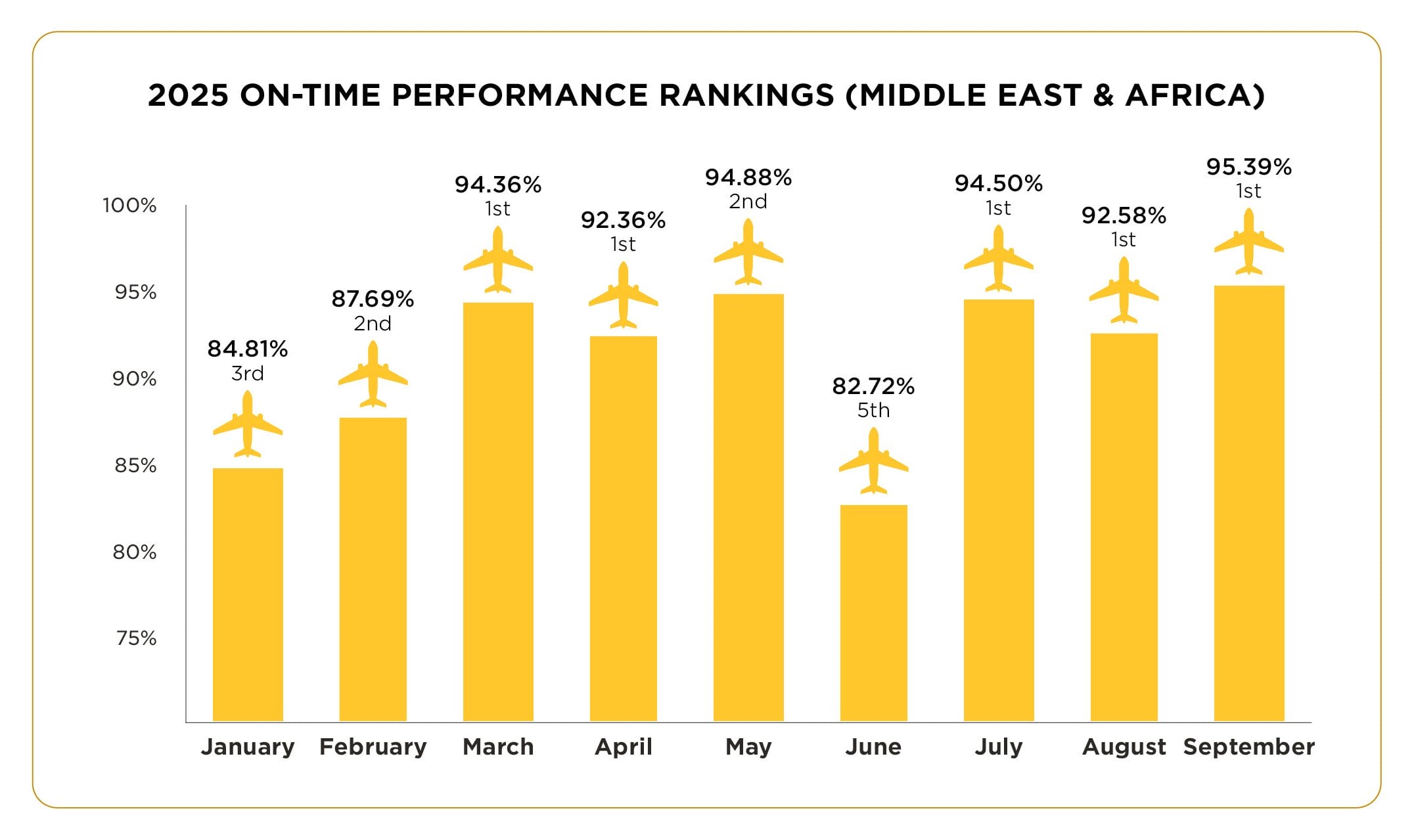
Royal Jordanian operates over 500 weekly flights with more than 110 daily departures from Amman, spanning four continents. That operational intensity requires precision, and the 2025 performance data demonstrates sustained execution:
Looking at these month-by-month results, what stands out isn’t just the peaks—it’s the consistency. Using Cirium’s definition of on-time arrivals within 15 minutes of schedule, Royal Jordanian maintained discipline even when they slipped to 5th in June. The airline had finished 3rd regionally in the 2024 Annual Review with 87.02% OTP and 99.31% completion rate.
These aren’t isolated wins. They represent systematic process management across route planning, turnaround operations, and real-time decision-making under operational pressure.
Leadership and Execution
What changed under Chairman Said Darwazeh and CEO Samer Majali wasn’t the strategy—Royal Jordanian’s regional focus predates their tenure. What changed was execution discipline. Majali, who returned to Royal Jordanian in 2021 after leading Gulf Air and SaudiGulf Airlines, brought additional operational discipline that shows in the numbers.
The 2024 results tell the story: operating profit jumped 260% to JD11.8 million on revenues of JD745.6 million, while carrying 3.7 million passengers. More telling—the airline is self-funding fleet modernization rather than relying on government capital injections. The leadership has plans to have had 70% of the fleet renewed by year-end.
Fleet decisions drive operational performance. Based on the most current information from Cirium Fleets Analyzer, the airline operates 35 Aircraft currently with 11 on order. Order book includes a six B787-9’s, three A321’s, one A320 and one E195 E2. The average age of the current fleet is 8.7 years. This fleet mix is clearly about matching equipment to mission—and creating the frequency advantage that built the business model in the first place.
Royal Jordanian’s performance offers a template, particularly for mid-sized carriers navigating between legacy constraints and LCC disruption. The lessons are transferable:
Strategic focus beats scale ambition. Trying to compete everywhere usually means winning nowhere. Royal Jordanian identified underserved regional routes and dominated them rather than fighting for share on contested long-haul corridors.
Alliances multiply capability without multiplying cost. Oneworld membership gave Royal Jordanian global network reach without the capital requirements of building it organically. For carriers lacking the resources of Gulf super-connectors, alliance leverage becomes essential infrastructure.
Service differentiation requires operational proof. Promising better service means nothing if flights don’t depart on time. Royal Jordanian’s OTP performance validates their service positioning—customers paying premium fares need reliability first.
Strategic Clarity in a Crowded Market
Royal Jordanian didn’t try to become Emirates or match Ryanair’s cost structure. They carved out defensible territory and executed with precision. What strikes me about their approach is the clarity—in an industry where many carriers struggle to articulate what makes them different, Royal Jordanian’s focus is unmistakable.
That September result—95.39% with perfect completion—isn’t an outlier. It’s what happens when strategy and execution align consistently. With three months remaining in 2025, I’m watching closely to see if they can maintain this momentum through year-end.
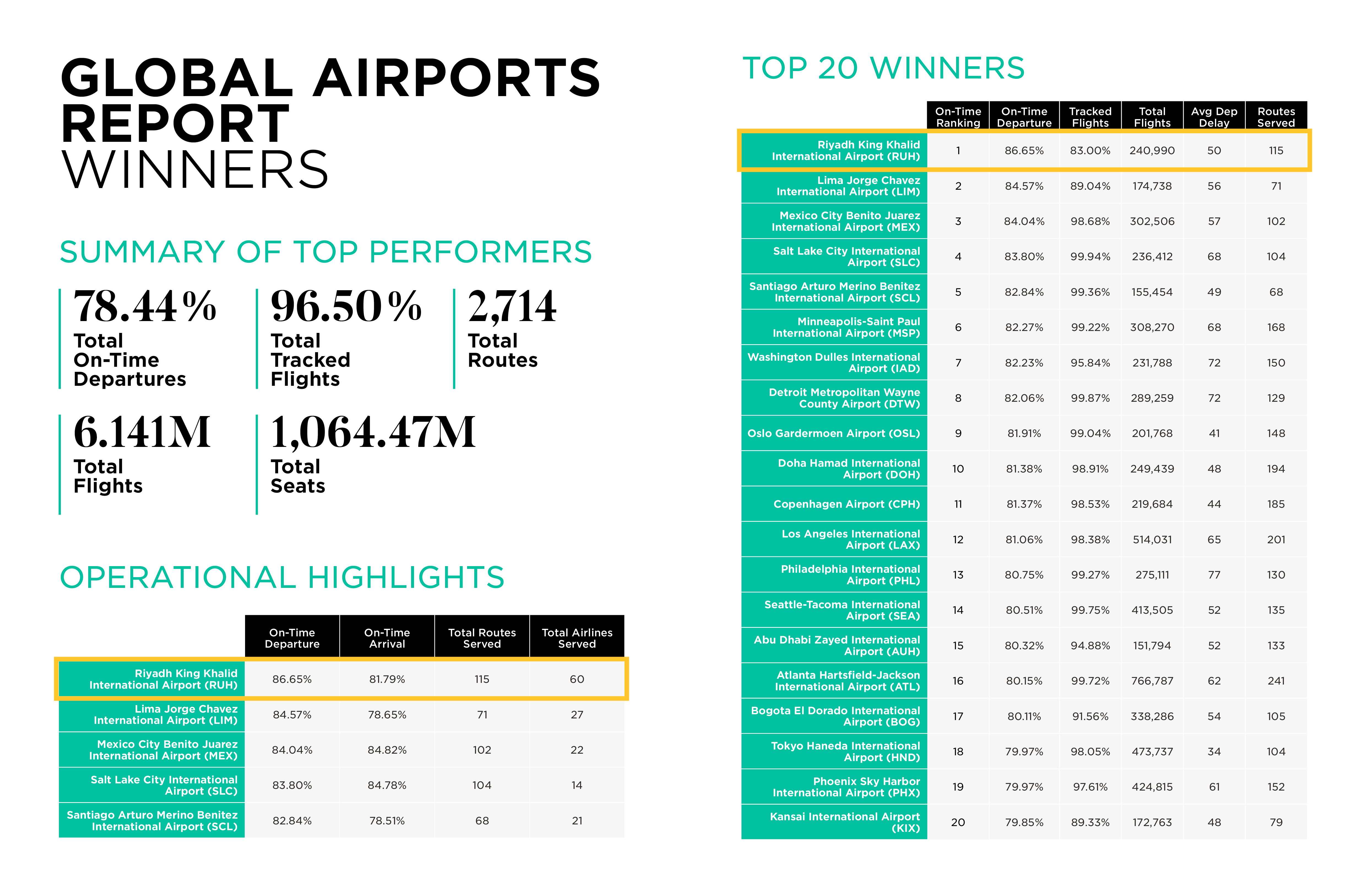
King Khalid International Airport (RUH), positioned 35 kilometers north of Riyadh, Saudi Arabia has established itself as a global benchmark for airport operational excellence. In Cirium’s 2024 On-Time Performance Awards, RUH was recognized as the Most On-Time Global Airport, achieving an industry-leading departure OTP rate of 86.65%—a distinction that places the airport at the forefront of global aviation performance standards.
In 2024, the airport handled a record-breaking 37 million passengers with double-digit year-on-year growth, added 15 new airlines to its roster and recognized as the second busiest airport in the Kingdom. These results demonstrate effective integration of infrastructure, planning, and process optimization across increasing passenger volumes.
Leadership Driving Transformation
Under the stewardship of CEO Ayman Abdulaziz AboAbah, who was appointed in February 2024, Riyadh Airports Company has accelerated its operational excellence initiatives. Mr. AboAbah brings extensive aviation sector experience, having previously served as CEO of Jeddah Airports where he enhanced planning and operations at King Abdulaziz International Airport. His tenure has coincided with RUH’s ascent to global recognition, reflecting strategic focus on operational discipline and systematic performance improvement.
The leadership team’s commitment to excellence has resulted in exceeding revenue targets by over 15%, with enhanced offerings, stronger partnerships, and significant increases in passenger movements, according to industry reports. This performance underscores the airport’s evolution from regional gateway to emerging global hub.
Operational Resilience Through Strategic Infrastructure
Ayman Abdulaziz AboAbah, CEO, Riyadh Airports Company
RUH’s performance reflects purposeful modernization strategies implemented over several years. The expansion of Terminals 1 and 2 increased the airport’s passenger handling capacity by 40% — from 10 million to 14 million annually. By upgrading baggage handling, adding security lanes, and introducing automation like self-service kiosks and automated boarding gates, the airport has cut processing times per passenger and unlocked higher throughput.
The 2022 commissioning of Terminals 3 and 4 marked a decisive step in RUH’s evolution. Terminal 3’s reconfiguration from domestic to international operations represents an important strategic shift to accommodate long-haul growth. A centralized check-in system now serves both terminals, allowing flexible resource utilization and enhanced operational fluidity. These terminal linkages, combined with renewed airside control infrastructure, have streamlined aircraft movements and reduced turnaround times—key enablers of on-time departures.
The airport’s connectivity received another boost with the opening of Riyadh Metro Line 4 on December 1, 2024, providing passengers with efficient access to the city center through stations serving all terminal complexes.
Strategic Alignment with National Objectives
RUH’s growth is tightly linked to Saudi Arabia’s Vision 2030, supporting Riyadh’s emergence as a global hub for business and tourism. Backed by GACA and managed by Riyadh Airports Company, its development roadmap ensures infrastructure expansion matches the pace of rising traffic and future demand—positioning RUH as a cornerstone of national connectivity.
The on-time performance gains reflect systematic operational improvements rather than statistical outliers. Enhancements to landside and airside coordination, expansion of aircraft parking bays, and deployment of real-time operational control technologies are part of a disciplined approach to minimize delays and improve predictability across the passenger journey.
Data Standards and Industry Recognition
Cirium’s On-Time Performance program serves as the gold standard for measuring airline and airport operational performance, using rigorous methodology that combines global flight tracking with airport-level operational data. On-time flights at airports are defined as those departing within 15 minutes of scheduled departure times. RUH’s recognition within this program reflects not only punctuality but consistency—demonstrating reliable performance across a complex operational environment.
The achievement underscores a broader transformation taking place across the Kingdom’s aviation sector—one that extends well beyond operational metrics to fundamental shifts in how airports can function as economic catalysts.
From Regional Gateway to Global Hub
Since opening in 1983, King Khalid International Airport (RUH) has evolved from a regional gateway to a critical global node. The transformation required infrastructure investment, operational discipline, and leadership vision working in concert.
Today, King Khalid International Airport (RUH) stands as one of the world’s most efficient large airports—a working model for how airports can excel amid rising expectations and traffic complexity. In an industry where timing defines competitive advantage, RUH’s four decades of strategic evolution positions it as an essential component of Saudi Arabia’s aviation future, proving that systematic operational excellence achieves results that resonate across global performance benchmarks.
Southwest carefully engineered transformation, redefining reliability, and showcasing the impact of strategic improvements and a commitment to sustained performance.
Two years ago, Southwest Airlines faced one of the toughest challenges in its history. A holiday meltdown in December 2022 left the airline scrambling, cancelling nearly 17,000 flights and disrupting travel for over 2 million passengers. Social media swarmed with frustrated posts, and trust in the airline hit rock bottom. The crisis wasn’t just weather-driven; it exposed deeper flaws, from outdated scheduling systems to operational vulnerabilities. Industry watchers wondered if Southwest could recover.
Fast forward to February 2025, and the airline is writing a very different story. With an impressive on-time arrival rate of 82.27%, Southwest Airlines has been named North America’s most on-time airline by aviation analytics leader Cirium. It’s not just a comeback; it’s a transformation that began long before Winter Storm Elliott.How did Southwest go from crisis to champion?
A Turning Point Built on Leadership
Southwest didn’t just “fix” its problems; it overhauled the way it operates, said Justin Jones, the airline’s Executive Vice President of Operations. Speaking with Scott McCartney recently on the Airlines Confidential podcast, Jones described the monumental effort it took for the airline’s leadership team to steer the airline out of rough skies.
“We knew we couldn’t just patch things up and move on. It required rethinking everything—from technology to teamwork to how we schedule flights,” he explained.
Southwest didn’t just “fix” its problems; it overhauled the way it operates, said Justin Jones, the airline’s Executive Vice President of Operations. Speaking with Scott McCartney recently on the Airlines Confidential podcast, Jones described the monumental effort it took for the airline’s leadership team to steer the airline out of rough skies.
“We knew we couldn’t just patch things up and move on. It required rethinking everything—from technology to teamwork to how we schedule flights,” he explained.
This leadership approach reassured both employees and customers that resilience was a key part of Southwest’s operations.
How Southwest Took Back Control
Southwest’s recovery wasn’t built on short-term solutions or lucky breaks. It was a carefully engineered transformation, focused on key areas where their previous systems had failed.
1. Preparing An Operation Ready For The Future
Southwest recognized the need for stronger, more adaptable technology to support its growing network. While already working to modernize the operation, the airline accelerated its efforts—investing $1.3 billion in more modern IT systems, including automated flight rescheduling tools and advanced decision-making platforms. These upgrades go beyond short-term fixes—they are designed to enhance efficiency, improve resilience, and ensure Southwest can operate smoothly even in the most challenging conditions.
2. Weather Resilience Strategies
Winter weather may be unpredictable, but its disruptive power can be anticipated. Southwest strengthened its defenses by expanding de-icing capabilities, boosting airport coordination, and adjusting staffing protocols during storms. These improvements meant fewer last-minute scrambles and more efficient operations during extreme conditions.
3. Smarter Scheduling, Fewer Delays
By aligning Network Planning and the Network Operations Center under a single leader, Southwest brought network thinking into how it manages the business every day, including aircraft routing, cancellation decisions, and coordination with all operating groups.
4. More Crew, Fewer Complications
Southwest also tackled one of the biggest contributors to operational chaos: staffing. By hiring more pilots, flight attendants, and ground crew members, the airline ensured resources were available even during high-stress moments. Crew shortages, once a critical weak link, were no longer a stumbling block in delivering reliable service.
5. Extra Aircraft for Extra Assurance
To add further stability, Southwest increased its fleet rotation by incorporating more spare aircraft. This allowed for quicker recoveries from unexpected mechanical issues or delays, minimizing disruptions for passengers. (Southwest didn’t add more spare aircraft per se; they added more late departing originators to give mechanics more time to work on the aircraft overnight. TechOps took numerous steps to further reduce aircraft downtime.)
A New Era for Southwest
By 2024, Southwest’s efforts were already showing results. The airline achieved a cancellation rate of just 0.62%, the lowest in the industry and well ahead of the 1.63% industry average. During the busy summer months, they flew a record-breaking 54 million passengers while improving on-time performance by two percentage points.
But the real breakthrough came in early 2025. With an A14 rate in the low-to-mid 80s (a measure of flights arriving within 14 minutes and 59 second of the scheduled time), Southwest ascended to the top of Cirium’s on-time rankings.
This achievement signaled a shift in an industry where Delta Air Lines has long set the standard for operational reliability.
Southwest’s climb to the #1 spot was more than just a comeback—it showcased the impact of strategic improvements and a commitment to sustained performance.
More Than Numbers
Behind the metrics is a story of persistence, innovation, and teamwork. Employees who worked tirelessly to restore faith in the airline. Passengers who began to take notice, moving from frustration to praise for the airline’s newfound reliability.
Leadership, too, played its part by inspiring confidence. Justin Jones credited the turnaround not to any single decision, but to the collective spirit of a company determined to win back trust.
“You can’t plan your way out of a crisis like this overnight,” he noted. “It takes consistent effort and a commitment to doing what’s right for passengers and our employees.”
Lessons in Transformation
Southwest’s rise to the top offers valuable lessons for the aviation industry and beyond. When faced with operational challenges, many companies opt for quick fixes. However, Southwest took a different approach—investing in core infrastructure, refining its network strategy, and strengthening its teams—demonstrating that resilience comes from deliberate action and long-term commitment.
For passengers, the message is clear as well. Even brands that falter can become reliable again with transparency, hard work, and a relentless focus on improvement.
The Flight Ahead
While Southwest’s success is worth celebrating, its team knows the job isn’t done. Consistency will depend on maintaining the momentum they’ve established and adapting as new challenges emerge.
Southwest is working to maintain this momentum even as the recently announced move to charge for checked luggage will likely result in more gate-checked bags that could threaten the hard-won reductions in turn times. The airline is adding technology at every gate to eliminate string tags, bolstering procedures to help gate agents manage volume, and installing equipment to get bags more efficiently from the gate to the ground.
But if the last two years have proven anything, it’s that Southwest Airlines is more than capable of weathering a storm and taking flight again.
More than a comeback, Southwest’s rise to the top shows that operational excellence is built on adaptability, strategy, and commitment.
This achievement is particularly significant for South African aviation, positioning the country as a leader in dependable air travel within the continent. South Africa’s advanced infrastructure and strategic location have long made it a key aviation hub, connecting intra-African routes and international markets. Beyond aviation, South Africa plays a vital role in the region culturally, economically, and geographically.
As a melting pot of diverse cultures and traditions, the country serves as a symbol of unity and richness in African heritage. Economically, South Africa is one of the continent’s largest economies, driving trade, innovation, and development across borders. Geographically, its position at the southern tip of the continent makes it a natural gateway between Africa and the rest of the world. FlySafair’s success not only enhances its own reputation but also reinforces South Africa’s role as a trailblazer in raising standards and fostering growth in the region on multiple fronts.
As South Africa’s largest low-cost airline, FlySafair’s commitment to punctuality is no accident with
FlySafair ranking as the most on-time regional carrier 11 out of 12-months in 2024 by Cirium.
Through investments in data-driven practices, advanced scheduling, and fleet management, the airline has minimized delays and reduced travel disruptions for passengers. Close collaboration with ground handling teams and air traffic management has further ensured seamless operations. Despite challenges such as rising operational costs, volatile jet fuel prices, and currency pressures, FlySafair has maintained its resilience through strategic initiatives. Refining its route network, optimizing fleet efficiency, and prioritizing operational excellence have been key factors in its success.
FlySafair’s leadership in on-time performance serves as a benchmark for the MEA region, where airlines face diverse challenges, including infrastructure gaps, regulatory complexities, and geopolitical instability.
By proving that precision and reliability are achievable even in demanding conditions, FlySafair inspires higher regional standards, benefiting passengers with more dependable travel experiences.
Being ranked number one in the MEA category is not just a recognition of FlySafair’s efforts—it’s a testament to its role in advancing aviation standards across the region. This success underscores the critical link between punctuality, customer trust, and innovation, inspiring progress throughout the industry while reinforcing FlySafair’s position as a leader in reliable air travel.
Report highlights
Delta Air Lines Secures Cirium’s Platinum Award for Operational Excellence for Fourth Year Running
Aeromexico Recognized as the Most On-Time Airline in the Global Category
Regional Leaders Announced: Delta Air Lines, Copa Airlines, Iberia Express, Japan Airlines, and FlySafair Take Top Honors
Bogotá El Dorado International Airport Earns Cirium’s Inaugural Airport Platinum Award
Riyadh King Khalid International Airport Named Most On-Time Global Airport for 2024
Panama City, Panama – Copa Airlines has cemented its place as Latin America’s undisputed leader in On-Time performance, achieving an unprecedented tenth year at the top. The airline celebrated this remarkable milestone on Friday, February 14th, 2025 at a special ceremony held at their Panama City Headquarters, Hangar 2, where they received the prestigious 2024 On-Time Performance Award from Cirium, the global leader in aviation analytics.
Presenting the award and leading the Cirum team was Jeremy Bowen, Chief Executive Officer of Cirium. Other members of the Cirium team included, Mike Malik, Chief Marketing Officer, Lydia Webb, Marketing Director – Americas & Strategic Programs and Daniela Arrebola, Business Development Manager. Accepting the award on behalf of Copa Airlines were Pedro Heilbron, Chief Executive Officer and three employees, representing different organizations within Copa, directly impacting on-time performance.
“Once again, Copa Airlines sets the standard for On-Time Performaance, securing its 10th award as the most on-time airline in Latin America. Achieving this level of consistency in an industry where so much is beyond our control is no small feat—it speaks to a well-run airline where every team member plays a role in delivering reliability day in and day out. Cirium is proud to recognize Copa’s achievement, and we extend our congratulations to everyone at Copa Airlines for their dedication and teamwork in making this possible”
Jeremy Bowen, CEO, Cirium
This decade of dominance underscores Copa’s unwavering commitment to operational excellence and passenger satisfaction. With an impressive on-time performance rate of 88.22% for 2024, Copa’s 125,445 flights saw a remarkable 98.73% completion rate. This achievement is particularly noteworthy in a year of high operational performance across Latin America, where airlines and airports ranked among the top performers globally. Copa consistently maintained high OTP scores throughout the year, even achieving top global rankings in February (91.66%) and May (90.24%).
“In a year of high operational performance in the Latin American region, Copa Airlines has once again soared to the top with an impressive on-time performance rate of 88.22% for 2024. Copa Airlines can now boast of a decade of continuous leadership and excellence in On-Time Performance in the region.”
Lydia Webb, Marketing Director – Americas & Strategic Programs, Cirium
This milestone reflects Copa Airlines’ commitment to providing a seamless and reliable travel experience. Their focus on operational efficiency, coupled with a dedicated team and strategic hub location, has solidified their position as the leading airline in Latin America for on-time performance. Copa’s contribution extends beyond aviation, connecting Panama, a country rich in cultural heritage and economic significance to the world.
Congratulations to the entire Copa Airlines team on this well-deserved recognition!
February 11, 2025, Mexico City, Mexico – Cirium, the global leader in aviation analytics, presented the 2024 On-Time Performance (OTP) Award for global airlines to Aeromexico. The ceremony celebrated the resilience and unwavering commitment by Aeromexico to on-time performance in 2024.
Jeremy Bowen, Chief Executive Officer for Cirium presented the award to Andres Conesa, Chief Executive Officer, Aeromexico. The two-part ceremony was attended by members of the media and press, governmental authorities, other stakeholders and employees.
Santiago Diago, Chief Operating Officer, and Andres Cataneda, Chief Customer Experience & Digital Officer were also in attendance and shared Aeromexico’s 2024 operational highlights and the vision for 2025. Throughout 2024 Aeromexico consistently demonstrated superior on-time performance. As the industry’s most trusted source of aviation data and analytics, Cirium is proud to honor the airline’s innovative approach, its resilience and unwavering commitment to excellence in the face of industry challenge.
“Today we are recognized as the most punctual global airline in the world in 2024, an unprecedented milestone in the history of aviation in Mexico and for our beloved airline. Of almost 197,000 flights, 86.7% arrived on time. In addition, we fulfilled 99.32% of the planned operations. I am proud to share that these results are the results of the enormous effort we have made to improve our processes, modernized our fleet, incorporated the newest technology and strengthened coordination with authorities, airports and service providers. But, above all, they reflect the most valuable asset that represents us: the great talent of the Aeroméxico family. We will continue to strive every day to provide the best service to our customers and make each trip an extraordinary experience” – Andres Conesa, CEO, Aeromexico
“It’s worth noting two important things about the results. Firstly: The OTP percentages at the very top of the global airline category in 2024 were incredibly close. Aeromexico won with an OTP of 86.7%; that was just 0.35% higher than the second-place airline. Which highlights how every single day of operation, and every flight is important in these rankings.Secondly, we must call out the excellent improvements in OTP that Aeromexico have been making over the last 4 years. In 2021, your OTP was 70.15%. But In 2022, OTP was up 4.7% to 74.86%. Then in 2023, OTP was up 2.6% to 77.48%, and in 2024, up an incredible 9% to 86.7%. On behalf of all of us at Cirium, congratulations to Andres and the whole Aeromexico team on your success, and we wish you good luck for 2025” – Jeremy Bowen, CEO, Cirium
In Cirium’s award analysis, an on-time flight is defined as a flight that arrives within 15 minutes of the scheduled gate arrival. For an airport, it is defined as departing within 15 minutes of its scheduled departure.
We are honored to announce Japan Airlines (JAL) as the top airline in the Asia-Pacific (APAC) region for On-time Performance (OTP) in 2024, achieving an exceptional 80.90% of flights arriving punctually on 314,774 flight operations, overcoming notable flight disruptions and delays as the result of Typhoon Ampil and Typhoon Shanshan in August 2024 which caused significant flight delays and cancellations throughout the country. This distinction highlights not only JAL’s operational excellence but also underscores its deep-rooted commitment to delivering reliable, world-class service to passengers.
JAL’s success in OTP reflects a cultural dedication to precision and quality that has been integral to the airline since its founding in 1951.
With a legacy spanning more than seven decades, JAL has consistently prioritized efficiency, safety, and customer satisfaction. These guiding principles have helped the airline earn a reputation as a global aviation leader and a standard-bearer for operational integrity.
Beyond punctuality numbers, JAL’s influence in global aviation is significant. Strategically positioned in Tokyo, Japan’s bustling capital and one of the world’s busiest hubs, JAL forms a critical link between APAC and the rest of the world. Its extensive network facilitates not only passenger movement but also trade and economic collaboration, solidifying its role as a key player in connecting global markets. Furthermore, JAL’s comprehensive corporate vision extends to sustainability and innovation, areas where it continues to set benchmarks for the broader aviation industry.
Japan’s cultural framework plays an undeniable role in JAL’s achievements. The nation is globally renowned for its emphasis on timeliness, meticulous planning, and technological innovation—qualities that seamlessly translate into JAL’s day-to-day operations.
Japan’s transportation sector, including its celebrated rail networks and aviation systems, exemplifies an unparalleled commitment to reliability.
This cultural mindset has significantly shaped JAL’s approach, fostering a strong focus on continuous improvement and precision.
Additionally, geographic factors bolster JAL’s emergence as a leader. Positioned within a major transit region, Japan serves as a vital gateway to Asia, enabling JAL to operate with unmatched connectivity and efficiency. Its headquarters in Tokyo further benefits from Japan’s robust technological infrastructure, helping the airline adopt cutting-edge solutions to enhance OTP and passenger experience.
With this recognition, Japan Airlines not only strengthens its leadership in the APAC region but also stands as a symbol of Japanese dedication to quality and reliability. For travelers and stakeholders alike, JAL exemplifies what can be achieved through a harmonious blend of tradition, innovation, and an unwavering focus on excellence in every aspect of aviation.
Report highlights
Delta Air Lines Secures Cirium’s Platinum Award for Operational Excellence for Fourth Year Running
Aeromexico Recognized as the Most On-Time Airline in the Global Category
Regional Leaders Announced: Delta Air Lines, Copa Airlines, Iberia Express, Japan Airlines, and FlySafair Take Top Honors
Bogotá El Dorado International Airport Earns Cirium’s Inaugural Airport Platinum Award
Riyadh King Khalid International Airport Named Most On-Time Global Airport for 2024
Efficiency and reliability are cornerstones of successful air travel, and in 2024, several Low-Cost Carriers (LCCs) have set a benchmark for operational excellence. Leading the charge is Iberia Express (I2) of Spain, showcasing a stellar 84.69% on-time performance (OTP) across 44,140 annual flights. Close on its heels is Brazil’s Gol (G3) with an OTP of 84.09% from an impressive total of 211,944 flights. Third on the list is Azul (AD), achieving an OTP of 82.42% for its 321,996 flights. These achievements not only highlight the efficiency of the airlines but also reflect their significant roles in their respective markets.
Iberia Express (Spain): Driving Efficiency in European Travel
Iberia Express stands out as a model of punctuality and operational discipline in Europe. A subsidiary of Iberia, this airline connects passengers across major European destinations at affordable prices without compromising performance.
With 84.69% of its flights arriving on time, Iberia Express has reinforced Spain’s reputation for efficient intra-European travel.
This achievement underscores the country’s emphasis on modernizing its aviation infrastructure and meeting the high expectations of international travelers. For business and leisure passengers alike, Iberia Express’s operational reliability is a testament to Spain’s focus on providing seamless short-haul services.
Gol (Brazil): Championing Growth in South America’s Aviation Market
Gol Linhas Aéreas, boasting an 84.09% OTP, demonstrates exemplary operational management in one of South America’s most dynamic and competitive aviation sectors. Gol’s success is symbolic of Brazil’s growing stature in global aviation, as the country invests heavily in modernizing airports and routes within and beyond South America.
By maintaining high on-time performance across such a substantial flight volume, Gol proves how operational efficiency can coexist with rapid market expansion.
This consistency not only strengthens customer trust but also positions Brazil as a leader in aviation mobility across the region.
Azul (Brazil): Excelling in High-Volume Operations
Azul Linhas Aéreas has demonstrated remarkable efficiency, achieving an OTP of 82.42% across an extraordinary 321,996 flight operations. As one of Brazil’s most prominent carriers, Azul has mastered the art of balancing high operational demand with reliability. Its commitment to punctuality cements its position as a cornerstone of Brazil’s aviation industry, ensuring passengers enjoy smooth, on-time journeys despite the challenges of managing such a vast network. Azul’s achievements reflect the growing sophistication of South America’s aviation infrastructure.
These carriers—Spain’s Iberia Express and Brazil’s Gol and Azul—have redefined the expectations for low-cost travel by prioritizing operational excellence. Their commitment to efficiency proves that affordability doesn’t have to come at the expense of reliability, enhancing customer confidence in LCC services. Congratulations to these airlines for setting new standards in the aviation industry and for continuing to deliver outstanding performance!
Report highlights
Delta Air Lines Secures Cirium’s Platinum Award for Operational Excellence for Fourth Year Running
Aeromexico Recognized as the Most On-Time Airline in the Global Category
Regional Leaders Announced: Delta Air Lines, Copa Airlines, Iberia Express, Japan Airlines, and FlySafair Take Top Honors
Bogotá El Dorado International Airport Earns Cirium’s Inaugural Airport Platinum Award
Riyadh King Khalid International Airport Named Most On-Time Global Airport for 2024
Lydia Webb, Marketing Director – Americas & Strategic Programs, Cirium
2024 witnessed outstanding on-time performance by Latin American carriers and airports. Small Airports globally saw a positive improvement trend with an average on-time performance of 81.71% compared to 79.08% in 2023. This meant fierce competition among airports with small margins between top performers. Guayaquil Jose Joaquin De Olmedo International Airport (GYE) stands out as the leader in the Small Airports category with an outstanding On-Time Performance score of 91.38%.
Guayaquil is the largest city in Ecuador and the capital of the Guayas Province. Situated on the west bank of the Guayas River, it is the nation’s main economic hub and capital port. Guayaquil is not just a commerce city; it also holds historical significance, and is the gateway to Pacific beaches and the Galapagos Islands. The service sector accounts for about fifty percent of Ecuador’s GDP, with transporation and tourism making up the bulk of the industry.
Tourism is an economic pillar for Ecuador and the aviation industry is a driving force behind it.
Guayaquil José Joaquín de Olmedo International Airport (GYE) is the second busiest airport in Ecuador with 3.7M passengers served last year. The airport serves as a domestic hub for Avianca Ecuador and LATAM Airlines Ecuador and several international carriers including American Airlines, Iberia and KLM. Guayaquil Airport has been a consistent Cirium On-Time top performer throughout 2024, with distinguished OTP scores. In September, the airport had the highest OTP score among all airport categories, including Global, achieving an impressive rate of 93.46%. It is also worth mentioning that Guayaquil Airport led the Small Airport category three times in 2024; August (90.83%), September (93.46%) and November (92.81%).
Last year, Jose Joaquin ranked third in the Small Airport category, but made a near 3-point improvement to take the leader position in this category in 2024.
Guayaquil’s success can be attributed to the operational hand of concessionaire TAGSA. Earlier this year, TAGSA and the airport celebrated celebrated two decades of exceptional service, commitment to quality, safety and excellence. Guayaquil Airport was also recently awarded the ACI-Airport Service Quality (ASQ) for “Best Airport in the category of 2 to 5 million passengers per year, Airport with the Most Dedicated Staff, Easiest Airport Journey, Most Enjoyable Airport and Cleanest Airport” in the Latin America and Caribbean region.
Guayaquil Jose Joaquin International Airport’s recognition as the most on-time small-sized airport for 2024 is also a demonstration of its unwavering pursuit to excellence. The airport’s investment in its people, customer service and operations has rendered the excellent results they sought after.
Report highlights
Delta Air Lines Secures Cirium’s Platinum Award for Operational Excellence for Fourth Year Running
Aeromexico Recognized as the Most On-Time Airline in the Global Category
Regional Leaders Announced: Delta Air Lines, Copa Airlines, Iberia Express, Japan Airlines, and FlySafair Take Top Honors
Bogotá El Dorado International Airport Earns Cirium’s Inaugural Airport Platinum Award
Riyadh King Khalid International Airport Named Most On-Time Global Airport for 2024