




























Aircraft maintenance intelligence for aviation MRO providers
Avoid surprises and protect your margin with advanced aviation analytics
Forecast demand. Align capacity. Protect margins.
Reduce downtime for your customers, optimize resources and grow your business. Cirium gives MRO providers the data, tools and intelligence to drive efficiency and accelerate growth.

Maintenance demand builds through utilization and ground time, but often isn’t visible until it becomes disruptive. Late visibility means reactive planning and surprise AOGs.
How Cirium helps:
Predict maintenance events earlier using utilization, aircraft lifecycle and ground events intelligence.

Hangars, labor and inventory are planned ahead, while fleet behavior shifts underneath. Without foresight, resources fall out of sync and throughput suffers.
How Cirium helps:
Identify forward‑looking demand using fleet, flight and utilization analytics.

PBH profitability depends on accurate flying assumptions. When reported hours don’t reflect real use, risk aren’t identified and margins are eroded.
How Cirium helps:
Independently verify utilization for defensible PBH validation with tracked utilization data.

Maintenance opportunities form before shop visits or contracts appear, but are easy to miss without external signals.
How Cirium helps:
Reveal emerging opportunities early through independent fleet, utilization and ground events intelligence.
Global airframe MRO trends: A deep dive
ON DEMAND WEBINAR
Cirium experts examine the trends to watch across the MRO value-chain and look forward to projected waves of checks in the years ahead.


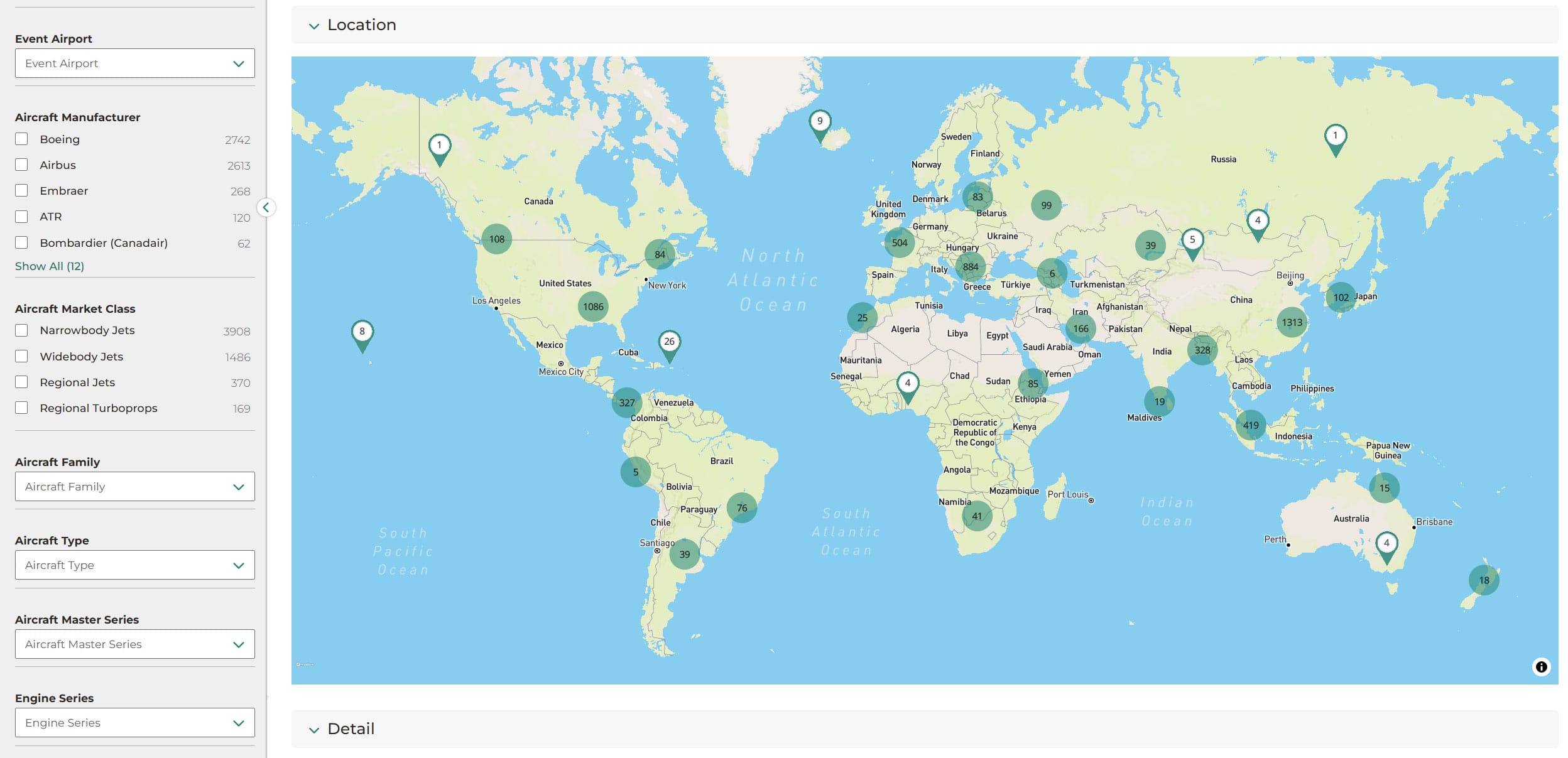
Analyze, monitor and predict aircraft maintenance events
SOLUTION
Cirium Ascend Ground Events, a dedicated event prediction tool for MROs to see when, where and why commercial aircraft spent time on the ground.

A trusted partner to MRO leaders
Partnering with the Top 4 MROs in the world, who service ~37,000 aircraft.
 “Cirium’s analytics are like discovering the Rosetta Stone.”
Product Management Director, European engineering firm
“Cirium’s fleets data is the best fleets database I know.”
Strategy Manager, North American MRO provider
Decision-ready data, delivered your way
A single source of truth
Cirium’s unified data platform connects fleets, schedules, flights and traffic for a complete view across the aircraft lifecycle.
Gold-standard data
Cirium’s rigorous data processing, consistent metrics and proprietary analytics enable precision forecasting and confident decision-making.
Flexible delivery
Our experts work alongside you to embed our intelligence seamlessly into your existing systems and workflows.

What could you achieve if you could see the full picture?
Speak to our experts today to discover how Cirium can embed clarity, speed and intelligence into your decision-making.
FAQ’S
A: Cirium helps organizations anticipate maintenance demand by analyzing real‑world aircraft behaviour, combining fleet status, utilization patterns, forward schedules and proprietary ground events signals. Together, these datasets provide earlier visibility of emerging maintenance requirements before they surface as AOG incidents or capacity issues. This allows MROs, OEMs and aftermarket teams to move from reactive planning to forward‑looking demand alignment.
A: Cirium reduces AOG exposure by providing early warning signals of potential maintenance events, using utilization trends, lifecycle insight and ground events intelligence to identify disruption before it escalates. By uncovering developing issues sooner, organizations can plan inspections, resources and customer engagement more proactively, helping minimise disruption and improve operational reliability.
A: Maintenance forecasting is more reliable when it is based on a unified view of aviation data rather than a single dataset. Cirium combines fleet intelligence, utilization and flight activity, ground events, and forward-looking schedules into one connected analytics platform. This integrated approach removes blind spots, improves confidence in forecasts, and supports defensible decisions that stand up to internal and external scrutiny.
A: Maintenance demand forecasting supports commercial opportunities by revealing where and when demand is building across fleets, regions and aircraft types. By identifying upcoming maintenance needs, fleet transitions and utilization spikes earlier, organizations can prioritize high value prospects, enter markets sooner and align commercial strategies with real demand.