



























Shruti Salwan, Markets Editor, ICIS


Jonathan Robins, Air Transport Reporter, Cirium
European jet fuel markets have been dramatically reshaped by the Middle East crisis since early March, as prices have surged amid tightening physical supply before partially retreating as alternative flows stabilise the system.
The initial shock raised concerns over aviation fuel availability, but airlines have held firm, absorbing higher costs and largely maintaining capacity, helped by a gradual easing of fuel prices and robust passenger demand.
Prices peak on supply shock
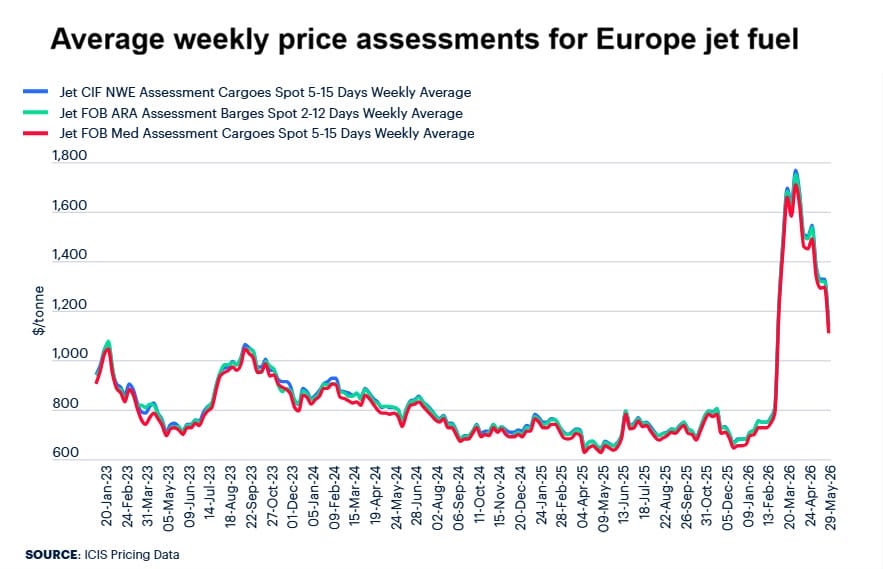
Following a sharp correction through April and May, European jet fuel prices have retreated significantly from the extreme highs triggered by the Middle East conflict earlier this year, although values continue to hold well above pre-crisis levels amid ongoing structural supply tightness.
By late May, CIF Northwest Europe cargo values had eased to around $1,100-1,200 per tonne from peaks near $1,750 reached at the end of March, according to data from energy information provider ICIS, which, like Cirium, is owned by RELX. Barges for FOB (free on board) delivery to the Amsterdam-Rotterdam-Antwerp (ARA) import region followed a similar trajectory, with the decline reflecting a gradual unwinding of the geopolitical risk premium alongside improving arbitrage inflows into Europe from alternative supply regions.
The easing in prices comes after one of the most aggressive rallies seen in the jet fuel market in recent years. Both Northwest Europe cargoes and ARA barges surged from below $800 per tonne in late February to around $1,200 within days as escalating tensions in the Middle East triggered fears over global supply availability.
The price surge gathered further momentum through March, reaching a peak by month-end before reversing course into the current correction.
Rising prices had reflected not only financial risk repricing but also a severe disruption to physical supply flows. As the International Energy Agency (IEA) has noted, “the closure of the Strait of Hormuz at end-February removed a significant share of global jet fuel supply from the market”, with Middle East exports collapsing from normal levels to just 70,000 barrels per day in April.
Inventory squeezed before limited supply relief
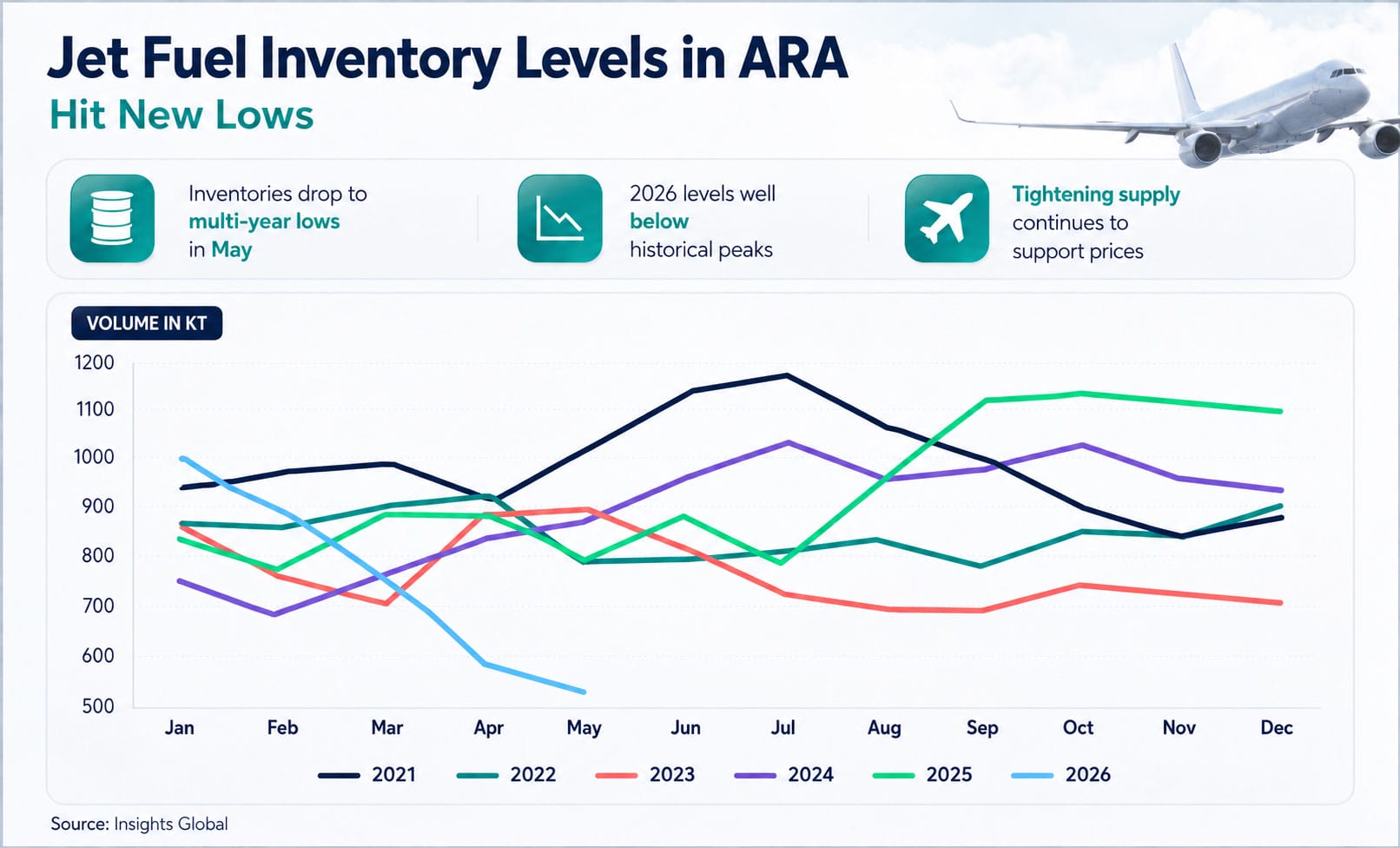
Europe proved particularly vulnerable given its structural reliance on imports. The IEA estimated the region imported around 550,000 barrels of jet fuel per day in 2025, with around 60% sourced from the Middle East. Arrivals to Europe plunged from roughly 330,000 barrels per day in March to only 60,000 in April, pulling ARA inventories below five-year lows.
Jet fuel stocks drew down steadily through March, falling from the mid-800,000s per-tonne range at end-February to below 700,000 by late March, before sliding to multi-year lows under 600,000 in late May. The rapid stock decline significantly reduced the market’s buffer against disruption, intensified competition for prompt barrels, and amplified price volatility.
Unlike the Covid crisis – when aviation demand collapsed and inventories surged – the 2026 upheaval has been characterised by tightening availability, falling stocks and aggressive bidding for prompt supply.
As the crisis evolved, arbitrage flows gradually began to stabilise the system. The IEA highlighted that the USA’s shift from net importer to net exporter, with shipments to Europe rising by almost 120,000 barrels per day, month on month, while West African exports climbed to 145,000 barrels per day, supported largely by increased production from Nigeria’s Dangote refinery.
Even so, replacement flows were insufficient to fully offset the Middle Eastern shortfall, particularly as OECD Asia exports remained constrained and Russian exports to the region – which had previously accounted for a notable share of incremental supply – fell to zero.
Prompt tightness has eased considerably from March extremes, but the market continues to reflect residual supply risk. The IEA has observed that “with European inventories drawing at pace and Middle East flows still largely offline, the supply chains now carrying the load are stretching to cover a much larger gap”, suggesting that rebalancing remains incomplete despite the recent correction.
Airlines regain confidence as supply outlook stabilises
Airlines’ approach to the fuel crisis has been changing as they have refined their expectations and as the jet fuel market has stabilised.
Initially sanguine about the issue, then slightly panicked as the realistic prospect of shortages sank in, many carriers have now reverted to their initial assessments.
That reflects the assumption that because jet kerosene represents the most valuable part of a refined barrel of oil, refiners will prioritise its production over other products. “There will be many other parts of the global economy who will be short of fuel [before the aviation industry],” was how Lufthansa Group chief executive Carsten Spohr put it at an industry event in mid-March.
Two months later, it seems this optimism has been borne out.
Presenting half-year results on 21 May, EasyJet chief executive Kenton Jarvis noted that jet fuel supply had diversified, with product now arriving from Norway, the USA and West Africa, and refinery runs globally on an uptick. The resulting influx of jet fuel was “probably not surprising given how expensive it is”, added Jarvis.
In a sign that it is far from panicked over the crisis, EasyJet has shaved only 0.3% of its summer capacity and still plans for a 3% annual expansion.
Likewise, Jet2 chief executive Steve Heapy said on 20 May that, following reassuring discussions with fuel suppliers that had dispelled the idea of shortages, “our message to holidaymakers is that summer is on”. Similar language was used a week later by Lufthansa in its own signalling to customers.
Close-in bookings hold up
Earning reports released by carriers in Europe over the past several weeks have provided the opportunity to gauge executives’ feelings on the state of the market.
Carriers have consistently acknowledged higher costs, as well as changes in booking patterns, but have also been at pains to point out that demand remains steady.
Although overall airline capacity is down slightly, the impact is not particularly significant, as airlines are axing unprofitable routes that they would have liked to cut anyway, while continuing to hike fares on more lucrative routes.
European departing capacity through June will be 3.6% higher compared to a year ago, Cirium data indicates.
Reporting annual results on 18 May, Ryanair Group pointed out that customers were booking close in to the date of travel. This, a typical response to wider turmoil, was the default amid the pandemic.
Travellers, having seen reports of jet fuel shortages, are reluctant to book far out over concerns that surcharges could be applied or that services could be axed, Ryanair observes. Yet demand remains firm.
“Take April,” said group chief Michael O’Leary. “Close in bookings were stronger and stronger”, coming in 0.5% ahead of its targets. He added that in his view, passenger hesitancy “will break in favour of European travel” for the peak season, a viewpoint he believed had been “vindicated by the strength of close-in volumes and pricing in May”.
The group was seeing forward bookings down by 1-2% currently for June, July and August, with “lots of people waiting to see” what happens before booking. “People will travel… the question is will they go long-haul to the Middle East or stay at home and go in Europe.”
O’Leary made plain that he expected Ryanair to ultimately benefit from the troubles roiling the sector. The group’s healthy balance sheet and strong hedged position should, he posited, enable it to emerge relatively unscathed from the crisis, while other airlines suffer more serious blows.
Supercharging consolidation
The recent history of the aviation market in Europe has been towards greater consolidation as weaker players are squeezed and fall by the wayside or get amalgamated into larger groups.
That has left the market split broadly into three large low-cost players – Ryanair, Wizz Air and EasyJet – plus three large airline groups that have legacy operations and low-cost units: IAG, Air France-KLM and Lufthansa Group. The dominance of these six was bolstered during the pandemic, and they were able to hoover up stragglers as smaller players, such as Alitalia and Flybe, failed.
Over recent years Air France-KLM has agreed a deal for SAS and Lufthansa has integrated ITA. Both are now competing for TAP Air Portugal. IAG failed to acquire Air Europa amid regulatory headwinds, but has seen a strong performance at its core brands. Meanwhile, Ryanair has expanded aggressively across the continent, although growth has been more constrained at EasyJet and Wizz.
The result of the crisis could be to accelerate existing trends. It is very possible that some smaller players, and perhaps even larger ones, will not survive – or at least not thrive. That could herald a more consolidated, US-style market dominated by giant airlines which control massive fleets and balance sheets.
ICIS is a global provider of independent commodity intelligence for the chemicals and energy markets. Cirium is the world’s most trusted source of aviation analytics, providing data and analytics to the air transport industry. ICIS and Cirium are both part of LexisNexis® Risk Solutions, a RELX business.